Showing posts with label John Grisham. Show all posts

Wednesday

Interview: Steve Cavanagh, Author of THE DEFENCE

Steve Cavanagh’s (right) debut novel, THE DEFENCE (Orion), is a legal thriller featuring the New York conman-turned-lawyer Eddie Flynn. I interviewed Steve for the Irish Examiner last weekend, and very enjoyable it was too. A sample:
Assuming he’s not autobiographical, is Eddie Flynn modelled on any real-life lawyers?
  “The only real person who was of any influence for Eddie was Clarence Darrow,” says Steve. “Darrow was one of the finest advocates of the last 100 years. He was a man who could turn and win any case. Any case. He was that good. He also swung close to crossing the line into the criminal side of things from time to time, or so legend would have it.”
  As for literary influences, Steve cites a rattlebag of names and styles that includes Michael Connelly, Lee Child, John Mortimer and John Grisham, as you might expect, but also Brendan Behan, Thomas Harris and Spike Milligan. It was Irish author John Connolly, however, who finally got Steve writing his novel.
  “The Charlie Parker series is probably my favourite crime series and the fact that a fellow Irishman could write great American crime thrillers was a big influence. I thought that if John Connolly could do it, I might be able to do it. When I started writing I quickly realised that Connolly is a genius, and I am not – so I had to really work at it.”
  For the rest of the interview, clickety-click here

Thursday

Reviews: Grisham, Fyfield, Hiekkapelto, Higashino

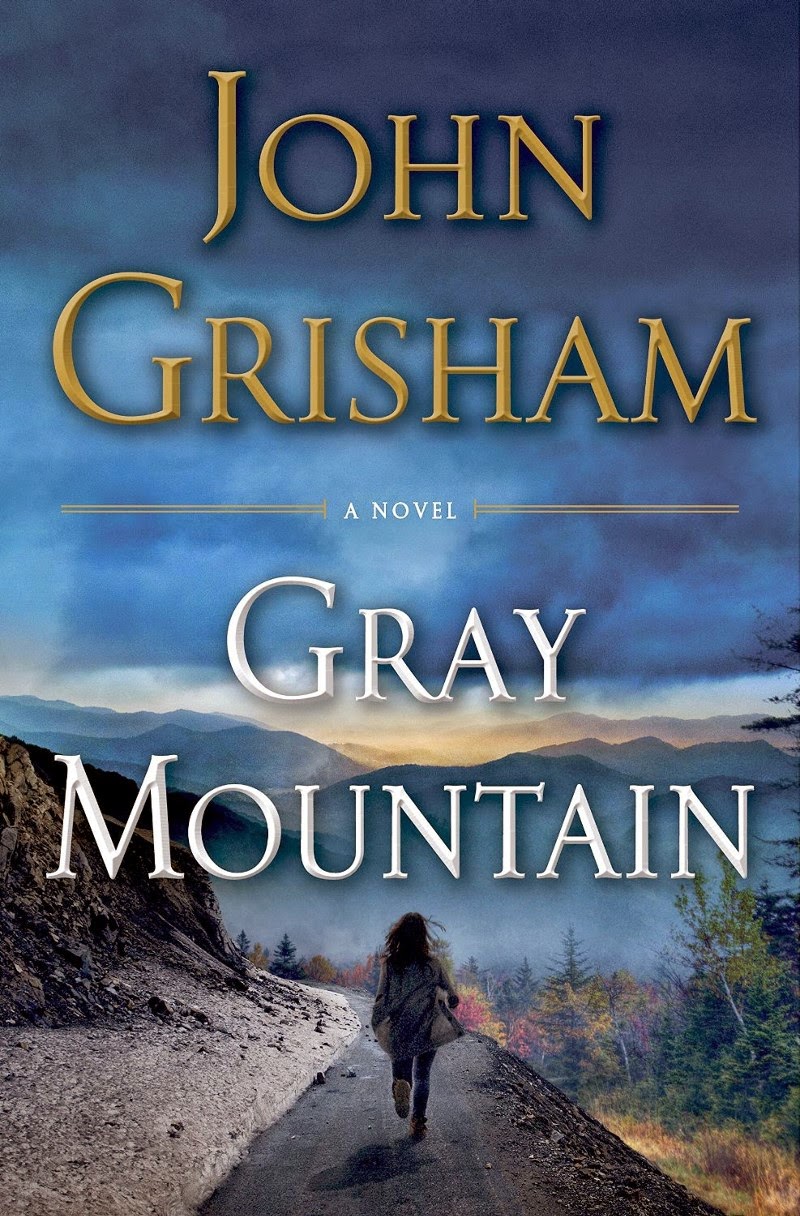
The coalmining communities of the Appalachian Mountains provide the setting for John Grisham’s Gray Mountain (Hodder & Stoughton, €19.99), a legal thriller that opens ten days after Lehman Brothers folds. The financial meltdown that follows has a knock-on effect in the legal world, as Samantha Kofer, a third-year associate with New York’s largest law firm, finds herself one of many lawyers who have been downsized out of their comfortable lifestyles. Scrabbling for any kind of work that might keep her ticking over until the world sets itself to rights again, Samantha takes a position with the Mountain Legal Aid Clinic in the small town of Brady, Virginia. Anticipating something of a cosy but boring ‘furlough’, Samantha is shocked to discover a world of poverty, brutality and corruption, and an entirely legal scandal that goes to the very heart of American politics. Grisham is a former lawyer and politician, and one who remains heavily involved in the Innocence Project in the United States, and Gray Mountain has the feel of a very personal project. The story lacerates ‘Big Law’ while celebrating the non-profit legal aid organisations, who make the most of their limited resources in their fight on behalf of the sick and dying miners who are victims of the politically connected coal companies, while also detailing the environmental disaster of strip-mining in the Appalachians. The daughter of two very different kinds of lawyer, Samantha is already deliciously cynical about the legal process when we first meet her, but Grisham deftly blends her professional awakening to the ugly truths of the American legal system into Samantha’s complex personal development. It’s a stirring tale, despite the occasional didactic digressions into a whole raft of issues – black lung disease, meth addiction, political apathy – bedevilling the Appalachian communities.
  In Casting the First Stone (Sphere, €20.50), Frances Fyfield brings together two heroines from previous novels. Diana Porteous, widow and art collector, is introduced to Sarah Fortune, the sister of Diana’s agent, and together they hatch a plot to recover paintings stolen from an old woman by her son. As befits a story that revolves around an unusual art heist, however, the plot – or many sub-plots, to be precise – isn’t really the most important aspect here. Fyfield is more concerned with mood, tone and texture, and the story is less a straightforward narrative than it is a collection of pen portraits, as Fyfield offers intriguing psychological profiles of a host of fascinating characters, from plucky young boys to grizzled ex-policemen and avaricious capitalists. There’s an ethereal quality to the prose that seems to flit back and forth between dream and nightmare, reflecting the sharp contrast between the settings of the wild coastline of Diana’s home and the bustle of the London she is forced to visit in pursuit of justice. At the heart of the story lies Diana’s quest for a sense of identity, of belonging: the widow still in mourning for her beloved husband rather poignantly collects a particular kind of painting, the unsigned and unattributed art that would otherwise languish unloved in someone’s cellar or attic.
  Identity is also key to Kati Hiekkapelto’s The Hummingbird (Arcadia Books, €13.40), the Finnish author’s promising debut novel. Born in Serbia, of Hungarian ethnicity, Anna Fekete’s experience as an outsider growing up in Finland gives her an unusual insight into the immigrant mind-set when she becomes a detective in the Finnish police service. Her first day on the job is something of a baptism of fire: a jogger is shot to death on the outskirts of the city, while Anna and her colleagues also receive a desperate call from a young Kurdish woman who believes she is about to be murdered by her family in an ‘honour killing’. The twin investigations provide The Hummingbird with its narrative spine, but much of the story, which is translated by David Hackston, is engaged in exploring what it means to be Finnish, a place where ‘people were expected to unflaggingly present a play directed by market forces, a performance called Western civilisation.’ The plot isn’t entirely convincing as it arrives at its conclusion, but for the most part Hiekkapelto provides an unsentimental account of Finnish society and its cultural traditions, in particular the Finnish obsession with hunting and guns, which means that, in theory, virtually anyone could be the killer on the rampage.
  Malice (Little, Brown, €18.75) by Japanese author Keigo Higashino revolves around an investigation into the murder of best-selling novelist Kunihiko Hidaka. Police detective Kaga is initially stumped by what appears to be a classic ‘locked room’ mystery, but soon comes to suspect Hidaka’s best friend, children’s author Osama Nonoguchi, when he discovers notebooks in Nonoguchi’s apartment which suggest that Nonoguchi was in fact the ghost-writer of Hidaka’s novels. Translated by Alexander O. Smith, and delivered in a crisp, clinical style (the story proceeds by way of written accounts delivered by the main players), Malice offers an unusual take on the traditional police procedural while also functioning as a critique of the crime novel, as the business of writing becomes the art of murder. In this it parallels Higashino’s English-language debut, The Devotion of Suspect X (2011), although Malice is more playful and inventive (and blackly humorous) when it comes to reworking the genre’s staples and conventions. As much a psychological thriller as it is a police procedural, Malice is rooted in a search for identity, albeit one in which Higashino invests the conceit of the ambiguous narrator with an notable complexity. The result is that the novel represents another bold statement of intent, and while Higashino isn’t exactly reinventing the crime novel, Malice is a superb example of how flexible the genre’s parameters can be. ~ Declan Burke

  This column was first published in the Irish Times.

Interview: Chris Pavone, Author of THE ACCIDENT

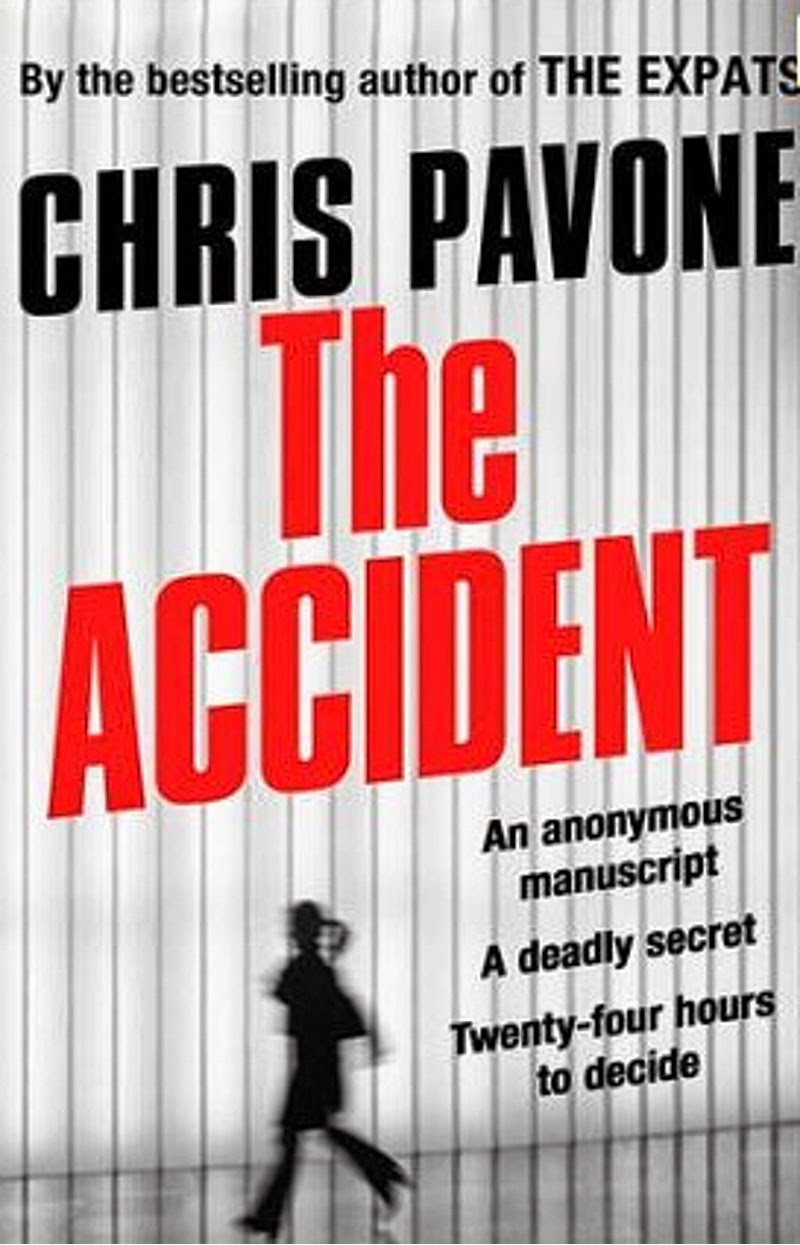
It made perfect sense that Chris Pavone’s debut thriller, The Expats, became a critically acclaimed bestseller when it was published in 2011, and that it subsequently won a slew of awards. The American author had, after all, worked as an editor in the publishing industry for almost two decades. Thus he had a canny understanding of the commercial requirements of a genre novel, and an insider’s knowledge of the craft involved in writing a block-busting thriller.
  At least, that’s the theory. Until you realise that Chris Pavone is actually a veteran editor of cook books and gardening tomes.
  He began in the industry as a copy-editor, he says, initially working on fiction. “But when it came time for me to become an acquisitions editor, I turned to non-fiction and cook books and some gardening titles, some fishing books,” Chris tells me when we sit down in the Merrion Hotel. “A lot of what I thought of as ‘light’ subjects, which in many ways were a lot more straightforward-looking to me as a young, still idealistic person. There were things about the fiction side of the business that weren’t quite right to me. It seemed to me that a lot of it was driven by things that didn’t strike me as being important to the work itself, and that wasn’t really true of these other types of books I was publishing.”
  If there’s a hint of cynicism about the fiction publishing industry in those words, it’s a cynicism that is writ large in Pavone’s current novel, The Accident. The story opens with a commissioning editor receiving a manuscript of a book that will, if published, destroy a media mogul’s career and lay bare the dark heart of America’s secret service. A race against time begins as a plethora of characters scheme, plot and murder in order to prevent the publication of the manuscript.
  “The book, for me, is very much about ambition and compromise,” says Pavone. “It’s not that that’s how I see the whole world, but I wanted to write a book that thought that way. The vehicle for feeling out these people’s compromises and ambitions is this manuscript that’s at the heart of The Accident. Everybody looks at this thing in a different way. It is to some extent corrupting to some of them. ‘Is this the point at which I sell out? Is this where I become corrupted?’ Or, ‘Is my corruption still in the future?’”
  The Accident is a pulsating tale that blends thriller, mystery and spy novel tropes and confirms the promise of Pavone’s debut, even if it’s the kind of novel that Pavone, in his younger years, ignored as a reader.
  “One of the epiphanies I had was that I got into publishing because I love literature,” he says. “I loved books by people who were dead before I was born, for the most part, who had won Nobel Prizes. But then it became part of my job to read a John Grisham book every year. I had been very dismissive of popular fiction – in fact, I’d refused to read it. And then I started working on popular fiction, and I realised these books weren’t the same as Hemingway, say, but they were good in a different way. They were great in a different way. I became much more of a relativist about the qualities of a novel. Now I think John Grisham writes fantastic books. They’ve got nothing to do with what Donna Tartt writes, for example, but they’re both writers I enjoy.”
  With two decades of experience under his belt, Chris Pavone was a highly regarded editor in the industry. Why the leap from gamekeeper to poacher?
  “I loved editing, and being a cook book editor is a really a great job. It’s difficult to imagine a more indulgent grown-up job to do, that someone would send you out to restaurants to find great chefs to write a book. But being an editor is essentially about other people’s passions, and helping other people bring out the best of what they have to say to the world. Eventually I realised that I wanted to try to create something myself, and that’s what writing novels is. Not because I wanted to put myself in front of the world, but because I wanted to create something that would go out into the world.”
  As an industry insider, Chris Pavone is more aware than most that the publishing world is today struggling to come to terms with a number of seismic changes in the traditional model. He admits to being ‘a little pessimistic’ about publishing’s future, but remains on the whole optimistic that readers and booksellers will combine to survive and thrive.
  “Bookselling, I believe, is enjoying a resurgence, especially the kind of bookselling we used to think of as booksellers before the advent of chain stores – the Mom & Pop stores, the independent neighbourhood store,” he says. “A lot of the big chain stores are now gone, and independent bookstores are springing up to step into the role again. The book market has levelled out, or at least it’s not declining as fast as it was a number of years ago, and I think readers are understanding more and more what thousands of certain types of independent retailers can bring to the market. That price is not the main consideration. I mean, relatively speaking, books are very inexpensive. A book takes a long time to read, and you don’t pay all that much for it. And paying less for a book isn’t necessarily the goal of every reader.”
  That said, he does believe that the industry may have to configure its ideas about how it generates the profits that will allow it to commission new writers, particularly in the face of the digital revolution.
  “I’m paying a lot more these days for things that I’m told are free,” he says. “But all these ‘free’ things – say on-line – they’re not free. You’re just not paying for the content. But you are paying for internet service. You’re paying for phone service. You’re paying for the hardware. And you’re paying a lot more than you used to pay, you’re just paying different people. We’re now paying telecom companies instead of movie producers and TV networks and book publishers. It doesn’t cost any less, it’s just going in a different direction.”
  With two best-sellers already under his belt, and Hollywood already circling around an adaptation of The Expats, Chris Pavone is particularly pleased that some of the highest praise he has received has come from his fellow writers. As an editor turned author, was he ever worried about push-back from writers concerned that he was muscling in on their territory?
  “I had many, many worries about my first book,” he laughs, “but that wasn’t one of them. I mean, I was worried that the book wasn’t good enough, and nobody would like it, that people would make fun of my ambitions. Waking up in the middle of the night in a cold sweat thinking it was all a huge mistake, and that I was going to die destitute and alone.” He grins. “Y’know, pretty much what every writer worries about.”

  Chris Pavone’s The Accident is published by Faber & Faber.

  This interview was first published in the Irish Examiner.

Tuesday

“Ya Wanna Do It Here Or Down The Station, Punk?” Pat Fitzpatrick

Yep, it’s rubber-hose time, folks: a rapid-fire Q&A for those shifty-looking usual suspects ...

What crime novel would you most like to have written?
Anything by Ed McBain. I picked up one his books in a second-hand book shop in New York because it was a dollar and I liked the cover. Before that I had no interest in crime novels; after that I had little interest in anything else. So McBain is my first love.

What fictional character would you most like to have been?
Philip Kerr’s brilliant creation, Bernie Gunther.

Who do you read for guilty pleasures?
I’d have to plead guilty to John Grisham. But he probably knows a lawyer who can get me off.

Most satisfying writing moment?
The first sentence. It tends to get tricky after that.

If you could recommend one Irish crime novel, what would it be?
THE BOOK OF EVIDENCE. I’m not sure if John Banville meant to it to be read as a crime novel. But that’s how I see it.

What Irish crime novel would make a great movie?
I think THE BOOK OF EVIDENCE would make for a great movie.

Worst / best thing about being a writer?
The worst is the feeling that everything you write could do with a bit of improvement. The best is when someone reads something you wrote and says otherwise.

The pitch for your next book is …?
The pitch is under wraps at the moment because it is a sequel to my current book and I don’t want to give too much away. But here’s a little taster for now:

He didn’t cry out when Fanta McCarthy hammered the long slender nails into his palms. But he knew it was only a matter of time before he told them everything. And then the killing could begin.

Who are you reading right now?
Would you believe EIGHTBALL BOOGIE by a certain Declan Burke? I know that seems like I’m sucking up to my interrogator, but it happens to be true.

God appears and says you can only write OR read. Which would it be?
I’d go looking for a new God, one who isn’t so cruel.

The three best words to describe your own writing are …?
Short, Sharp and Entertaining (I hope.)

KEEP AWAY FROM THOSE FERRARIS is Pat Fitzpatrick’s debut novel.

Thursday

All The Rage

It’s a hearty congratulations to Gene Kerrigan from all here at CAP Towers, on the news that THE RAGE has been shortlisted for a Los Angeles Times Crime / Mystery award. THE RAGE, of course, won the CWA Gold Dagger, way back in 2012. I thought the novel was terrific when I first read it; for that review, clickety-click here.
  The line-up for the Mystery / Thriller category runs as follows:
Richard Crompton, “Hour of the Red God,” Sarah Crichton Books/Farrar, Straus & Giroux
Robert Galbraith, “The Cuckoo's Calling,” Mulholland Books/Little, Brown & Co.
John Grisham, “Sycamore Row,” Doubleday Books
Gene Kerrigan, “The Rage,” Europa Editions
Ferdinand von Schirach, “The Collini Case,” Viking
  For the full list of all nominees in the LA Times Book Awards, clickety-click here

Wednesday

Review: SYCAMORE ROW by John Grisham

John Grisham’s debut A Time to Kill was largely ignored when it was first published in 1989. A legal thriller written while Grisham was still a practising lawyer in Mississippi, it featured the ambitious Jake Brigance, who defends his friend, Carl Lee Hailey, when Hailey is charged with the capital murder of two white men accused of raping his ten-year-old daughter, Tonya.
  The bestselling success of The Firm (1991), The Pelican Brief (1992) and The Client (1993) led to A Time to Kill being republished, and Grisham’s reputation as the pre-eminent author of legal thrillers was established. His latest offering, his 30th in total, is billed as a sequel to A Time to Kill, and reintroduces us to Jake Brigance and the world of Clanton, Mississippi.
  Set three years after Jake’s career-making defence of Carl Lee Hailey, the story opens with the discovery of the body of Seth Hubbard, a successful businessman who, dying of cancer, has opted to commit suicide. Immediately after the news of Hubbard’s death breaks, Jake receives a letter and a handwritten will from Seth Hubbard, in which the dead man renounces his previous will, cutting out his children and leaving 90% of his estate to his black housekeeper, Lettie Lang.
  When it emerges that the estate is worth $24 million before tax, the scene is set for what Jake describes as ‘a courtroom brawl’.
  Despite being described as a sequel to A Time to Kill, Sycamore Row offers a different kind of story. The former featured shootings, bombings and burnings, and laced its courtroom proceedings with dramatic action which imperilled the lives of Jake and his family. Sycamore Row, by contrast, centres on a complex probate case which explores the impact of a multi-million windfall on an entire county, as Grisham employs the vast sums of money as a kind of abrasive, scrubbing away at the Southern civility and hospitality to reveal the atavistic instincts of the white and black citizens of Ford County. Central to the story is Jake’s own crisis of conscience and his growing distaste for his profession, even as he uses the tools of his trade to repair the damage inflicted on his family during his defence of Carl Lee Hailey.
  Ultimately, however, both novels are concerned with race. The central mystery, and much of the characters’ prurient interest, revolves around the question of why a white businessman might leave his fortune to a black housekeeper. “This is not Carl Lee Hailey,” Jake tells his mentor, Lucien Wilbanks. “This is all about money.” Lucien disagrees. “Everything is about race in Mississippi, Jake, and don’t you forget that.”
  It’s a fascinating set-up, and Grisham takes his time investigating every facet of the case. Indeed, there are times when this approach feels self-indulgent; in a meandering narrative, Grisham walks us through the painstaking accumulation of detail in pre-trial while also exploring the effect of the rewritten will on the personal lives of those directly affected by Seth Hubbard’s apparently malicious disregard for blood-ties and family inheritance.
  What gradually emerges, piece by piece, is a mosaic of Ford County, one in which past and present overlap. It is, presumably, no coincidence that William Faulkner is referenced on no fewer than three occasions; indeed, Jake Brigance works in his office at a rolltop desk beneath a portrait of Faulkner. While his prose lacks the sound and fury of Faulkner’s, Grisham steeps us in the atmosphere of the Deep South, conjuring up its languid pace and impeccable manners, its drawls and its humidity, the barbed banter of its cafés and coffee shops, its charming hucksters and impossibly erudite rogues. It’s a delicious melange, particularly when Grisham unsentimentally juxtaposes Clanton’s genteel and sincere hospitality with elements of unrepentant racism.
  The result may not be the white-knuckle legal thriller that made Grisham’s reputation, but it is a reflective, warts-and-all portrait of a people uncomfortable with their past but proud of who they are. – Declan Burke

  This review was first published in the Irish Times.

Tuesday

In Which The Cosmos Clears Its Throat

I am reliably informed by those who know such things that the baseball season has - technically, and even officially - already begun. I am also informed that regular season play commences tomorrow, Wednesday April 4th, when baseball bats all over the US of A give voice to that musical ‘crack’ that is, according to political analyst George Will, “the sound the cosmos makes each spring when it clears its throat and says, ‘We made it through another winter.’”
  Having fallen for baseball in a shamefully wanton fashion last summer, I’ve been looking forward to the start of the season for quite some time now. I’ve also been anticipating it with a kind of creeping dread, given that I don’t have the time to scratch myself these days, let alone get sucked into watch three hours worth of baseball every night.
  But I will. Go Phillies, etc.
  Anyway, the timing is good for John Grisham’s CALICO JOE, a charming novel with shades of THE NATURAL, in which a rookie phenom called Joe Castle debuts for the Cubs in the 1973 season, only to come up against a mean-spirited Mets pitcher with a penchant for beanballs. Told by the son of said pitcher, and looking back on the events of ’73 from the perspective of today, it’s essentially a love letter to the game of baseball. And, like all the best love stories, and despite Grisham’s crowd-pleasing instincts at the finale, it is at its heart a tale of poisoned innocence and paradise lost.
  It’s also only 194 pages long. If you start reading it now, you’ll be finished in time for the first pitch …

Wednesday

“Ya Wanna Do It Here Or Down The Station, Punk?”: Gerry Galvin

Yep, it’s rubber-hose time, folks: a rapid-fire Q&A for those shifty-looking usual suspects ...

What crime novel would you most like to have written?
THE DEBT TO PLEASURE by John Lanchester, for the cruel, patrician detachment of his main character, Tarquin Winot and his food descriptions, to die for!

What fictional character would you most like to have been?
Inspector Clouseau in the Pink Panther for the sheer pleasure of being hilariously inept.

Who do you read for guilty pleasures?
John Grisham, who always tells a good story.

Most satisfying writing moment?
When I finally discovered ‘the right voice’ for James Livingstone Gall in KILLER A LA CARTE.

The best Irish crime novel is …?
THE PICTURE OF DORIAN GRAY by Oscar Wilde. A stunning and creepy depiction of depravity, never bettered.

What Irish crime novel would make a great movie?
So many! Any of Benjamin Black’s or Gene Kerrigan’s - all that authentic Dublin detail.

Worst / best thing about being a writer?
The worst thing is re-reading my over-indulgent wordiness and the best is loving the precious moments of flow.

The pitch for your next book is …?
Food critic, James Livingstone Gall, finally comes to grips with his murderous nature; rehab and a form of redemption. But he is unaware that a newly appointed Detective Inspector is revisiting past unsolved murders with James Livingstone Gall on top of his most wanted list. James, on the run, soon reverts to murder mode, globe-trotting, one step ahead of the posse.

Who are you reading right now?
THE MASTER by Colm Toibin, having just finished a couple of novels by Lawrence Block, a master in his own right. Henning Mankell’s THE DOGS OF RIGA is on standby.

God appears and says you can only write OR read. Which would it be?
I’d insist on the right to consult my lawyer.

The three best words to describe your own writing are …?
Could do better.

Gerry Galvin’s KILLER A LA CARTE is published by Doire Press.

The Girl With The Midas Touch

Stieg Larsson, eh? “I LOVE HIM!” “BUT I HATE HIM!” Etc, ad nauseum.
  But what do crime writers think of Stieg Larsson? I had a piece published a couple of weeks ago in the Irish Examiner, in which I asked Val McDermid, John Banville, Colin Bateman, Stuart Neville and Eoin McNamee why they believe Stieg Larsson became such a runaway phenomenon, and what they think of his work themselves. It ran a lot like this:
The Girl With the Midas Touch: The Stieg Larsson Phenomenon

Ask any tattoo artist and they’ll tell you that demand for dragons has gone through the roof. The reason, of course, is the phenomenal success of Stieg Larsson’s ‘Millennium’ trilogy of novels: THE GIRL WITH THE DRAGON TATTOO, THE GIRL WHO PLAYED WITH FIRE, and THE GIRL WHO KICKED THE HORNET’S NEST have sold almost 30 million copies in over 40 countries.
  Larsson’s popularity is about to go truly stratospheric, however. The second movie based on the travails of investigative journalist Mikael Blomqvist and computer hacker Lisbeth Salander opens August 27th, a Hollywood adaptation of the first novel will star Daniel Craig, and there are rumours that Larsson’s former partner, Eva Gabrielsson, is currently writing a fourth novel based on an unfinished story Larsson left behind before his untimely death.
  As has been the case with best-selling crime authors Dan Brown, James Patterson and John Grisham, however, Larsson’s work has sharply divided his fellow writers. Some hail the Millennium trilogy as a new departure for the crime fiction genre, while others dismiss it as derivative, clunky and overblown.
  “I read the first volume when on holiday and found it ‘very readable’, which as well as an encomium is a sort of insult, in my lexicon,” says John Banville, who writes crime novels under the nom-de-plume Benjamin Black, the latest of which, ELEGY FOR APRIL, is published this month. “I thought it greatly over-written - it could have fitted very nicely into 175 pages or so - and simple-minded in its plotting.”
  Val McDermid, who recently won the ‘Diamond Dagger’ for lifetime achievement awarded by the Crime Writers’ Association, and whose latest offering is TRICK OF THE DARK, places the ‘Millennium’ trilogy in the wider context of best-selling novels. “What I think Larsson has done is similar to what JK Rowling did so spectacularly well,” she says, “he’s synthesised the most successful elements of other people’s writing into something that has the ability to reach a mass market. There’s nothing especially revolutionary about his work - it’s unusual to see a man writing with such strong views on misogyny, but women thriller writers have been doing that for a long time now without generating such amazement.”
  “I think the trilogy succeeds despite itself,” says Eoin McNamee, whose ORCHID BLUE will be published in November. “The work is rife with banalities and clichés - the major plot lines clunk, the male protagonist is a twitching bundle of liberal political fancies, and illiberal sexual fantasies, sometimes sad and sometimes deeply uncomfortable. You find yourself stopping dead at points and wondering how an editor could have let particular sequences through.”
  Meanwhile, Stuart Neville, whose sophomore novel COLLUSION was published last month, is not impressed by Larsson’s reputation as a campaigning novelist. “I’ve seen the screen version of THE GIRL WITH THE DRAGON TATTOO,” he says, “and listened to the audio book, and I’m not a huge fan of either. In particular, I find it hard to square what I’ve seen and heard with Larsson’s rep as a liberal feminist. Lisbeth Salander seemed more like a schoolboy fantasy to me, and there were parts of the film that struck me as out-and-out misogyny.”
  Colin Bateman, himself a perennial best-seller, is less critical of the film. “I started the first book and didn’t get anywhere with it,” he says, “but I can say that about a lot of books. Then I saw the first movie and quite enjoyed it, though to tell you the truth subtitles tend to lend an intellectual quality to movies they probably don’t deserve - it could quite easily have been an extended episode of a British cop show, with added S&M.”
  So why have the novels been so phenomenally successful?
  “The books,” says McNamee, “have the quality that distinguishes great crime writing - atmosphere. It’s not so much the physical as the psychic landscapes evoked. The air of fatigued Calvinism and social progressivism gone past its usefulness. The themes of sex and family that you find in the genre from John D. McDonald to James Lee Burke. Beneath the sometimes overwrought architecture of the books, there’s a feeling of real harm abroad, of transgressive whispering in the shadows. You have the sense of an absent God, innocence abandoned, of children being sinned against in the darkness.”
  “I think he’s a terrific storyteller,” says McDermid, “and he’s created a pair of protagonists who really have the power to make us care what happens to them. I like his ideas, and I wish he’d lived to explore further the issues he was clearly so passionate about. I also wish he had lived long enough to work with an editor to make the books sharper and less baggy. What I think is excellent news for crime writers is that it has woken up a wider audience to the power of the contemporary genre.”
  “I think it’s based on a reversal of genders,” says Banville, “the hero is a feminine type but acceptable to men, and the heroine is far more ferocious than any man, but justifiably so. Also, she is the irresistible nemesis that we all secretly long to be. And, of course, the back-story is one of horrifying and almost unimaginable violence, which is something we glory in. Future generations may dub ours the Age of the Wests, Fred & Rose, and wonder at our taste for vicarious blood-letting.”
  McNamee also identifies Lisbeth Salander as the crucial element in Larsson’s success. “You can almost hear the gear change in the first book as Larsson realises that she’s much more interesting than the male protagonist,” he says. “The character manages to rise above the hovering banalities of the spiked and tattooed punkette, and raise a skinny fist against an indifferent universe. She’s not Marlow or Lew Archer but she has the gravitas of those solitary, compromised figures, moving easily from the bed-sit world of misfit computer hackers to the shadowed big houses of the well-got. That’s the genius of the trilogy - it’s all very modern, very Calvinist, very noir.”
  Bateman, whose latest ‘Mystery Man’ novel DR YES is published later this month, has a typically idiosyncratic take on the Larsson phenomenon. “With all their ‘Blumquists’ and ‘Rhomohedrons’, the novels aren’t always an easy read,” he says, “so I suspect they are THE BRIEF HISTORY OF TIME of crime novels, purchased but not always read. Whereas I’m just not purchased.”
  This feature first appeared in the Irish Examiner.

Sunday

Nobody Move, This Is A Review: The Irish Times’ ‘Crime Beat’

The Irish Times continued its ‘Crime Beat’ round-up of recent crime fiction titles yesterday, with yours truly casting a cold-ish eye over new offerings. To wit:
There’s more to Scandinavian crime fiction than Henning Mankell and Stieg Larsson. THE SNOWMAN (Harvill Secker, £12.99, pb), the seventh in Jo Nesbø’s Harry Hole series to be translated into English, finds the laconic police inspector Hole investigating what appears to be the work of a serial killer who targets women, whose deaths are marked by the mysterious appearance of a snowman. Hole’s hard-bitten, hard-drinking and self-loathing mannerisms are the very stuff of stock characterisation, but Nesbø is fully aware of the genre’s conventions and is most enjoyably readable when subverting them. Needle-sharp dialogue and a vividly detailed depiction of Oslo and its hinterlands are bonuses, as is Hole’s rueful awareness of his limitations.
  Anne Zouroudi’s THE LADY OF SORROWS (Bloomsbury Publishing, £12.99, pb) is the fourth novel to feature Hermes Diaktoros, aka ‘the Fat Man’, a gentleman detective with apparently limitless resources. Set in Greece some decades ago, the novel finds Hermes investigating the famous ikon of Kalmos, which may or may not be a fake, depending on whether one’s religious faith can be measured in drachmae. Fans of more hardboiled fare might be disappointed by the lack of blood and gore; Diaktoros is a detective very much in the vein of Miss Marple, and tone and pace are equally gentle. Where Zouroudi scores, however, is in her lovingly detailed descriptions of Greek island landscapes.
  The Roman detective Falco returns in Lindsey Davis’s NEMESIS(Century, £18.99, hb), the twentieth in a series that turns a sardonic eye on the foibles of ancient Rome. Falco’s old foe Anacrites, a Praetorium spy, plays the foil here, as Falco investigates a series of murders connected to a gang of freed slaves. As always, Davis’s cutting wit and Chandleresque observations are as much a pleasure as the page-turning quality of the tale, as she blows the dust off historical Rome with considerable glee. Also published by Century is FALCO: THE OFFICIAL COMPANION (£19.99, hb), in which Davis fleshes out the backdrop to each of the Falco novels.
  From historical Rome to mythical Ireland: REQUIEMS FOR THE DEPARTED (Morrigan Books, £8.99, pb), edited by Gerard Brennan and Mike Stone, is a compilation of modern crime stories derived from Irish myth and legend. Queen Mhaca (Arlene Hunt and Stuart Neville), the Banshee (Ken Bruen), the Children of Lir (Neville Thompson) and Cuchulainn (Tony Black) are among the legends mined for inspiration in a collection that is uneven in tone but never less than challenging in its ability to draw parallels between contemporary criminality and its pre-historical origins. Adrian McKinty’s ‘Diarmuid and Grainne’ and Brian McGilloway’s ‘Fisherman’s Blues’ are the pick of the bunch.
  Another unusual Irish offering comes from Robert Fannin, whose FALLING SLOWLY (Hachette Ireland, £12.99, pb) is a Kafkaesque tale set in Bristol. Devastated when he arrives home one lunchtime to discover that his girlfriend has committed suicide, Desmond Doyle is further shocked to learn that Detective Inspector Harry Kneebone is determined to prove that Doyle was responsible for her murder. As his life starts to fall apart, and Doyle ‘falls slowly’ in a downward spiral, he begins to question his own sanity - and whether he is, in fact, his girlfriend’s killer. A tautly plotted tale, this quickly belies its languid pace and philosophical musings to become a compelling, cerebral thriller.
  In THE WINGS OF THE SPHINX (Mantle, £14.99, pb), Andrea Camilleri’s Inspector Montalbano negotiates the labyrinthine social strata of Sicily as he pursues the killer of a young woman who can only be identified by a butterfly tattoo, the ‘sphinx’ of the title. Montalbano’s 11th outing has some of the qualities of a soap opera, as the tribulations of the inspector’s love life are as integral to the narrative as his professional duties, during which he uncovers human trafficking into Sicily conducted by a rather surprising cabal. Deftly plotted but sedately paced, the story suffers from a lack of urgency, particularly as the most terrifying danger the inspector encounters is the threat of his favourite restaurant having to go without fresh fish for the duration.
  John Grisham’s latest offering, THEODORE BOONE (Hodder & Stoughton, £12.99, hb), is yet another legal thriller from the bestselling master of the courtroom drama, but the twist here is that the eponymous hero is a 13-year-old ‘lawyer’. The precocious offspring of two lawyer parents, Theodore ‘represents’ his peers in legal issues - for example, talking his best friend April through the legalities of her parents’ divorce. When he is approached by a fellow teenager with an insight into a murder case currently being tried, however, Theodore quickly finds himself out of his depth. Reminiscent at times of To Kill a Mockingbird in the way it offers a child’s-eye view of the legal niceties of the adult world, the novel has a direct, unaffected tone that gives Theodore’s plight an unexpectedly poignant twist. By the same token, the plot’s lack of conflict - Theodore is universally admired by young and old, for example - makes for a frustratingly simplistic narrative.
  Far more complex and challenging is Maureen Gibbon’s THIEF (Atlantic Books, £12.99, hb), in which Suzanne, a teacher who was raped as a 16-year-old, strikes up a relationship with Alpha Breville, a convict serving prison time for rape. Gibbon, who was herself raped as a teenager, offers no simple solutions to the scenario she devises for Suzanne: THIEF does not deliver the polemic, panacea or ersatz catharsis of the conventional crime novel. It is, however, a fascinating insight into one woman’s journey to come to terms with an horrific crime many years after the event. Despite its quietly elegiac tone, and Gibbon’s frequent philosophical digressions, THIEF is a riveting page-turner that is as uplifting as it is harrowing. - Declan Burke
  This article first appeared in The Irish Times

Wednesday

Myth This One At Your Peril

Yours truly had a piece in the Irish Times a couple of weeks ago about REQUIEMS FOR THE DEPARTED, a collection of contemporary crime stories based on Irish myths and mythology. The launch of said tome, which is co-edited by Gerard Brennan and Mike Stone, takes place this coming Thursday, June 10th, at No Alibis in Belfast, with the blurb elves wittering thusly:
No Alibis Bookstore is pleased to invite you to the launch of Irish crime fiction anthology, REQUIEMS FOR THE DEPARTED, edited by Gerard Brennan and Mike Stone, on Thursday 10th June at 6:30PM.
  Along with co-editor Gerard Brennan (of Crime Scene NI fame), we’re expecting appearances from the following contributors: Brian McGilloway, Stuart Neville, Arlene Hunt, T.A. Moore, Tony Bailie, John McAllister and Garbhan Downey, so this is sure to be an evening to remember.
  Book your spot now by emailing David (david@noalibis.com), or calling the shop on 9031 9607.
  Lately I have been mostly reading: THE LAST CHILD by John Hart, THE HOLY THIEF by William Ryan, ISLAND UNDER THE SEA by Isabel Allende, THE LADY OF SORROWS by Anne Zouroudi, THE PLEASURE SEEKERS by Tishani Doshi, NEMESIS by Lindsey Davis, and THEODORE BOONE by John Grisham.

Tuesday

I Believe In Harvey

Is Michael Harvey Irish enough to qualify as an Irish crime writer? Well, he was born and raised in Boston, graduated from Boston Latin School, is married to Mary Frances and owns a dog called Maggie. He also owns a pub called The Hidden Shamrock. And as if that wasn’t enough, his series protagonist is ‘former Irish cop turned PI, Michael Kelly’. All of which, in our humble opinion, makes Michael Harvey as Irish as a tinkers’ wake. His latest offering is THE THIRD RAIL, about which the blurb elves have been wittering thusly:
This ferocious new novel from the author of THE CHICAGO WAY and THE FIFTH FLOOR finds Michael Harvey at the top of his game in an expertly plotted, impossible to put down thriller set in Chicago’s public transit system. Harvey’s tough talking, Aeschylus-quoting, former Irish cop turned PI, Michael Kelly, is back in another sizzling murder mystery that pits him against a merciless sniper on the loose in Chicago’s public transportation system. After witnessing a shooting on an L platform - and receiving a phone call from the killer himself - Kelly is drawn toward a murderer with an unnerving link to his own past, to a crime he witnessed as a child, and to the consequences it had on his relationship with his father, a subject Kelly would prefer to leave unexamined. But when his girlfriend - the gorgeous Chicago judge Rachel Swenson - is abducted, Kelly has no choice but to find the killer by excavating his own stormy past. Stylish, sophisticated, edge-of-your-seat suspense from a new modern master.
  Impressed? John Grisham is. “A magnificent new voice,” quoth the Grishmeister. “A major new voice,” says Michael Connelly, determined to be outdone. “Gritty and witty … a real winner,” says Kathy Reichs.
  So there you have it. Michael Harvey. THE THIRD RAIL. We’re claiming him for our own …

Saturday

Nobody Move, This Is A Review: THE LOST SYMBOL by Dan Brown

I’ve damned Dan Brown fairly liberally in these pages in the past, not least by lumping him in with John Grisham and James Patterson as some kind of unholy trinity that gives crime writing a bad name. So I wasn’t expecting much when I was commissioned to review THE LOST SYMBOL, although I did crack the pages with as open a mind as I was able to muster. And whaddya know, it was fun. Hokey, schlocky fun, for sure, but fun. Is there room in the world for fun books? God, I hope so … Anyway, herewith be the review:
“If you’re out to describe the truth,” Albert Einstein declared, “leave elegance to the tailor.”
  Elegance may be at a premium in Dan Brown’s ‘The Lost Symbol’ but there is – theoretically – no end to the truth to be uncovered by symbologist Robert Langdon when he gets sucked into an anti-Masonic conspiracy set in Washington, D.C.. Called to America’s capital by his good friend and mentor, the high-ranking Mason Peter Solomon, Langdon quickly finds himself in possession of a coded pyramid and pursued by the CIA. Decoded, the pyramid promises knowledge of the Ancient Mysteries the Masons have for centuries hoarded on behalf of all mankind; but Mal’akh, a sinister, tattooed eunuch, is determined that mankind will never experience true enlightenment.
  Unsurprisingly, ‘The Lost Symbol’ offers many of the features that made ‘The Da Vinci Code’ a phenomenal best-seller. The story takes place over a few hours; short chapters and teasing cliff-hangers create a propulsive momentum; the twists and turns are drip-fed in the form of information dumps by the polymath Langdon. Word games, secret societies and global conspiracies all figure, with Langdon, by turns hapless and brilliant, something of a flesh-and-blood philosopher’s stone who transforms the apparently blind alleys of Washington D.C. into the shimmering glories of Classical Rome.
  The prose is clunky, certainly, and Brown has an irritating penchant for italics, while the excessive use of exposition makes a mockery of the dictum, ‘Show, don’t tell’. The storytelling is preposterously melodramatic, and all but very few of the characters appear to have been borrowed from wherever it is they store the Bond villains who weren’t quite villainous, insane or megalomaniac enough to make a worthy adversary for 007. That said, there’s no denying that the story is as addictive the next cigarette. You know it’s not good for you, and you’ll probably feel bad afterwards, but hey, one more hit won’t kill you …
  If the backdrop to ‘The Da Vinci Code’ was largely based on ‘The Holy Blood and the Holy Grail’, the backbone of ‘The Lost Symbol’ is Fritjof Capra’s ‘The Tao of Physics’. Here Brown seeks to blend the mysticism of Far Eastern, Egyptian, Classical and early European societies with the latest advances in quantum physics and the ‘metaphysical philosophy’ of noetics. He invokes a number of eminent scientists – Newton, Spinoza, Bohr – in the process, although none are more name-checked (or misrepresented) than Einstein, who spent the latter part of his career in a fruitless attempt to justify his claim that God does not play dice.
  It’s an entertaining romp, if you’re prepared to ignore some of the more outrageous assertions about the links between, say, the Upanishads and string theory, but there is a crucial difference between ‘The Lost Symbol’ and ‘The Da Vinci Code’. In the latter, Brown was taking aim at one of the western world’s most sacred cows. Here he is bent on rehabilitating the reputation of one of its most tarnished icons, that of America itself. Whether that perverse spirit of anti-iconoclasm is sufficient to drive ‘The Lost Symbol’ to sales of eighty million copies remains to be seen. – Declan Burke
  This review first appeared in the Irish Times

Tuesday

No, You’re A Snob. No, YOU!

Apparently John Banville (right) created a bit of a to-do at Harrogate last weekend when he said that he writes the Benjamin Black novels a lot faster than he writes his John Banville novels. Stuart Evers blogs about Banville’s snobbery here, and Sarah Weinman writes about it here … No one, apparently, asked Banville himself.
  The truth about the difference between crime fiction and literary fiction, even if it’s an unpalatable one for most crime fiction fans, is that literary fiction tends to be written with more style and panache; and for those who are offended by the fact that crime novels don’t win the Booker Prize, say, well, that’s because the Booker is generally given to writers who are eloquent stylists.
  Yes, there are superb stylists writing crime fiction, just as there are wonderful storytellers writing literary fiction; but – and it’s a broad generalisation, I know – crime fiction fans tend to favour character, plot and narrative over the inventive use of language. When was the last time you read of a crime fic fan recommending an author or novel on the basis of how well it’s written? And – for the record – how well a novel is written should ALWAYS be important, regardless of what kind of novel it is intended to be.
  But aside from all of that, what’s all this nonsense about being offended because John Banville writes Benjamin Black novels quicker than he writes John Banville novels? Are crime writers and readers so insecure in their choice of reading that they need to be flattered by the literary crew? Are they so delicate in their reverse snobbery that they can’t accept criticism, be it implied, perceived or otherwise? Are they so narrow-minded that they can’t take on board a contrary point of view without resorting to name-calling and pigtail-pulling?
  To paraphrase Raymond Chandler, yet again: there are only two kinds of books, good books and bad books. And to paraphrase John Connolly: 95% of crime fiction is shit, because 95% of everything is shit.
  Anyone who knows anything about the business of writing crime fiction knows that there is one bottom line, and that’s the almighty dollar: and it’s this bottom line that results in so many functional, practical, fast-paced but ultimately bland crime fiction novels in the genre. Take a look at the best-sellers – John Grisham, Dan Brown, James Fucking Patterson.
  Seriously, people – when those three ‘writers’ are the biggest and best in the genre, don’t you think the literary crew are entitled to sneer?

UPDATE: Crime Fic Reader Rhian was at the John Banville / Reginald Hill interview at Harrogate, and took notes. If you’re interested in what was said, clickety-click here.

Wednesday

Never Mind The Bollocks, Here’s The Espresso Machine

As all three regular readers of CAP will know, I’ve been off the smokes since Sunday, which is the longest period of non-smoking I’ve had for at least 20 years – although I am using nicotine replacement patches, so I feel like a bit of a fraud. Anyway, the point being, I may not be thinking all that clearly at the moment, so bear with me if this post is ludicrously naïve …
  I’ve just been writing a newspaper feature on the Espresso Book Machines (right), which are destined to revolutionise bookselling by virtue of their print-on-demand simplicity. You walk into a bookstore, ask for a particular book, and the folks there don’t have it? No problem, they’ll just print it off for you while-u-wait (and have an espresso, possibly). As I understand it, the quality of book that results is top-notch …
  At the moment, EBMs are retailing at €120,000, so it might be a while yet before your friendly independent bookstore gets one in. The flip side of the cost is that, once you have an EBM installed, then your storage / warehousing costs are cut to virtually nil, you’ll never have to send a customer away empty-handed again, and you are – in terms of stock, at least – finally operating on a level playing field with the chain-store operators.
  Happy days for indie bookstores, and especially those with an extra €120,000 lying around.
  Here’s what I’m wondering, though. If the EBM takes off – and it should, really, and not least because it’s environmentally friendly, reducing transport costs, and book pulping, etc., – then it’s very much the case that mainstream publishers will be making their books available to the public at large via print-on-demand EBMs. Correct? And if this is the case, then what will be the difference between, say, Random House and Lulu?
  There’s the quality issue, of course, because self-published / vanity published books tend to lack a certain rigour the discerning reader expects. But this isn’t always the case. I co-published THE BIG O with Hag’s Head back in 2007, paying half the costs, which is as close as it gets to vanity publishing without putting an actual mirror on the cover, and yet – if the reviews detailed down the left side of this page are any measure – the quality was fine and dandy-o by most readers.
  So, leaving aside the quality issue for a moment, what will be the difference between Lulu and Random House once the print-on-demand EBMs gain a foothold in the market?
  I mean, if I’m a writer, with a novel ready to go, then what’s to stop me establishing a tiny publishing house (Hubris Books, say), publishing the novel via Lulu, and then selling it through a combination of Amazon and EBM? Yes, I’m absorbing all the costs – but then, look at all the costs I’m side-stepping (printing, transport, distribution, returns, pulping). Plus, once Lulu prints off its first copy, it need never print off another copy again, leaving the heavy lifting to the EBMs.
  What you’re lacking, of course, is the kind of promotion and visibility an established and respected publishing house, like Random House, can bring to the table. But then, these days most writers are like me anyway, generating whatever limited publicity they can themselves, while the likes of Dan Brown and John Grisham hoover up the advertising spend.
  Of course, the new technology isn’t going to put big publishers out of business, which is a good thing, because good publishers bring good books to market, which is just fine by me. But the new technology might well foster a DIY spirit among writers akin to that which fuelled the punk movement in music circa 1975, which allowed independent voices be heard, voices that had something relevant worth saying that the mainstream at the time wasn’t listening to.
  The music industry hasn’t changed a whole lot over the last 30 years or so, although it is quickly adapting now to the new technologies, but I find it hard to believe that, without the Sex Pistols, the Clash, the Buzzcocks and Joy Division, for example, we’d have got (for example) the non-mainstream sounds of some of my personal faves, such as Tindersticks, the Pixies, Antony and the Johnsons …
  Will the new technologies allow for more independent voices to emerge from the publishing industry? Will the industry celebrate and nurture such voices? Will it be a confrontational, adversarial relationship? Or is there a mutually beneficial balance to be struck between the established presences of mainstream publishing and their more indie, left-field brethren?
  Only time, that notoriously doity rat, will tell …

UPDATE: Lightning Source today revealed its new EBM strategy for Books Expo America – clickety-click here for more details. Or you could just roll it there, Collette …

The General Reading Public: Morons?

I got a pretty depressing email yesterday, from a guy who is a terrific writer (names not mentioned, for courtesy’s sake), the gist of which ranneth thusly:
“I have pretty much decided to treat fiction writing the way I did before I started making a living at it (appropriate, since I no longer am), which is to just do it for my own amusement, if it gets published and I get a little check once in a while so much the better.”
  Which followed hard on the heels of a very similar email from another terrific writer, who’s pretty down in the dumps about his latest book, which is marvellous, but which he reckons might well be his last, because he’s a grown man with real responsibilities and who the hell can waste time writing brilliant novels when there’s kids to be fed and roofs to be kept over little heads …?
  Meanwhile, the publishing world is agog with rumours that there’s record printings of Dan Brown’s latest waste of a rain forest.
  There’s something not quite right, folks. Either the general reading public are morons, which I very much doubt, being one of said public, or the people running the industry are the morons.
  But I have to say, while writing novels ‘just for my own amusement’ is the best reason in the world to do it, writing novels for fun because no one wants to buy them, while the likes of Dan Brown, that plank Grisham and Waistoid Patterson sell by the barrow-load … Actually, hold on – scratch the paragraph above. The general reading public are morons.
  This blog will self-destruct in 10 seconds. 10, 9, 8, 7, 6, 5 …

Tuesday

“Ya Wanna Do It Here Or Down The Station, Punk?”: Ava McCarthy

Yep, it’s rubber-hose time, folks: a rapid-fire Q&A for those shifty-looking usual suspects ...

What crime novel would you most like to have written?
THE POET, by Michael Connelly. I enjoy Connelly’s Harry Bosch series, but for me THE POET has an extra pull. There was a page-turning quality about it that had me riveted, and the twists and surprises were hard to second guess.

What fictional character would you most like to have been?
Kinsey Millhone, from Sue Grafton’s alphabet mystery series (A IS FOR ALIBI, B IS FOR BURGLAR, etc.). She’s a feisty, prickly, no-nonsense kind of gal, with an admirable capacity to be true to herself at all times. Plus, she has some really snappy one-liners …

Who do you read for guilty pleasures?
I associate guilt with many things, but never with reading! If I’m reading a book, it’s because I’m enjoying it and I can’t imagine why I’d feel sheepish about that. Perhaps one of the stories I enjoy re-reading which might be a bit unexpected is J.K. Rowling's Harry Potter series. Great magical world, great characters and full of human wisdom & insight.

Most satisfying writing moment?
Writing THE END. For me, it takes such a long time to get there and the sense of achievement is huge.

The best Irish crime novel is …?
I actually haven’t read that many Irish crime novels – I’m still working my way through a long list of them! I’d favour the women writers, (Alex Barclay, Julie Parsons, Tana French) but perhaps only because they’re the main ones I’ve read. The best is hard to pick – Alex Barclay’s DARKHOUSE was a high impact debut, and the back-story for her Texan serial killer left a lasting impression.

What Irish crime novel would make a great movie?
For some reason, I think Irish true-crime books would all make brilliant movies. THE GENERAL, based on Paul Williams’ book, was great, and I’d love to see a film version of Niamh O’Connor’s THE BLACK WIDOW.

Worst / best thing about being a writer?
The best thing is you don’t have to rely on anyone else to get the job done. Which means the worst thing is, when it all goes wrong you only have yourself to blame.

The pitch for your next book is …?
THE COURIER: When Harry Martinez, ex-hacker turned security professional, gets entangled in a world of illicit diamond trading, she’s drawn into a world of executions, greed and betrayal. From the racecourses of Ireland to the diamond mines of South Africa, Harry must use her own unique skills to prove her innocence, and most of all, to survive.

Who are you reading right now?

I’m about to start John Grisham’s THE ASSOCIATE. It hasn’t had great reviews, but I’m a big fan of his early legal thrillers and I really miss them, so I’m hoping he’s moving back to what I believe he does best.

God appears and says you can only write OR read. Which would it be?
Read. It was my first love, and the effect that books had on me was the reason I wanted to write in the first place. I’d give myself over to the world of story and escape. Besides, writing is hard….

The three best words to describe your own writing are …?
Did my best.

Ava McCarthy’s THE INSIDER is published by HarperCollins

Wednesday

When Harry Lost Sal

Trust me, for the next five years or so the hot topic in thrillers will be people trying their damnedest to break out of banks, rather than into them. Meanwhile, set in the world of dubious high finance, Dubliner Ava McCarthy’s debut, THE INSIDER (due in April), couldn’t be more timely. Quoth the blurb elves:
A cutting-edge international debut thriller set in the world of hackers, techno-thieves and inside traders, for fans of John Grisham. Henrietta ‘Harry’ Martinez lost her investment banker father, Sal, at a young age. He taught her everything he knew -- about taking risks and calculating odds. But Sal made a bad gamble when he went into business with ‘The Prophet’, an anonymous trader who claims Harry owes him, now her father’s jailed for fraud. It’s twelve million euros. Or her life. With no money and little time, Harry must track down Sal’s crooked partners and escape the people on her trail -- journalists, police and hired killers. But Harry has her own skills, honed by her father, skills her enemies haven’t anticipated. Now, from the London Stock Exchange to the casinos of the Bahamas, the chase is on. The stakes are high. And the bets are off!
  The Big Question: Has Ava McCarthy and / or HarperCollins engineered the worldwide economic crash in order to give THE INSIDER a platform? Answers on used fifties to The Grand Vizier’s Blind Orphan Foundation, c/o Moolah Mansions, Grand Bahama.
  Meantime, the vid below is of Ava offering the inside skinny. Roll it there, Collette …

Tuesday

Nobody Move, This Is A Review: THE ASSOCIATE by John Grisham

Fair play to the Irish Times – at a time when newsprint all over the planet is slashing its books coverage, the Old Lady has introduced a ‘Book of the Day’ review on its op-ed pages. Yours truly had the honour on Tuesday, to wit:
Book of the Day
The Associate
By John Grisham
Century
373pp, £18.99

Recently, the Wall Street Journal ran a feature on why large publishing firms find it impossible to escape the ‘blockbuster trap’. This is a lottery-style business model, albeit on a vast scale: you invest huge amounts of money in very few titles, and hope that some of them hit the jackpot and provide a return that will sustain the company’s entire roster. It’s a boom-or-bust philosophy that appears cavalier, but the alternative for any company not willing to play the game is that the author’s agent will simply take his client to a company who will.
  As a result, there’s a lot riding on John Grisham’s latest novel, THE ASSOCIATE, for Random House imprint Century. Grisham is a brand name and a perennial best-seller. THE ASSOCIATE, his twenty-first thriller, is perceived as something of a weather vane; if Grisham doesn’t sell, then the publishing industry is in dire straits.
  Perhaps that accounts for the novel’s conservatism. The cover proclaims Grisham as the ‘bestselling author of THE FIRM’, and the inside jacket acknowledges that THE ASSOCIATE is ‘reminiscent’ of Grisham’s breakthrough title, which took bestseller lists and Hollywood by storm. In point of fact, THE ASSOCIATE is so ‘reminiscent’ of THE FIRM that the unwary reader may suffer déjà vu.
  The protagonist, Kyle McAvoy, is a an idealistic law student, the editor of the Yale Law Journal, and a young man with a very bright future. His prospects quickly grow bleak, however, when he is blackmailed by a shadowy organisation, fronted by one Bennie Wright, into infiltrating one of Wall Street’s largest law firms and charged with winkling out the secrets of a multi-billion lawsuit. Thus begins a cat-and-mouse tale in which Kyle attempts to discover who is directing Bennie Wright before he gets caught in the act of corporate espionage and blackballed for life.
  It’s a conventional set-up by the standards of the contemporary thriller, and Grisham’s bland prose lacks the style that might compensate, while the dialogue is at times laughably preposterous (“You awake?” Joey whispered. “Yes. I assume you are too.”) There’s precious little narrative tension, either – Kyle’s predicament, and the reason he is being blackmailed, is that Bennie possesses a video-recording that suggests Kyle may or may not have been present, years previously, when two of his college roommates may or may not have had non-consensual sex with a woman who subsequently claimed she was raped.
  Grisham attempts to gloss over the fact that any half-baked law student would call the blackmailer’s bluff with the words ‘reasonable doubt’, but any reader familiar with even the most basic of legal procedures will realise that Kyle – particularly if he is as bright as Grisham claims – can walk away from the mess at any point. In order to appeal to as wide an audience as possible, however, Kyle becomes the kind of genre-friendly but utterly implausible character who is noble enough to put a multi-million dollar career on the line for the sake of his former friends’ reputations.
  There are, for those new to Grisham’s oeuvre, some fascinating insights into the workings of large legal firms, which the ex-lawyer describes in intimate detail: the crushing workload, the rapacious billing practices, the sheer lunacy of the mentality that pervades the upper echelons of sprawling corporations that have, as Mark Twain once said, neither a head to think with nor an ass to kick. But even those kind of details will be already familiar to Grisham fans, and the frequent digressions contribute to a frustratingly disjointed narrative.
  THE ASSOCIATE may seem the perfect panacea for an industry currently questioning its modus operandi: its very familiarity may provide comfort in a time of doubt. In the long run, however, the championing of such staid, conservative novels can only accelerate the industry’s downward spiral of boom-or-bust. – Declan Burke
This review first appeared in the Irish Times

Yep, It’s The Latest ‘Dear Genre’ Letter

Given the way the global economy is going – not so much a downward spiral as a lemming-like suicidal plunge – we’ll all be reading and writing by the flicker of animal-fat tallow candles in caves this time next year. Well, everyone except those writing genre fiction, apparently. Quoth the Sacramento Bee:
The editors at Forbes magazine know a thing or two about great wealth, if only from reporting on it. The magazine, which bills itself as “the Capitalist Tool”, recently compiled its annual “World’s Best Paid Authors” list. Those making the most dough between June 2007 and June 2008 – via book sales, advances and movie deals – were:
• J.K. Rowling, $300 million
• James Patterson, $50 million
• Stephen King, $45 million
• Tom Clancy, $35 million
• Danielle Steel, $30 million
• John Grisham and Dean Koontz, tied at $25 million
• Ken Follett, $20 million
• Janet Evanovich, $17 million
• Nicholas Sparks, $16 million
  Funnily enough, I’ve only read two of the authors on that list, and one was so bad I had to stop reading after my brain shrivelled up and made a desperate dive for freedom through my left ear. The Big Question: Who’s the worst writer on that list? Over to you, people …