Showing posts with label Arlene Hunt. Show all posts

Thursday

Event: ‘Lady Killers’ at Bray Literary Festival

The inaugural Bray Literary Festival, founded by Tanya Farrelly (right), takes place over the weekend of September 22nd – 24th, and it would be a quixotic literary festival that dared go ahead these days without at least one crime fiction panel. Which brings us rather neatly to ‘Lady Killers’, a panel composed of Arlene Hunt, Louise Phillips and Sam Blake, who will be talking all things crime fiction at Bray Town Hall on Sunday 24th, from 2-3.30pm.
  For all the details, including how to book your tickets, clickety-click here …

Tuesday

Event: Irish Crime Writing at Boyle Arts Festival

I’m hugely looking forward to taking part in the Irish crime writing panel at the Boyle Arts Festival on July 22nd – they’re a fabulous bunch in Boyle, and looked after yours truly very well the last time I was there. Andrea Carter will be moderating a panel composed of Arlene Hunt, Louise Phillips and your humble correspondent, with the event taking place at 5pm on July 22nd at the Family Resource Centre, Boyle. If you’re in the vicinity – and where else would you want to be on a summer’s evening? – drop on by and say hello. For all the details, clickety-click here …

Friday

‘Not Everyone Murders People in Their Sleep’: Liz Nugent

Liz Nugent (right) had a piece in the Irish Times this week, titled ‘Not Everyone Murders People in Their Sleep’, during which she touched on ‘the rise of Irish female crime writers’:
“I am often asked about the rise of Irish female crime writers in recent years. Maybe Tana French and Alex Barclay opened the doors for the rest of us, and as writer Jane Casey says, women are more attuned to threat. We are the ones looking over our shoulders, making sure that we have our keys in our hands, texting each other to make sure we got home safely.”
  I’d add Arlene Hunt and the doyenne of Irish crime fiction, Julie Parsons, to that list of trailblazers, and further suggest that Maeve Binchy probably had a lot to do with normalising the idea that being an Irish writer didn’t necessarily involve wanting to emulate the Joyces and Becketts of the canon.
  As to why women writers have come to the fore in recent years – we can add Sinead Crowley, Louise Phillips, Annemarie Neary and Andrea Carter to the names above – it may have something to do with the way crime fiction has moved on from the classical fantasy of the lone hero(ine) – Holmes, Poirot, Marple, Marlowe – taking on and defeating bad guys, and instead adopting a more realistic approach to the age-old human fear of the social and personal threat that crime represents.
  Whatever the reason, Liz Nugent is certainly in the vanguard, domestically and internationally, and her next novel, SKIN DEEP (Penguin Ireland), is already hotly anticipated. Quoth the blurb elves:
'Once I had cleared the bottles away and washed the blood off the floor, I needed to get out of the flat.'
 Delphine Hamilton is a fake. She has been living on the Côte d'Azur for ten years, posing as an English heiress. However, her alimony is running out, her looks are fading, and her wealthy lovers are fewer and further between.
 Down to her last euros, and desperate to get out of her apartment, Delphine decides to spend the day at the Negresco where she is caught stealing another guest's meal. He takes pity on her and invites her to a party.
 The guests are young and beautiful and Delphine feels her age, and is achingly conscious of her worn out dress. But after a few lines of cocaine and multiple cocktails, she is oblivious to everything.
 Hours later, as dawn is breaking, she wakes up on the floor of a deserted hotel penthouse. She makes her way home through the back streets.
Even before she opens the door she can hear the flies buzzing and she realizes that the corpse in her bedroom has already begun to decompose ...
  SKIN DEEP will be published in March 2018.

Saturday

Event: The ‘Something Wicked’ Crime Fiction Festival at Malahide

Something Wicked, Ireland’s only standalone crime fiction festival, takes place this year from October 28th – 30th, featuring Alex Barclay, Liz Nugent, Arlene Hunt, René Gapert, Dave Rudden and Sam Blake. Quoth the blurb elves:
Murder comes to Malahide on the October bank holiday weekend in the form of the Something Wicked Crime Writing Festival, which runs from Friday 28th to Sunday 30th. Over the course of the three days, there will be something for all ages interested in crime, crime fiction and children’s books.

On Friday October 28th a panel of bestselling authors will discuss how they write about murder and violent crime. The panellists are Alex Barclay (Darkhouse, Blood Runs Cold), Sam Blake (Little Bones) and Liz Nugent (Unravelling Oliver, Lying in Wait) and will be hosted by Bert Wright (Administrator of the Bord Gais Energy Irish Book Awards). The event will be held at Malahide Lawn Tennis Club at 7:30pm. Tickets €12.50*/€15 (*early bird)

‘Malahide Murder Morning’ takes place on Saturday Oct 29th. This is a forensics and crime scene workshop where participants will witness the procedures and protocols following the discovery of a dead body. They will also learn how to write authentic crime fiction. The workshop will be led by Forensic Anthropologist René Gapert, Deputy State Pathologist Linda Mulligan and Garda Vanessa Stafford, with actor and screen writer Paddy C. Courtney acting as host. Award winning crime novelist Arlene Hunt (Vicious Circle, The Chosen, The Outsider) will complete the line-up, as she discusses how to incorporate the panellists’ information into a crime novel. The three-hour workshop takes place in the Malahide Parish Centre at 10am. Tickets €20*/€25 (*early bird)

Manor Books on Church Road will be the venue for ‘Killer Kids’ at 11am on Sunday October 30th. Bestselling author Dave Rudden (Knights of the Borrowed Dark) will host a workshop for children, who will learn the art of storytelling through the medium of crime fiction. Tickets €5.
  For all the details, clickety-click here.

News: Irish Crime Fiction at Trinity College

There’s a fascinating course on Irish crime fiction being taught in Trinity College these days, under the aegis of Professor Chris Morash and Dr Brian Cliff, titled – with breathtaking simplicity – ‘Irish Crime Fiction’. To wit:
“‘The detective novel’, wrote Walter Benjamin, ‘has become an instrument of social criticism’. This new co-taught seminar will explore perhaps the fastest-growing area of contemporary Irish literature, the Irish crime novel, considering its roots, its emphasis on crisis and change in a society, and its ability to distil and magnify a society’s obsessions. For these reasons, studies of Irish crime fiction are on the cusp of becoming a key strand in the study of contemporary Irish culture, here and abroad.”
  Authors under scrutiny include John Connolly, Declan Hughes, Tana French, Arlene Hunt, Benjamin Black, Eoin McNamee and Stuart Neville, with DOWN THESE GREEN STREETS playing its humble part as one of the establishing texts.
  For more, clickety-click here …

Sunday

“Ya Wanna Do It Here Or Down The Station, Punk?” Lisa Alber

Yep, it’s rubber-hose time, folks: a rapid-fire Q&A for those shifty-looking usual suspects ...

What crime novel would you most like to have written?
This may sound perverse, but I’d love to channel the darkness that burbles around inside Gillian Flynn. She’s wicked! Have you seen photos of her? Looks like she bakes pies for homeless people. Any of her novels will do: SHARP OBJECTS, DARK PLACES, or GONE GIRL.

What fictional character would you most like to have been?
Fictional characters go through too many hardships and conflicts before their happy endings. I’m too lazy for all that. There’s gotta be a sidekick out there who lives a charmed life and is only around enough to support the hero. That’s more my speed. Anyone got any ideas for me?

Who do you read for guilty pleasures?
DA VINCI CODE-type thrillers are my guilty pleasures because I love all that Catholic Church conspiracy stuff. I also like pseudo-scientific symbology stuff that incorporates our greatest myths into the story lines. I just finished a thriller centred around the Amazons. Fun stuff.

Most satisfying writing moment?
The “a-ha.” You know when you’re writing along, maybe it’s not going well, but you’re slapping down the words anyhow (knowing you’ll have a helluva rewrite later), and then somehow, you lose sense of yourself and time and the world around you, and then later you come to and an hour has passed and you can’t remember what you wrote exactly, but you know it’s something grand? Yeah, that. That’s what I love. It’s rare, but the potential is always there. Also, the a-ha moment when you’re writing along and all of a sudden a fantastic idea comes to you out of nowhere -- a plot twist or character revelation -- and you feel so euphoric, the best high ever, that you jump out of your chair and do a little jig that causes your cat to tear out of the room? Yeah, that too.

If you could recommend one Irish crime novel, what would it be?
I’m still in Irish-crime-novel discovery mode! Some of the obvious recommendations for people like me who aren’t as well-read as they could be are Tana French and Benjamin Black (a.k.a. John Banville) – and you too. Immediate curiosity has me leaning toward checking out Arlene Hunt, Adrian McKinty, Declan Hughes, and Bartholomew Gill (although he’s Irish-American) next.

What Irish crime novel would make a great movie?
Benjamin Black’s first mystery, CHRISTINE FALLS, would make a fabulous movie. I picture something stylized, gritty, atmospheric, and filmed in a limited palette (neo-noir Mulholland Drive comes to mind). The way the central mystery about dead Christine slowly circles in on the starring detective’s family baggage is great. Plus, it’s got Catholic Church stuff in it. Like I said above, I can’t get enough of that.

Worst / best thing about being a writer?
Right now, the worst thing about being a novelist is my need for a day J-O-B. It’s a creative energy sucker, that’s for sure. I struggle to find energy to get the fiction writing in--before work, after work, on weekends. I’m the kind of person who needs long swaths of down time to stay centred and to rejuvenate. The best things are the ‘a-ha’ moments I described above.

The pitch for your next book is ...?
My debut novel, KILMOON, just came out. It’s set in County Clare, the first in a series.

“Family secrets, betrayal, and vengeance from beyond the grave … Merrit Chase is about to meet her long-lost father. Californian Merrit Chase travels to Ireland to meet her father, a celebrated matchmaker, in hopes that she can mend her troubled past. Instead, her arrival triggers a rising tide of violence, and Merrit finds herself both suspect and victim, accomplice and pawn, in a manipulative game that began thirty years previously. When she discovers that the matchmaker’s treacherous past is at the heart of the chaos, she must decide how far she will go to save him from himself—and to get what she wants, a family.”

I’m working on the second novel in the series, for the moment called Grey Man. Things get personal, oh so personal, when a teenage boy dies and disaster hits Detective Sergeant Danny Ahern’s family as a result.

Who are you reading right now?
I’m trying out an author I’ve never read before: James Barney, THE JOSHUA STONE. Another in the realm of guilty pleasures because it features secret government experiments and voodoo science.

God appears and says you can only write OR read. Which would it be?
I could give up writing if I had to (it’s freaking hard work!), but never reading. Reading goes along with those long swaths of down time I require.

The three best words to describe your own writing are ...?
Atmospheric, multi-layered, and intricate.

KILMOON is Lisa Alber’s debut novel.

Wednesday

BELFAST NOIR; Or, Northern Ireland Is The New Black

Here’s a nice way to wake up to 2014. Over on his blog, Adrian McKinty (right) announces that the short story collection BELFAST NOIR (Akashic) has just gone off to the printer, with said tome co-edited by Adrian and Stuart Neville. Quoth Adrian:
“We were delighted to get stories from Glenn Patterson, Eoin McNamee, Garbhan Downey, Lee Child, Alex Barclay, Brian McGilloway, Ian McDonald, Ruth Dudley Edwards, Claire McGowan, Arlene Hunt, Steve Cavanagh, Lucy Caldwell, Sam Millar and Gerard Brennan. A pretty impressive list I think you’ll agree.”
  Yes, I do, especially when you add the names of McKinty and Neville to that list. Untypically, the normally reserved McKinty (koff) then makes a bold prediction about the future of Northern Irish fiction and the demise of its Scandinavian counterpart:
“I think the wheel may finally turning towards Northern Irish fiction. For years the words ‘The Troubles’, ‘Northern Ireland’ and ‘Belfast’ caused book buyers, programme makers and publishers to either shrug with indifference or shudder in horror; but the new generation of writers coming out of Belfast is so good that a previously reluctant audience has had their interest piqued. I’ve been saying on this blog for the last three years that the Scandinavian crime boom is going to end and the Irish crime boom is going to begin and I still believe that. The depth of talent is there. All it needs is a spark, hopefully Belfast Noir will add kindling to a growing fire ...”
  For all the details, clickety-click here …

Friday

Review: THE OUTSIDER by Arlene Hunt

The latest crime fiction column in the Irish Times features new offerings from Ian Rankin, Arlene Hunt, Donna Leon, Paul Johnston and Lee Child. The Arlene Hunt review runs like this:
Arlene Hunt is best known for her Dublin-set ‘QuicK Investigations’ novels, which feature the private eye duo John Quigley and Sarah Kenny, although her most recent offering, the standalone The Chosen (2011), was set in a remote rural setting in the US. In The Outsider (Portnoy Publishing, €11.50), Hunt sets her story in another rural setting, that of County Wicklow, with the story centring on the twins Emma and Anthony Byrne. A teenager who ‘may or may not be on the autism spectrum’, Emma develops a rare ability to rehabilitate physically and psychologically brutalised horses; why would anyone want to harm such a gentle soul? The backdrop of the Wicklow countryside suggests that The Outsider belongs to the ‘cosy’ or ‘malice domestic’ tradition, but while the style and setting are far removed from the hardboiled conventions, Hunt excels at excavating the petty passions of village life that, unchecked, lead here to anger, obsession and murderous rage. Moreover, The Outsider is not the straightforward narrative of taboos broached and justice served we expect from ‘cosy’ novels. In creating a community of apparently ordinary people capable of extraordinary cruelty, Hunt deftly blurs the lines between justice and revenge and propels her tale into the realms of true tragedy. – Declan Burke
  For the rest of the column, clickety-click here …

Sunday

The Trinity Report

I had a terrific time at the Irish Crime Fiction Festival at Trinity College over the weekend, and I didn’t even get to see half of it. The most enjoyable – albeit nerve-wracking – experience was chairing the paradoxically titled ‘Irish Crime Fiction Abroad’ panel in the Edmund Burke theatre on Saturday morning, with said panel comprised of (l-r, above) John Connolly, Jane Casey, Arlene Hunt, Alan Glynn and Conor Fitzgerald (pic courtesy of @paysan). The conversation ranged through issues such as place, identity and language, all in the context of how an Irish writer adapts his or her storytelling to another culture and society. I was too involved to have any sense of how it was all received, of course, but for my own part I found it utterly fascinating.
  It was terrific, too, to be in Trinity and meet – even for the briefest of chats – so many people all on the same wavelength. Joe Long and Seth Kavanagh, all the way from NYC; Michael Russell; Sue Condon; Paul Charles; Conor Brady; Kevin McCarthy; Eoin McNamee; Stuart Neville; Stephen Mearns; Sean Farrell; Michael Clifford; Rob Kitchin; Declan Hughes; Critical Mick; and Bob Johnston, all the way from the Gutter Bookshop.
  I had to leave at lunchtime on Saturday, due to work commitments so I missed out on the Saturday afternoon panel (and seeing Brian McGilloway, Niamh O’Connor, Gene Kerrigan and Louise Phillips); and I also missed out on John Connolly interviewing Michael Connelly, which I imagine was the weekend’s highlight. A real pity that, but needs must.
  Even so, it looked to me like the festival was a triumph, and a tribute to the fantastic efforts of Dr Brian Cliff, Professor John Waters of Glucksman House at NYC, and that tireless champion of all things Irish crime writing, John Connolly. Hearty congratulations to all involved, and here’s hoping the Trinity Irish crime writing event becomes a regular feature of the Irish literary scene.

Friday

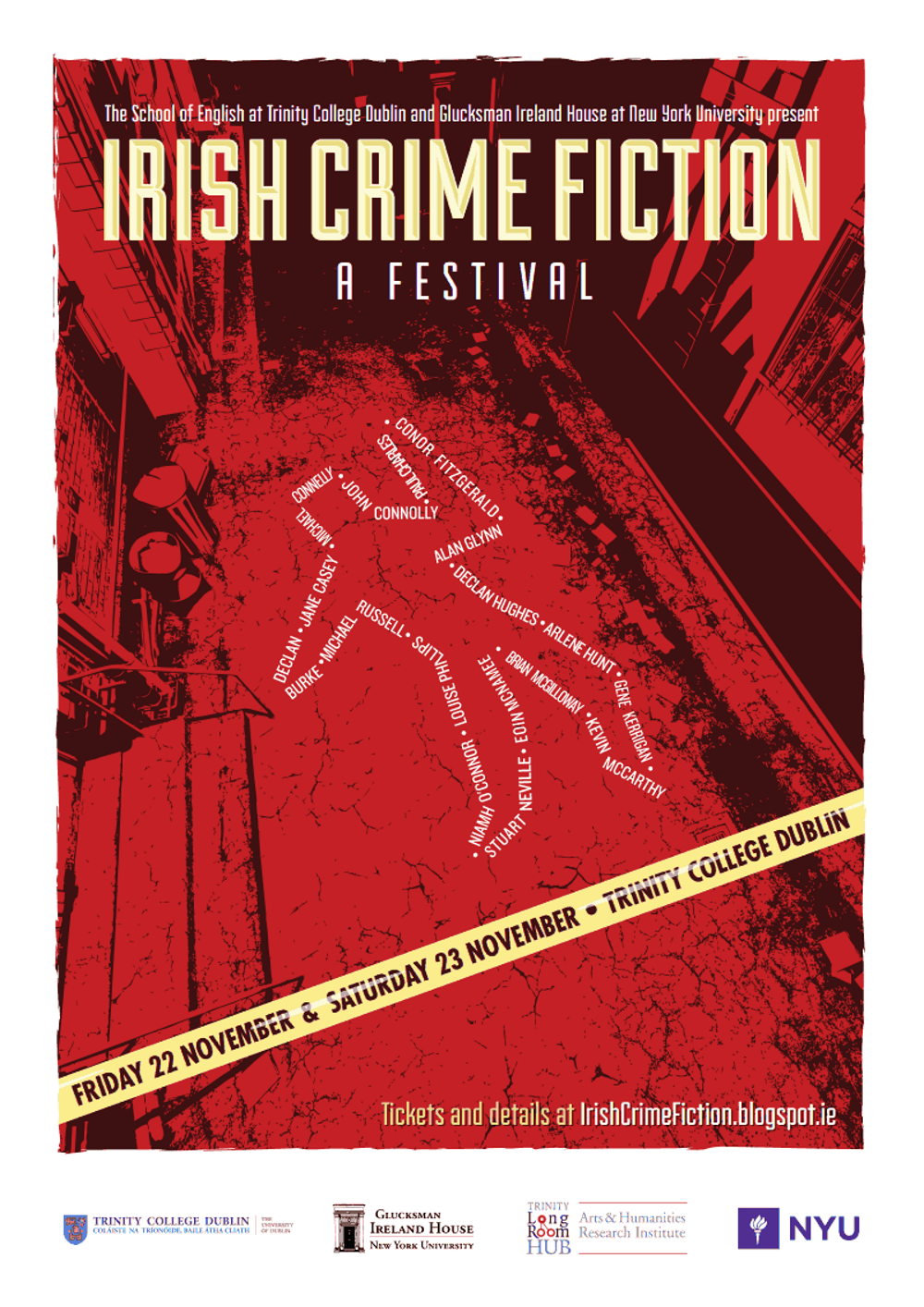
Irish Crime Fiction: A Festival


UPDATE: Ahead of ‘Irish Crime Fiction: A Festival’, which begins today at Trinity College in Dublin, I found myself last night fondly remembering the symposium at NYU in 2011 in the company of some of Irish crime writing’s finest. The details remain hazy, possibly because I found myself caught up in an Alan Glynn novel …

For all the details on the Trinity College festival, clickety-click here …

Tuesday

“Ya Wanna Do It Here Or Down The Station, Punk?” Ita Ryan

Yep, it’s rubber-hose time, folks: a rapid-fire Q&A for those shifty-looking usual suspects ...

What crime novel would you most like to have written?
CROOKED HOUSE, or any one of about ten other Agatha Christies. She was the mistress of the twist. Another favourite is DEATH COMES AS THE END. That managed the difficult feat of getting the reader to look forward optimistically to the future while perched on a rock above the Nile in approximately 2000BC.

What fictional character would you most like to have been?
Sarah Kenny from the Quick Investigations series by Arlene Hunt. I’ve always loved Wexford St. It’s my favourite part of Dublin, with great bars and slapdash little cafés and flower sellers and unlikely charity shops. It’s lively and happening – just this side of seedy. Imagine the fun of perching a floor or two above it in an old-fashioned office and having dodgy characters appear and tell you implausible tales. Mind you, if a quarter of what happens to Sarah happened to me I’d have a nervous breakdown within a week.

Who do you read for guilty pleasures?
Janet Evanovich. Georgette Heyer. P.G. Wodehouse. Terry Pratchett. I also enjoy children’s books. My kids are getting to the age now where I can read my collection of children’s fiction to them. I’m enjoying that very much.

Most satisfying writing moment?
When I re-read something a month or two later and it still makes me laugh, or cry.

If you could recommend one Irish crime novel, what would it be?
There are so many to choose from, but everyone should read MY LADY JUDGE, the first in the series of Mara novels by Cora Harrison. It transports you back to early 16th-century Ireland, depicting a happy community in the Burren living under traditional Brehon law. It was a pivotal time, with the looming threat of advances from the East. The history books tell us what happened next. All the same, you’ll find yourself hoping that maybe they’re wrong.

What Irish crime novel would make a great movie?
Tana French’s BROKEN HARBOUR. It has it all going on: tension, bleakness, disintegration. It should be filmed in the incredible light you get on a sunny winter’s day in Ireland, and pervaded by the sound of the sea.

Worst / best thing about being a writer?
The worst thing is the editing. I do a lot of revising myself before handing over to my editor. I hate it. It’s totally worth doing, though. The best thing is getting a tweet or a message from someone who enjoyed the book. That’s like magic. This guy in Australia live-tweeted IT CAN BE DANGEROUS. Very entertaining.

The pitch for your next book is …?
Cynthia’s had a rough day. And now she’s found Nathan’s body. This could impact negatively on her performance review. Not to mention that the police are bound to suspect her, seeing as how she has no alibi and was cutting code right outside his office when he was murdered. Explaining that techies rarely interact with managers for long enough to kill them isn’t going to sort the problem. There’s only one thing to do before she’s arrested - find the killer herself. How hard can it be? She has a hotline to Nathan’s devilishly handsome son, enthusiastic friends and a lifetime’s expertise in armchair detection. Cynthia’s exploits soon reach the ears of the enigmatic Superintendent in charge of the case. She can handle that, but then she attracts the murderer’s attention ... (I must admit, that’s the pitch for my current book. My next book is currently just a tiny glint in Cynthia’s eye. But it’ll be brilliant.)

Who are you reading right now?
I’m re-reading Gamma, Helm, Johnson and Vlissides’ classic work DESIGN PATTERNS: ELEMENTS OF RE-USABLE OBJECT-ORIENTED SOFTWARE. I’m suffering from jet lag at the moment, and it helps me sleep.

God appears and says you can only write OR read. Which would it be?
I’d put up a good fight, but it’d have to be read. I couldn’t possibly do without books.

The three best words to describe your own writing are …?
Funny, fast whodunit.

Ita Ryan’s IT CAN BE DANGEROUS is published by Kells Bay Books.

Thursday

Coming Out

UPDATE:   Arlene Hunt launches THE OUTSIDER this evening, November 7th, at the Gutter Bookshop, Temple Bar. See you there, folks ...

As author, editor and publisher, Arlene Hunt is one of the hardest working women in Irish crime fiction. Her latest novel, THE OUTSIDER (Portnoy Publishing), will be published on October 29th, bearing one of the most striking covers of the year. To wit:
From the time she was born, Emma Byrne was different. Shy and reclusive, her world revolved around animals, so much so that by the time she was 15, Emma was a much sought after horse trainer. So who would try to harm this gifted young woman? Who was shooting in Crilly Woods on that fateful August day? Emma’s twin brother, Anthony, is determined to get to the bottom of what happened to his sister, and in the course of his investigations makes a terrible mistake, one that will change all their lives forever …
  Arlene will be appearing at ‘Irish Crime Fiction: A Festival’ at Trinity College, which takes place on November 22nd / 23rd.

Monday

The Derry Air

There’s something special in the Derry air, alright. About the only downside to the weekend’s trip to Derry for the ‘Killer Books’ festival was that I was still stuck on the M50 on the way home on Sunday evening when Sligo Rovers scored the winner in the Cup Final about three hours into injury time.
  Other than that, ‘Killer Books’ made for a very fine weekend indeed. As always, the best part of such events is meeting fellow scribes, such as Lee Child and Desmond Doherty (right and righter). I also had a couple of brief-but-lovely chats with Claire McGowan, Andrew Pepper, Stuart Neville, William Ryan, John McAllister, Arlene Hunt, Alan Glynn, Stephen Mearns and Ann Cleeves.
  On Friday afternoon I had the honour of taking part in a panel discussion on comedy crime fiction alongside Colin Bateman (who was a busy man, given that his ‘Teenage Kicks’ punk musical opened in Derry over the weekend) and Gerard Brennan, all of which was moderated in some style by the great Garbhan Downey.
  All told, ‘Killer Books’ was a huge credit to its curator, Brian McGilloway, who launched his latest offering, HURT, on the Friday evening. Here’s hoping that ‘Killer Books’ in Derry becomes an annual event …

Derry’s Killer Books

Brian McGilloway is curating the ‘Killer Books’ event in Derry next month, which takes place under the aegis of the City of Culture 2013 and runs from November 1st to November 3rd. Brian took to Facebook a couple of days back to give a flavour of the event, which runs a lot like this:
“I’m hugely excited to be curating Killer Books at the Verbal Arts Centre in Derry, supported by Easons, from 1-3rd Nov. Guest authors include Lee Child, Ann Cleeves, Colin Bateman, Stuart Neville, Claire McGowan, Declan Burke, Declan Hughes, Louise Phillips, William Ryan, John McAllister, Gerard Brennan, Andrew Pepper, Alan Glynn, Arlene Hunt, Paul Charles, Dave Barclay, Garbhan Downey, Des Doherty and more. I’ll also be launching HURT on Friday 1st in the Verbal Arts at 7pm. There will also be CSI demonstrations, Victorian murder tours of the city walls, story telling, special kids events and much, much more.”
  For details on how to book tickets, etc., contact the Verbal Arts Centre on 02871 266946.

Thursday

“Ya Wanna Do It Here Or Down The Station, Punk?” Jennifer Ridyard

Yep, it’s rubber-hose time, folks: a rapid-fire Q&A for those shifty-looking usual suspects ...

What crime novel would you most like to have written?
Lauren Beukes’s THE SHINING GIRLS. Yes, it’s a serial killer novel that veers crazily into time travelling science fiction, but it’s done wonderfully, with a clear head and an unswerving belief in itself, and it’s just brilliant. I’m consumed with admiration, possibly even a girl-crush.

What fictional character would you most like to have been?
Lyra, from Philip Pullman’s ‘His Dark Materials’ trilogy. Armoured bears, animal souls, a multiverse, a cracking adventure and a mighty pop at the status quo? What’s not to love?

Who do you read for guilty pleasures?
Twitter.

Most satisfying writing moment?
Finishing, obviously. And then stroking the published cover like a proud mammy. But there’s also a delicious pleasure in re-reading what you’ve done after one of those rare afternoon’s when you’ve smoothed out a knot and everything has just flowed. Chances are you realise it’s pretentious bollocks the next day, and delete it all, but still. It’s nice.

If you could recommend one Irish crime novel, what would it be?
Arlene Hunt’s THE CHOSEN. Great writer, cracking story, without any pretensions about being anything but. Though it’s not set in Ireland. Does it still count?

What Irish crime novel would make a great movie?
See above!

Worst / best thing about being a writer?
Worst: having to show someone what you’ve written - letting them loose on your babies to scoff and mock and call them ugly. It’s pure self-doubt. Best: when you’re told your babies are smart and beautiful!

The pitch for your next book is …?
Eh … Well, I guess it’s part two of ‘The Chronicles of the Invaders’. Nuff said.

Who are you reading right now?
John Wyndham’s THE CHYRSALIDS, again, and just for laughs THE STATE OF AFRICA by Martin Meredith.

God appears and says you can only write OR read. Which would it be?
Read! Do I have to have a proper job too or can I just read? Bliss.

The three best words to describe your own writing are …?
Anecdotal, bold, emotive.

CONQUEST by Jennifer Ridyard and John Connolly is the first novel in ‘The Chronicles of the Invaders’ series.

Sunday

Killer Queens

The Red Line Book Festival in Tallaght will feature an intriguing evening’s conversation between some of Ireland’s best female crime writers on October 18th, as Susan Condon hosts a discussion between Alex Barclay, Arlene Hunt and Louise Phillips. Also taking part is Joanne Richardson, a former county coroner from Colorado, a state where Alex Barclay has set her last couple of novels. Should be a terrific evening. The details:
Main Auditorium @ Civic Theatre, Tallaght
Friday 18th October, 8pm
Tickets €12/€10 concession
Booking at 01 4627477; boxoffice@civictheatre.ie


A killer evening not to be missed! Popular crime writers Alex Barclay, Arlene Hunt and Louise Phillips share insights into creating a gripping thriller with special guest Joanne Richardson, former County Coroner of Summit, Colorado. Writer Susan Condon chairs this lively panel discussion.
  For all the details, clickety-click here …

Friday

Irish Noir: The Radio Series

‘Irish Noir’ is a new four-part radio series from RTE which begins on Saturday, September 14th. Presented by John Kelly (right), it features contributions ‘from the biggest names in our country’s crime writing scene’, and your humble correspondent. To wit:
Irish Noir is the story of Irish Crime fiction. From its gothic origins, through the fast paced storylines provided by Celtic Tiger excess – and right up to the bleak fictional landscape inspired by Austerity Ireland.

In the last 15 years, Irish crime writing has experienced a renaissance in popularity comparable to the Scandinavian and Scottish crime writing scenes. But before that, Irish crime writing was in the doldrums. Irish Noir is a major new four-part series presented by John Kelly, which will explore why it took so long for this popular genre to get a comfortable footing in this country. To what extent did politics and history play a part? And did the enormous success of Irish literary giants like Joyce and Beckett cloud the ambitions of writers who might have naturally had more hard-boiled aspirations ...? In other words, did we turn our literary noses up at crime fiction?

This will be a must-listen series for all bookworms, featuring contributions from the biggest names in our country’s crime writing scene – John Connolly, John Banville, Tana French, Declan Burke, Declan Hughes, Arlene Hunt, Alex Barclay, and Stuart Neville to name but a few ...

Irish Noir was made in conjunction with the BAI’s Sound and Vision fund. It starts on RTE Radio 1 at 7pm on Saturday September 14th.
  To listen in, clickety-click here …

Thursday

Well Hello, Dollies

Louise Phillips launches her second novel, THE DOLL’S HOUSE (Hachette Books Ireland), next Wednesday, August 7th, at the Gutter Bookshop. Arlene Hunt will be doing the honours, and festivities kick off at 6.30pm.
  Louise’s debut, RED RIBBONS, was shortlisted for the Ireland AM Irish Crime Fiction Novel of the Year in 2012, and THE DOLL’S HOUSE sees the return that book’s heroine, criminal psychologist Dr Kate Pearson. Quoth the blurb elves:
People say that the truth can set you free. But what if the truth is not something you want to hear?
  Thirty-five years ago Adrian Hamilton drowned. At the time his death was reported as a tragic accident but the exact circumstances remained a mystery.
  Now his daughter Clodagh, trying to come to terms with her past, visits a hypnotherapist who unleashes disturbing childhood memories of her father’s death. And as Clodagh delves deeper into her subconscious, memories of another tragedy come to light - the death of her baby sister.
  Meanwhile criminal psychologist Dr Kate Pearson is called in to help in the investigation of a murder after a body is found in a Dublin canal. When Kate digs beneath the surface of the killing, she discovers a sinister connection to the Hamilton family.
  What terrible events took place in the Hamilton house all those years ago? And what connects them to the recent murder?
  Time is running out for Clodagh and Kate.
  And the killer has already chosen his next victim . . .

Saturday

They Write Wrongs

Author and publisher Arlene Hunt (right) will be running a crime writing course later this month at the Irish Writers’ Centre – it’s a one-week, ‘writing-heavy, intensive course’ that will feature guest speakers Alex Barclay, Louise Phillips, yours truly, and more. Herewith be the gist:
Have you ever considered where you might hide a body? Thought about being the gumshoe who follows clues to find a killer? Daydreamed on a Monday morning where you might like to retire with the proceeds of ill gotten gains? If so, join author and publisher, Arlene Hunt, to explore the underlying themes of crime fiction. Focusing on characters, plot development, story arcs and mystery, we will dissect our story with gory relish. We will explore intent and red herrings, create tension; and ultimately unmask our villain.
  This is a writing-heavy, intensive course that deals with the complicated business of crime fiction. Over five days we are going to develop and craft a functional crime fiction novella to be read on the final day.
  Not for the faint hearted!
  The course takes place from July 29th to August 2nd. For all the details, clickety-click here …