Dervla McTiernan’s debut, The Ruin (2018), introduced Detective Cormac Reilly, recently relocated to Galway from Dublin. In her follow-up, The Scholar (Sphere, €15.99), Cormac’s partner Emma discovers the body of a young woman who has been killed, and badly disfigured, during a hit-and-run outside the Galway laboratories of Darcy Therapeutics. The victim is initially thought to be Carline Darcy, the granddaughter of billionaire pharmacist John Darcy and reputed to be one of the finest young scientific minds of her generation – but when the victim’s true identity is learned, Emma herself becomes a suspect in Cormac’s case. There are shades of Ross Macdonald in McTiernan’s sophomore novel: an austere patriarch, successive generations of a family manifesting the same flawed gene, a self-crippling lust for power, money and status (‘To Carline they were the bloody Kennedys. Everything Carline did, she did because she was trying to earn a ticket to Camelot.’). McTiernan employs the police procedural form rather than that of the private eye, however, and where a single private detective might have been able to turn a blind eye to Emma’s possible involvement in murder, Cormac Reilly has obligations to a more public code of conduct. The result is a complex, densely plotted murder investigation in which the investigators are professionally and emotionally compromised, not least because their opinion of the fabulously wealthy Darcy family is nowhere as impartial as it should be: ‘There was always something morbidly fascinating about the super-rich. It was like sniffing at a piece of meat that had been hung a bit too long, that had a taint of rot about it.’ ~ Declan Burke
This review appeared in the Irish Times’ crime fiction column for March, which also included new titles from Jo Spain, Stina Jackson, William Boyle and Sofie Laguna.
Showing posts with label Irish crime fiction. Show all posts
Thursday
Sunday
Friday
Review: IN THE DARK RIVER by Conor Brady
Joe Swallow should be a happy man. Recently promoted to detective inspector in the Dublin Metropolitan Police as a result of consistent excellence, as detailed in former Irish Times editor Conor Brady’s previous Victorian-era novels – A June of Ordinary Murders (2012), The Eloquence of the Dead (2013) and A Hunt in Winter (2016) – Swallow is liked by the rank-and-file of Dublin Castle and esteemed by his chief, John Mallon. He has even earned the grudging respect of Dublin’s criminal fraternity, chief among them the Vanucchi Gang. Newly married to his beloved Maria, Joe Swallow should be able to put his feet up on his desk and enjoy the fruits of his labour.
Not that he wants to. The tragedy of Maria’s recent miscarriage, and his inability to articulate his grief, have driven Swallow to take on a greater workload, overseeing an investigation into the skeleton discovered in an underground branch of the Poddle and taking responsibility for investigating an armed robbery at the Rathgar home of one of Dublin’s legal eagles. And then there’s the rather pressing issue of British intelligence operatives employing the Victorian equivalent of black ops as they try to destroy Charles Stewart Parnell and the Irish Parliamentary Party …
In the Dark River opens in Madrid, with journalist Richard Piggott brooding on his disgrace. His attempt to smear Parnell revealed as forgeries, Piggott likely faces a charge of perjury should he return to Ireland. Was Piggott’s humiliation and ruin sufficient to cause him to take his own life, as the British Secret Service suggests? Or is Swallow right to believe that Piggott, a pawn, was simply taken off the board?
Parnell’s imminent fall from grace casts a long shadow across In the Dark River – the reader understands that, in the long run, Swallow’s machinations as he strives to protect ‘the uncrowned king of Ireland’ are irrelevant. That flies in the face of the certainties (truth, justice, the status quo upheld) that crime fiction tends to offer, but Brady offers a similarly idiosyncratic take on the other investigations that occupy Swallow’s time: crooks get off scot-free, killers go unaccused, villains form covert alliances with the police. Don’t be fooled by the historical setting and the genteel tone, the ‘cosy’ style and the police procedural form: beneath its apparently placid surface, In the Dark River is anything but a traditional mystery novel.
It’s as if the dark river – which we initially assume to be the Poddle, which wends its way beneath the Dublin streets, and in which the woman’s skeleton is discovered – is in fact Time itself. All the cases that present themselves for Swallow’s investigation began bubbling up long ago, and only emerge into view when it is too late for Swallow to do anything but belatedly appreciate the extent to which he is out of his depth. He can make all the appropriate gestures – open a murder book, delegate detectives to investigate killings and robberies, engage in counter-intelligence designed to frustrate the British Secret Service – but all the while the river keeps flowing relentlessly on.
Joe Swallow is a good man, and a good policeman, but he is not superhuman. Crime was as intrinsic to Victorian Dublin as it was to the modern city, and one man, no matter how grudgingly respected he is, is going to persuade the Vanucchi Gang and their ilk to go straight. Despite Swallow’s best efforts, Charles Stewart Parnell is doomed. If that fatalistic streak runs contrary to the crime novel’s expectations, so be it. Joe Swallow – solid and dependable, loyal to the cause of the greater good even as he flounders about in the dark river – is arguably the most realistic policeman in Irish crime fiction’s thin blue line. ~ Declan Burke
This review was first published in the Irish Times.
Not that he wants to. The tragedy of Maria’s recent miscarriage, and his inability to articulate his grief, have driven Swallow to take on a greater workload, overseeing an investigation into the skeleton discovered in an underground branch of the Poddle and taking responsibility for investigating an armed robbery at the Rathgar home of one of Dublin’s legal eagles. And then there’s the rather pressing issue of British intelligence operatives employing the Victorian equivalent of black ops as they try to destroy Charles Stewart Parnell and the Irish Parliamentary Party …
In the Dark River opens in Madrid, with journalist Richard Piggott brooding on his disgrace. His attempt to smear Parnell revealed as forgeries, Piggott likely faces a charge of perjury should he return to Ireland. Was Piggott’s humiliation and ruin sufficient to cause him to take his own life, as the British Secret Service suggests? Or is Swallow right to believe that Piggott, a pawn, was simply taken off the board?
Parnell’s imminent fall from grace casts a long shadow across In the Dark River – the reader understands that, in the long run, Swallow’s machinations as he strives to protect ‘the uncrowned king of Ireland’ are irrelevant. That flies in the face of the certainties (truth, justice, the status quo upheld) that crime fiction tends to offer, but Brady offers a similarly idiosyncratic take on the other investigations that occupy Swallow’s time: crooks get off scot-free, killers go unaccused, villains form covert alliances with the police. Don’t be fooled by the historical setting and the genteel tone, the ‘cosy’ style and the police procedural form: beneath its apparently placid surface, In the Dark River is anything but a traditional mystery novel.
It’s as if the dark river – which we initially assume to be the Poddle, which wends its way beneath the Dublin streets, and in which the woman’s skeleton is discovered – is in fact Time itself. All the cases that present themselves for Swallow’s investigation began bubbling up long ago, and only emerge into view when it is too late for Swallow to do anything but belatedly appreciate the extent to which he is out of his depth. He can make all the appropriate gestures – open a murder book, delegate detectives to investigate killings and robberies, engage in counter-intelligence designed to frustrate the British Secret Service – but all the while the river keeps flowing relentlessly on.
Joe Swallow is a good man, and a good policeman, but he is not superhuman. Crime was as intrinsic to Victorian Dublin as it was to the modern city, and one man, no matter how grudgingly respected he is, is going to persuade the Vanucchi Gang and their ilk to go straight. Despite Swallow’s best efforts, Charles Stewart Parnell is doomed. If that fatalistic streak runs contrary to the crime novel’s expectations, so be it. Joe Swallow – solid and dependable, loyal to the cause of the greater good even as he flounders about in the dark river – is arguably the most realistic policeman in Irish crime fiction’s thin blue line. ~ Declan Burke
This review was first published in the Irish Times.
Thursday
Launch: Anthony J. Quinn’s THE LISTENERS
Anthony J. Quinn launches THE LISTENERS (Head of Zeus) in Belfast’s No Alibis at 6.30pm on Thursday, December 13th. Previously the author of the Celsius Daly series, and a number of standalone novels, Anthony has embarked on a new series set in Scotland. Quoth the blurb elves:
Not long out of the fast-track training course at Edinburgh’s police college, Detective Sergeant Carla Herron is about to be tested to breaking point.For more on Anthony J. Quinn, clickety-click here …
She’s been called to Deepwell psychiatric hospital in the Scottish borders to interview a patient who has confessed to the murder of one of the hospital’s psychotherapists. The confession is vividly detailed, but for a man locked in a secure ward and under 24-hour surveillance, it is also utterly impossible.
So why can’t the supposedly murdered psychotherapist be contacted? Why are the hospital staff so secretive, so difficult to work with? Why have other Deepwell patients made disturbingly similar confessions over the past year? Against the advice of her superiors, Carla delves deeper into the hospital’s past and is plunged into a labyrinth of jealousies, lies and hallucinations.
Struggling to separate fact from fantasy, Carla embarks on a chilling trail through the bleak uplands and dark forests of the Scottish borders, every step taking her closer to a final – deadly – reckoning.
Tuesday
Reviews: Irish Times crime fiction column, December 2018
My crime fiction column for the Irish Times this month is an all-Irish affair, and features Kevin McCarthy, Tanya Farrelly, Fiona Gartland, Nessa O’Mahony and Ken Bruen. To wit:
Kevin McCarthy’s first two novels, Irregulars and Peeler, were set against the backdrop of the Irish Civil War, but Wolves of Eden (W.W. Norton) opens in the wake of the American Civil War, with the psychologically scarred Union Army veteran Lieutenant Molloy dispatched to Fort Phil Kearny in the Dakota Territory to ‘put boots on the gallows’ – i.e., investigate the apparent murder of the fort’s sutler and his wife. Molloy being an alcoholic determined to drink himself to death, the investigation is largely conducted by his second-in-command, Sergeant Kohn; woven through Kohn’s attempts to penetrate the code of omertà that pertains at Fort Kearny is a rambling, semi-literate confession written by Michael O’Driscoll, an Irish immigrant who has served with the Union Army during the recent War. A compelling tale of men who were ‘chucked into the roaring flames of history,’ Wolves of Eden is superbly detailed in its depiction of frontier soldiering, with Fort Kearny besieged by Chief Red Cloud and the story playing out against the events which led to the Fetterman Massacre of 1866. Flashing with shards of coal-black humour – Michael’s brother Tom, shot in the face at the battle of Chickamauga, has ‘a face that would make a funeral turn from a main road’ – Wolves of Eden is a brutal, blood-soaked and unsentimental account of the Old West that bears comparison with Cormac McCarthy’s Blood Meridian.
Tanya Farrelly’s When Your Eyes Close (Killer Reads) is an audacious exercise in genre-blending. Nick Drake is an alcoholic who undergoes hypnotherapy in a desperate bid to curtail his boozing, only to witness himself committing multiple murders in what appears to be a previous life. Shaken to his core, and reluctantly believing himself to be the knife-wielding killer John Davis, Nick sets out to investigate what really happened – only to discover that Caitlin, the daughter he orphaned during his killing spree, is struggling to cope with the mysterious disappearance of her husband, David. Where Farrelly’s crime debut The Girl Behind the Lens came coated in gritty realism, When Your Eyes Close revels in its fantastical premise (even if much of Caitlin’s backstory is rooted in the ongoing homelessness crisis). The plot isn’t entirely seamless as Farrelly juggles her parallel time-lines, but the overall effect is an entertainingly off-beat account of a man determined to bring himself to justice.
Big Pharma finds itself in the dock In the Court’s Hands (Poolbeg), the debut thriller from Irish Times journalist Fiona Gartland, which opens with Beatrice Barrington, a stenographer at the Dublin Criminal Court, observing a suspicious liaison in the Phoenix Park between Stephen O’Farrell, the accused in a high profile case, and the forewoman of the jury, Rachel Deere. When Rachel is subsequently found dead in her apartment, Beatrice suspects foul play, and enlists the help of ex-Garda detective Gabriel Ingram to help her investigate. There’s more than a hint of the Miss Marple about the prim, fussy and resolutely moral Beatrice Harrington, and In the Court’s Hands offers a neat blend of the courtroom drama and the amateur sleuth sub-genres, and even tosses in what appears to be an homage to Raymond Chandler as Beatrice, nosing around where she shouldn’t, finds herself drugged and incarcerated in a mental hospital. Regular flashbacks to the younger Beatrice’s life in 1980s Dublin leach tension from the main plot, but they are vividly rendered and contribute handsomely to a promising debut.
Poet Nessa O’Mahony publishes her debut crime novel with The Branchman (Arlen House) which opens in 1925 with Michael Mackey, a detective officer in the newly formed Garda Special Branch, sent to the Garda barracks in Ballinasloe “to root out subversion”. Mackey, a veteran of numerous conflicts, isn’t fooled by the beauty of rural Galway: “It all looked innocent enough, but who knew what old animosities were lurking in those green fields?” There’s enough animosity to deliver a murder, certainly, and Mackey quickly discovers himself investigating the theft of a cache of stolen arms. O’Mahony is particularly strong on the everyday detail of a stranger negotiating a hazardous landscape – the character of Mackey is loosely based on her own grandfather, Michael McCann – and delivers a series of brief, intense chapters which generate a ferocious pace. Most fascinating, perhaps, is O’Mahony’s evocation of the wider political backdrop, that fragile, imperfect peace that took hold in the wake of the War of Independence and the Civil War.
Jack Taylor returns in Ken Bruen’s In the Galway Silence (Head of Zeus), the 14th novel to feature the Galway-based private eye. Commissioned to investigate the bizarre murder of the anti-social Renaud twins, Jack quickly concludes that ‘It wasn’t a mystery as to them being killed but a mystery as to why it hadn’t happened sooner.’ The investigation, however, serves as springboard into a much wider exploration of the country’s ills, as Jack, self-described as ‘a broken PI’, wanders the mean streets of Galway lamenting the state of ‘the new broken Ireland.’ Post-modern to a fault, In the Galway Silence is littered with references to Jack Taylor’s preferred reading, which here includes the cult crime fiction authors Craig McDonald, Eddie Bunker and Daniel Woodrell, and further features the Galway-based author Scott Harden, whose ‘alleged stint in a South American jail had given him preternaturally totally white hair,’ and whose appearance causes Jack to believe that, ‘I could be looking at me fein (myself).’ Located on the literary spectrum somewhere between Charles Bukowski’s Pulp and the wilder extravagances of James Crumley’s private eye C.W. Sughrue, In the Galway Silence exudes a nihilistic thrill in smashing the crime fiction conventions to smithereens. ~ Declan Burke
This column first appeared in the Irish Times.
Kevin McCarthy’s first two novels, Irregulars and Peeler, were set against the backdrop of the Irish Civil War, but Wolves of Eden (W.W. Norton) opens in the wake of the American Civil War, with the psychologically scarred Union Army veteran Lieutenant Molloy dispatched to Fort Phil Kearny in the Dakota Territory to ‘put boots on the gallows’ – i.e., investigate the apparent murder of the fort’s sutler and his wife. Molloy being an alcoholic determined to drink himself to death, the investigation is largely conducted by his second-in-command, Sergeant Kohn; woven through Kohn’s attempts to penetrate the code of omertà that pertains at Fort Kearny is a rambling, semi-literate confession written by Michael O’Driscoll, an Irish immigrant who has served with the Union Army during the recent War. A compelling tale of men who were ‘chucked into the roaring flames of history,’ Wolves of Eden is superbly detailed in its depiction of frontier soldiering, with Fort Kearny besieged by Chief Red Cloud and the story playing out against the events which led to the Fetterman Massacre of 1866. Flashing with shards of coal-black humour – Michael’s brother Tom, shot in the face at the battle of Chickamauga, has ‘a face that would make a funeral turn from a main road’ – Wolves of Eden is a brutal, blood-soaked and unsentimental account of the Old West that bears comparison with Cormac McCarthy’s Blood Meridian.
Tanya Farrelly’s When Your Eyes Close (Killer Reads) is an audacious exercise in genre-blending. Nick Drake is an alcoholic who undergoes hypnotherapy in a desperate bid to curtail his boozing, only to witness himself committing multiple murders in what appears to be a previous life. Shaken to his core, and reluctantly believing himself to be the knife-wielding killer John Davis, Nick sets out to investigate what really happened – only to discover that Caitlin, the daughter he orphaned during his killing spree, is struggling to cope with the mysterious disappearance of her husband, David. Where Farrelly’s crime debut The Girl Behind the Lens came coated in gritty realism, When Your Eyes Close revels in its fantastical premise (even if much of Caitlin’s backstory is rooted in the ongoing homelessness crisis). The plot isn’t entirely seamless as Farrelly juggles her parallel time-lines, but the overall effect is an entertainingly off-beat account of a man determined to bring himself to justice.
Big Pharma finds itself in the dock In the Court’s Hands (Poolbeg), the debut thriller from Irish Times journalist Fiona Gartland, which opens with Beatrice Barrington, a stenographer at the Dublin Criminal Court, observing a suspicious liaison in the Phoenix Park between Stephen O’Farrell, the accused in a high profile case, and the forewoman of the jury, Rachel Deere. When Rachel is subsequently found dead in her apartment, Beatrice suspects foul play, and enlists the help of ex-Garda detective Gabriel Ingram to help her investigate. There’s more than a hint of the Miss Marple about the prim, fussy and resolutely moral Beatrice Harrington, and In the Court’s Hands offers a neat blend of the courtroom drama and the amateur sleuth sub-genres, and even tosses in what appears to be an homage to Raymond Chandler as Beatrice, nosing around where she shouldn’t, finds herself drugged and incarcerated in a mental hospital. Regular flashbacks to the younger Beatrice’s life in 1980s Dublin leach tension from the main plot, but they are vividly rendered and contribute handsomely to a promising debut.
Poet Nessa O’Mahony publishes her debut crime novel with The Branchman (Arlen House) which opens in 1925 with Michael Mackey, a detective officer in the newly formed Garda Special Branch, sent to the Garda barracks in Ballinasloe “to root out subversion”. Mackey, a veteran of numerous conflicts, isn’t fooled by the beauty of rural Galway: “It all looked innocent enough, but who knew what old animosities were lurking in those green fields?” There’s enough animosity to deliver a murder, certainly, and Mackey quickly discovers himself investigating the theft of a cache of stolen arms. O’Mahony is particularly strong on the everyday detail of a stranger negotiating a hazardous landscape – the character of Mackey is loosely based on her own grandfather, Michael McCann – and delivers a series of brief, intense chapters which generate a ferocious pace. Most fascinating, perhaps, is O’Mahony’s evocation of the wider political backdrop, that fragile, imperfect peace that took hold in the wake of the War of Independence and the Civil War.
Jack Taylor returns in Ken Bruen’s In the Galway Silence (Head of Zeus), the 14th novel to feature the Galway-based private eye. Commissioned to investigate the bizarre murder of the anti-social Renaud twins, Jack quickly concludes that ‘It wasn’t a mystery as to them being killed but a mystery as to why it hadn’t happened sooner.’ The investigation, however, serves as springboard into a much wider exploration of the country’s ills, as Jack, self-described as ‘a broken PI’, wanders the mean streets of Galway lamenting the state of ‘the new broken Ireland.’ Post-modern to a fault, In the Galway Silence is littered with references to Jack Taylor’s preferred reading, which here includes the cult crime fiction authors Craig McDonald, Eddie Bunker and Daniel Woodrell, and further features the Galway-based author Scott Harden, whose ‘alleged stint in a South American jail had given him preternaturally totally white hair,’ and whose appearance causes Jack to believe that, ‘I could be looking at me fein (myself).’ Located on the literary spectrum somewhere between Charles Bukowski’s Pulp and the wilder extravagances of James Crumley’s private eye C.W. Sughrue, In the Galway Silence exudes a nihilistic thrill in smashing the crime fiction conventions to smithereens. ~ Declan Burke
This column first appeared in the Irish Times.
Monday
Shortlist: Irish Crime Fiction Book of the Year
It’s that time of the year again, when the shortlists for the Irish Books of the Year awards are announced, and as always the Crime Fiction category offers some fascinating choices. To wit:
Irish Independent Crime Fiction Book of the YearMeanwhile, there’s five crime titles in the six nominees for the Ryan Tubridy Listener’s Choice Award. To wit:
Skin Deep – Liz Nugent (Penguin Ireland)
A House of Ghosts – W. C. Ryan (Bonnier Zaffre)
The Confession – Jo Spain (Quercus)
One Click – Andrea Mara (Poolbeg)
The Ruin – Dervla McTiernan (Sphere)
Thirteen – Steve Cavanagh (Orion)
RTE Radio One’s The Ryan Tubridy Show Listeners’ Choice AwardHearty congratulations to all the nominees; the winners will be announced on November 27th. To vote for your favourite title, clickety-click here …
Ladder to the Sky – John Boyne (Doubleday)
The Stolen Girls – Patricia Gibney (Bookouture)
The President is Missing – Bill Clinton and James Patterson (Century)
Ruin – Dervla McTiernan (Sphere)
Skin Deep – Liz Nugent (Penguin Ireland)
The Woman in the Window – A.J. Finn (HarperCollins)
Saturday
Publication: WHEN YOUR EYES CLOSE by Tanya Farrelly
Tanya Farrelly published her second thriller, WHEN YOUR EYES CLOSE (Killer Reads), on November 15th. Quoth the blurb elves:
THREE LIVES ARE ABOUT TO CHANGE FOREVER …For more on Tanya Farrelly, clickety-click here …
Nick Drake is determined to get his life back on track. And if hypnosis has even a chance of working, he’ll give it a try. But as his eyes close, Nick sees something that terrifies him.
Michelle Carlin is Nick’s girlfriend. She’s determined to stick by Nick no matter what, but she can tell he’s hiding something from her, something dangerous.
Caitlin Davis is still reeling from the suspicious disappearance of her husband a year ago. But she has secrets of her own which could ruin her and everything she holds dear.
These three people’s lives are set to collide. And as long-buried secrets, lies and betrayals come to light, they will be lucky to escape unscathed …
Thursday
Paperback: THE LIAR’S GIRL by Catherine Ryan Howard
First published last February, Catherine Ryan Howard’s THE LIAR’S GIRL (Corvus) will be published in paperback on January 3rd, 2019. Quoth the blurb elves:
Dublin’s notorious Canal Killer, Will Hurley, is ten years into his life sentence when the body of a young woman is fished out of the Grand Canal. Though detectives suspect they are dealing with a copycat, they turn to Will for help. He claims he has the information the police need, but will only give it to one person – the girl he was dating when he committed his horrific crimes.For more on Catherine Ryan Howard, clickety-click here …
Alison Smith has spent the last decade abroad, putting her shattered life in Ireland far behind her. But when she gets a request from Dublin imploring her to help prevent another senseless murder, she is pulled back to face the past - and the man - she's worked so hard to forget.
Tuesday
One to Watch: DARKEST TRUTH by Catherine Kirwan
Solicitor Catherine Kirwan publishes her debut novel, DARKEST TRUTH (Arrow), a story set in Cork and featuring the solicitor Finn Fitzpatrick. Quoth the blurb elves:
It only takes one person to break the silence.DARKEST TRUTH will be published on January 10th.
When solicitor Finn Fitzpatrick is approached by a man to investigate the death of his daughter, her first instinct is to refuse.
The father is grieving, and unable to accept that his daughter committed suicide. And yet something about the man’s story chimes with Finn.
Why did a bright, confident, beautiful young girl suddenly drop out of school, isolating herself from everyone who cared about her?
Could it be that the father’s suspicion is right and that his daughter was groomed and abused by the most famous film director in Ireland? If the story is true there are bound to be other victims.
The more she investigates, the darker and more twisted the picture becomes.
Soon Finn herself is in danger.
Because these are powerful people she is trying to expose. And they are willing to do anything to protect their secrets.
Saturday
Thursday
Public Interview: Ian Rankin in Belfast
Ian Rankin (right) makes a rare public appearance in Ireland tomorrow evening, when the creator of John Rebus takes to the stage in a public interview with the inimitable Brian McGilloway. To wit:
Meanwhile, the NOIReland crime fiction festival is set to return in March 2019. Watch this space …
Event: A Noirish Night with Ian RankinTickets cost £10, and can be booked here.
Venue: Hilton Belfast, Belfast
Date: Fri 16 Nov 2018 at 7:30PM
Section: Lagan Suite
Meanwhile, the NOIReland crime fiction festival is set to return in March 2019. Watch this space …
Monday
Publication: A COLD FLAME by Aidan Conway
Aidan Conway published A COLD FLAME (Killer Reads), the second in his Rome-set Detective Rossi series, on September 6th. Quoth the blurb elves:
Five men burnt alive.For more on Aidan Conway, clickety-click here …
In the crippling heat of August in Rome, a flat goes up in flames, the doors sealed from the outside. Five illegal immigrants are trapped and burnt alive – their charred bodies barely distinguishable amidst the debris.
One man cut into pieces.
When Detective Inspectors Rossi and Carrara begin to investigate, a terror organisation shakes the city to its foundations. Then a priest is found murdered and mutilated post-mortem – his injuries almost satanic in their ferocity.
One city on the edge of ruin.
Rome is hurtling towards disaster. A horrifying pattern of violence is beginning to emerge, with a ruthless killer overseeing its design. But can Rossi and Carrara stop him before all those in his path are reduced to ashes?
Labels:
Aidan Conway A Cold Flame,
arson,
Irish crime fiction,
Rome
Friday
Launch: WOLVES OF EDEN by Kevin McCarthy
Kevin McCarthy’s previous novels were set during the Irish Civil War, but his latest offering, WOLVES OF EDEN (W.W. Norton), opens in the wake of the American Civil War. Quoth the blurb elves:
Dakota Territory, 1866. Following the murders of a frontier fort’s politically connected sutler and his wife in their illicit off-post brothel, Lieutenant Martin Molloy and his long-suffering orderly, Corporal Daniel Kohn, are ordered to track down the killers and return with “boots for the gallows” to appease powerful figures in Washington. The men journey west to the distant outpost in a beautiful valley, where the soldiers inside the fort prove to be violently opposed to their investigations. Meanwhile, Irish immigrant brothers Michael and Thomas O’Driscoll have returned from the brutal front lines of the Civil War. Unable to adapt to life as migrant farm laborers in peacetime Ohio, they reenlist in the army and are shipped to Fort Phil Kearny in the heart of the Powder River Valley. Here they are thrown into merciless combat with Red Cloud’s coalition of Native tribes fighting American expansion into their hunting grounds. Amidst the daily carnage, Thomas finds a love that will lead to a moment of violence as brutal as any they have witnessed in battle-a moment that will change their lives forever. Blending intimate historical detail and emotional acuity, WOLVES OF EDEN sets these four men on a deadly collision course in a haunting narrative that explores the cruelty of warfare and the resilience of the human spirit.Kevin McCarthy launches WOLVES OF EDEN at the Central Hotel, Exchequer Street, Dublin 2, on Wednesday, November 14th. For more on Kevin McCarthy, clickety-click here …
Wednesday
Publication: IN THE GALWAY SILENCE by Ken Bruen
Ken Bruen, aka the Godfather of Irish Noir, publishes IN THE GALWAY SILENCE (Head of Zeus) on November 1st, the 14th in the Galway-set Jack Taylor series. Quoth the blurb elves:
After too much tragedy and violence, Jack Taylor might have at long last found contentment. Of course, he still knocks back too much Jameson and dabbles in uppers, but he has a new woman in his life, a freshly bought apartment, and little sign of trouble on the horizon, unless you count looking after his girlfriend’s spoilt nine-year-old.For more on Ken Bruen, clickety-click here …
But once again, trouble comes to him, this time in the form of wealthy Frenchman Pierre Renaud, who wants Jack to investigate the double-murder of his twin sons. Entitled, drug-addled, les enfants terribles were bound to a wheelchair, mouths glued shut and pushed off the pier.
He shouldn’t, but Jack reluctantly agrees to investigate and it opens the door to the past again ...
Tuesday
Essay: ‘Walking the Tightrope: Brexit, books and the Border’ by Brian McGilloway
Brian McGilloway (right) published a long-form essay in the Irish Times last weekend, considering the ways in which Northern Irish writers have written about the post-‘Troubles’ landscape in Northern Ireland, and the possible consequences for the re-imposition of a hard border between Northern Ireland and the Republic. Sample quote:
It is here where writers become most important. In the absence of a truth commission in the North, it is up to writers to tiptoe between the conflicting versions of history and to tell the truth of the past as we saw it, whether that means considering the impact of the past on the present, or as Adrian McKinty is doing in his superlative Sean Duffy series, revisiting and reliving events of the past with the benefit of hindsight.For the full essay, clickety-click here …
And if writers are indeed our truth commission, their truth of the Border is not that it was a place of security and unity, but one of division, crime and violence. And yet, there are those now wishing to reinforce that very Border again, psychologically if not physically.
My greatest concern is that Brexit will force those of us who were prepared to move forward and shelf old allegiances and aspirations in the name of peace to look once more to the tribe, to retreat back into our own communities because the hardening of the Border in any sense requires a reassertion of a single identity.
Saturday
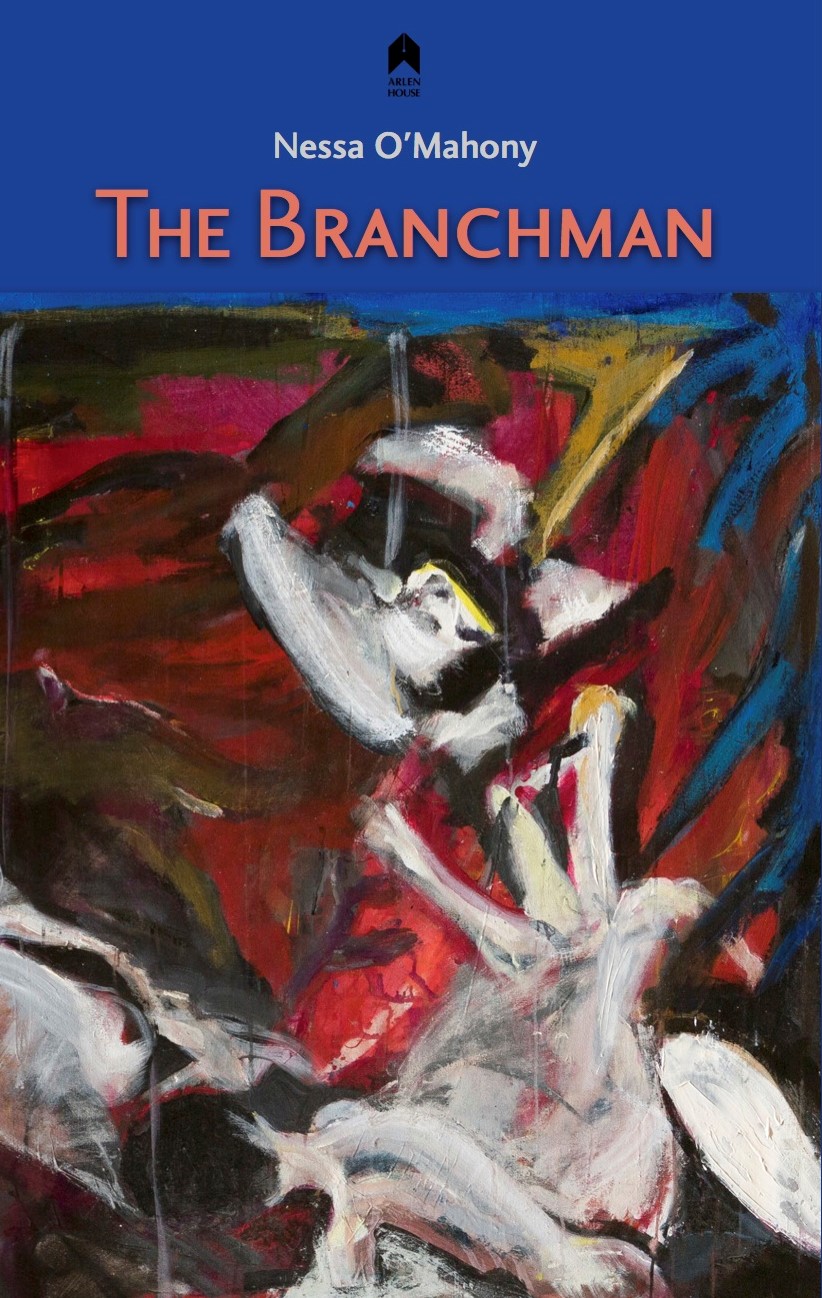
Publication: THE BRANCHMAN by Nessa O’Mahony
With four volumes of poetry already under her belt, Nessa O’Mahony recently published her debut crime novel, THE BRANCHMAN (Arlen House), which is set in the wake of the Irish Civil War. Quoth the blurb elves:
The Civil War may be over, but there’s no peace, not by a long chalk, and we need a very special type of man to be its guardian.For more on Nessa O’Mahony, clickety-click here …
East Galway, 1925. Detective Officer Michael Mackey of the newly-created Special Branch has been sent to the Garda Barracks in Ballinasloe on a mission to root out subversives. Soon he has a murder to solve, stolen arms to recover, and a lost love to rescue. But who can he trust?
Friday
Review: TOO CLOSE TO BREATHE by Olivia Kiernan
First published back in April, and issued in paperback on January 10, Olivia Kiernan’s TOO CLOSE TO BREATHE (riverrun) was one of the finest crime debuts of 2018. To wit:
Olivia Kiernan’s debut TOO CLOSE TO BREATHE introduces Det Chief Supt Frankie Sheehan, who investigates the death of Eleanor Costello, a woman discovered hanged in her home and initially believed to have killed herself before Sheehan’s sharp eye detects anomalies that result in a murder investigation. Delivered in propulsive, minimalist prose, Sheehan is precisely the kind of gruff, no-nonsense cynic you’d want investigating your own murder. TOO CLOSE TO BREATHE is an exhilarating police procedural, not least because Sheehan is a complex, layered character who, suffering from PTSD after a frenzied knife attack that left her physically and psychologically scarred, declares herself “a living token of the murder. Proustian memory. I’m a direct path of access to the thrill of the kill.” Noir in tone (“We’re all the murdering kind, given the right motivation,” Sheehan’s superior tells her), and sharply observed – “hard-looking rusted metal furniture stands like a lonely family in the corner” – TOO CLOSE TO BREATHE reads like a hard-boiled take on Tana French and immediately establishes Olivia Kiernan as a talent to watch. ~ Declan BurkeThis review was first published in the Irish Times.
Thursday
Public Interview: Liz Nugent and Ali Land at Murder One
I’m very much looking forward to interviewing Liz Nugent and Ali Land at Smock Alley on November 2nd, a public interview which opens the Murder One crime fiction festival. To wit:
Domestic Noir takes as its premise the belief that the domestic sphere can be a dark and dangerous environment for women. Two fresh and highly-successful new voices discuss with Declan Burke how their work fits into the genre.For all the details, including how to book tickets, clickety-click here …
Ali Land’s debut novel Good Me Bad Me became a Sunday Times and international bestseller. It was short-listed for Dead Good Reader Awards and for the Crime Writers Association New Blood Dagger. It also became a Richard and Judy book club pick. Ali is currently working on her second novel.
Liz Nugent has become one of Ireland’s most popular and successful novelists. With her three intriguing and deeply sinister novels, Unravelling Oliver, Lying in Wait, and most recently Skin Deep, she has built an enormous following both at home and abroad.
Tuesday
Public Interview: Eoin McNamee
Eoin McNamee’s latest novel, THE VOGUE (Faber & Faber), was published on October 18th. Quoth the blurb elves:
Late 1944, and two teenagers dance the Vogue in silence on the projectionist's floor of the Cranfield Aerodrome. She draws the outlines of their footwork in eyebrow pencil on the white sheet. He loses their bet.Eoin will be in conversation with Paula Shields at the dlr Lexicon in Dun Laoghaire on November 6th. For all the details, clickety-click here …
Decades later, a ghost returns to Mourne to identify a body found in the shifting sands. Names have long since been changed; children long since cast out; lies long thought forgotten.
Set against an eerie landscape, awash with secrets, The Vogue is a grimly poetic dance through the intertwined stories of a deeply religious community, an abandoned military base, and a long-shuttered children's Care Home.
Monday
Event: Michael Connelly Interview at City Hall
I thoroughly enjoyed the experience of interviewing Michael Connelly at Dublin’s City Hall in the opening event of the Murder One crime fiction festival – Michael isn’t just a terrific writer and a great pro, he’s also a really nice guy who makes things incredibly easy on whoever happens to be interviewing him. The subjects covered included the origins of Harry Bosch and the influence of the artist Hieronymus Bosch and Raymond Chandler, the darker strain that has appeared in the more recent Harry Bosch novels, and the handing on of the baton from Harry to Michael’s newest series character, Renée Ballard. My favourite line from the afternoon, when I asked whether the semi-retired Harry could go to work as a private investigator for Mickey Haller: “Harry Bosch is driven by justice, and Mickey Haller is driven by a chauffeur.”
The rest of the Murder One festival takes place next weekend, Friday 2nd to Sunday 4th of November, and features Lynda LaPlante, Liz Nugent, Peter James, William Ryan, Ali Land, Clare Mackintosh, Mark Billingham, Declan Hughes, Jane Casey and lots more. For details of how to book tickets to the events, clickety-click here …
Subscribe to:
Posts (Atom)


