Showing posts with label Donna Tartt. Show all posts

Tuesday

One to Watch: TANGERINE by Christine Mangan

Set in 1950’s Morocco, Christine Mangan’s debut TANGERINE (Little, Brown) is billed as a blend of Patricia Highsmith and Daphne du Maurier. To wit:
The last person Alice Shipley expected to see since arriving in Tangier with her new husband was Lucy Mason. After the horrific accident at Bennington, the two friends - once inseparable roommates - haven’t spoken in over a year. But Lucy is standing there, trying to make things right.
  Perhaps Alice should be happy. She has not adjusted to life in Morocco, too afraid to venture out into the bustling medinas and oppressive heat. Lucy, always fearless and independent, helps Alice emerge from her flat and explore the country.
  But soon a familiar feeling starts to overtake Alice - she feels controlled and stifled by Lucy at every turn. Then Alice’s husband, John, goes missing, and Alice starts to question everything around her: her relationship with her enigmatic friend, her decision to ever come to Tangier, and her very own state of mind.
  According to Joyce Carol Oates, TANGERINE is ‘As if Donna Tartt, Gillian Flynn and Patricia Highsmith had collaborated in a screenplay to be filmed by Hitchcock.’ The movie rights have already been sold, with Scarlet Johansson slated to star, and George Clooney producing.
  TANGERINE will be published in March.

Friday

Exhibition: Ger Holland at dlr Lexicon

I’m not entirely sure why I look so constipated in this photograph with Jo Nesbo, although it’s possible that I’m being slowly strangled by that rare, multi-coloured Dun Laoghaire python that has leapt onto my neck. Anyway, the pic was taken by the very talented Ger Holland, who has become synonymous with photography at literary events in Ireland over least few years. Ger has her first exhibition of photographs next week, Tuesday March 3rd, and as you’d imagine, she’s delighted about it all:
“I’m delighted to welcome you all to my first exhibition in the dlr Lexicon in Dun Laoghaire, Co. Dublin. The exhibition features 40 photographs that I have taken of writers at the Mountains to Sea dlr Book Festivals over the last three years and from 16 different dlr Library Voices events, including Jo Nesbo, Donna Tartt, Ian McEwan and Armistead Maupin.”
  For all the details, clickety-click here

Thursday

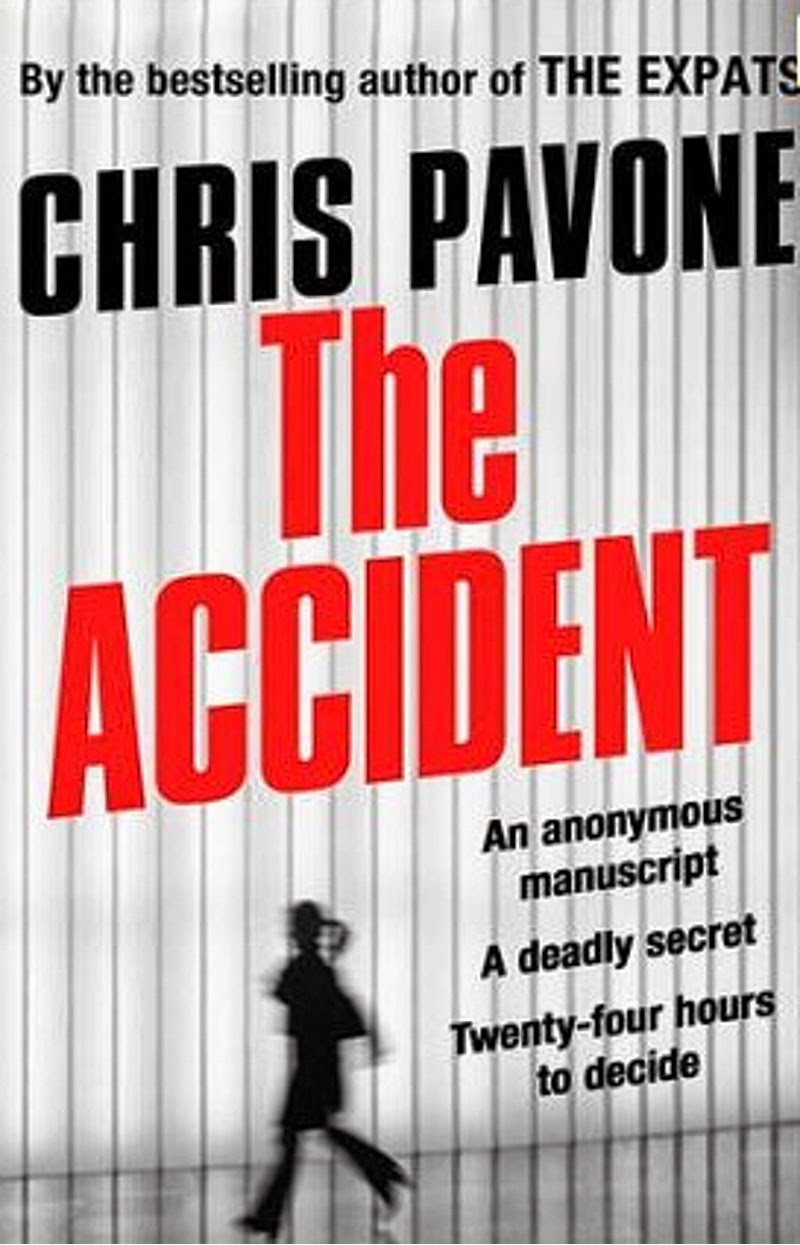
Interview: Chris Pavone, Author of THE ACCIDENT

It made perfect sense that Chris Pavone’s debut thriller, The Expats, became a critically acclaimed bestseller when it was published in 2011, and that it subsequently won a slew of awards. The American author had, after all, worked as an editor in the publishing industry for almost two decades. Thus he had a canny understanding of the commercial requirements of a genre novel, and an insider’s knowledge of the craft involved in writing a block-busting thriller.
  At least, that’s the theory. Until you realise that Chris Pavone is actually a veteran editor of cook books and gardening tomes.
  He began in the industry as a copy-editor, he says, initially working on fiction. “But when it came time for me to become an acquisitions editor, I turned to non-fiction and cook books and some gardening titles, some fishing books,” Chris tells me when we sit down in the Merrion Hotel. “A lot of what I thought of as ‘light’ subjects, which in many ways were a lot more straightforward-looking to me as a young, still idealistic person. There were things about the fiction side of the business that weren’t quite right to me. It seemed to me that a lot of it was driven by things that didn’t strike me as being important to the work itself, and that wasn’t really true of these other types of books I was publishing.”
  If there’s a hint of cynicism about the fiction publishing industry in those words, it’s a cynicism that is writ large in Pavone’s current novel, The Accident. The story opens with a commissioning editor receiving a manuscript of a book that will, if published, destroy a media mogul’s career and lay bare the dark heart of America’s secret service. A race against time begins as a plethora of characters scheme, plot and murder in order to prevent the publication of the manuscript.
  “The book, for me, is very much about ambition and compromise,” says Pavone. “It’s not that that’s how I see the whole world, but I wanted to write a book that thought that way. The vehicle for feeling out these people’s compromises and ambitions is this manuscript that’s at the heart of The Accident. Everybody looks at this thing in a different way. It is to some extent corrupting to some of them. ‘Is this the point at which I sell out? Is this where I become corrupted?’ Or, ‘Is my corruption still in the future?’”
  The Accident is a pulsating tale that blends thriller, mystery and spy novel tropes and confirms the promise of Pavone’s debut, even if it’s the kind of novel that Pavone, in his younger years, ignored as a reader.
  “One of the epiphanies I had was that I got into publishing because I love literature,” he says. “I loved books by people who were dead before I was born, for the most part, who had won Nobel Prizes. But then it became part of my job to read a John Grisham book every year. I had been very dismissive of popular fiction – in fact, I’d refused to read it. And then I started working on popular fiction, and I realised these books weren’t the same as Hemingway, say, but they were good in a different way. They were great in a different way. I became much more of a relativist about the qualities of a novel. Now I think John Grisham writes fantastic books. They’ve got nothing to do with what Donna Tartt writes, for example, but they’re both writers I enjoy.”
  With two decades of experience under his belt, Chris Pavone was a highly regarded editor in the industry. Why the leap from gamekeeper to poacher?
  “I loved editing, and being a cook book editor is a really a great job. It’s difficult to imagine a more indulgent grown-up job to do, that someone would send you out to restaurants to find great chefs to write a book. But being an editor is essentially about other people’s passions, and helping other people bring out the best of what they have to say to the world. Eventually I realised that I wanted to try to create something myself, and that’s what writing novels is. Not because I wanted to put myself in front of the world, but because I wanted to create something that would go out into the world.”
  As an industry insider, Chris Pavone is more aware than most that the publishing world is today struggling to come to terms with a number of seismic changes in the traditional model. He admits to being ‘a little pessimistic’ about publishing’s future, but remains on the whole optimistic that readers and booksellers will combine to survive and thrive.
  “Bookselling, I believe, is enjoying a resurgence, especially the kind of bookselling we used to think of as booksellers before the advent of chain stores – the Mom & Pop stores, the independent neighbourhood store,” he says. “A lot of the big chain stores are now gone, and independent bookstores are springing up to step into the role again. The book market has levelled out, or at least it’s not declining as fast as it was a number of years ago, and I think readers are understanding more and more what thousands of certain types of independent retailers can bring to the market. That price is not the main consideration. I mean, relatively speaking, books are very inexpensive. A book takes a long time to read, and you don’t pay all that much for it. And paying less for a book isn’t necessarily the goal of every reader.”
  That said, he does believe that the industry may have to configure its ideas about how it generates the profits that will allow it to commission new writers, particularly in the face of the digital revolution.
  “I’m paying a lot more these days for things that I’m told are free,” he says. “But all these ‘free’ things – say on-line – they’re not free. You’re just not paying for the content. But you are paying for internet service. You’re paying for phone service. You’re paying for the hardware. And you’re paying a lot more than you used to pay, you’re just paying different people. We’re now paying telecom companies instead of movie producers and TV networks and book publishers. It doesn’t cost any less, it’s just going in a different direction.”
  With two best-sellers already under his belt, and Hollywood already circling around an adaptation of The Expats, Chris Pavone is particularly pleased that some of the highest praise he has received has come from his fellow writers. As an editor turned author, was he ever worried about push-back from writers concerned that he was muscling in on their territory?
  “I had many, many worries about my first book,” he laughs, “but that wasn’t one of them. I mean, I was worried that the book wasn’t good enough, and nobody would like it, that people would make fun of my ambitions. Waking up in the middle of the night in a cold sweat thinking it was all a huge mistake, and that I was going to die destitute and alone.” He grins. “Y’know, pretty much what every writer worries about.”

  Chris Pavone’s The Accident is published by Faber & Faber.

  This interview was first published in the Irish Examiner.

Tuesday

Around The Web In 80 Seconds*

Confused? You might well be … Ken Bruen has just released the latest Jack Taylor novel, SANCTUARY, and yet ye olde google search for ‘Ken Bruen Sanctuary’ throws up the news, courtesy of Crime Spree Cinema, that ‘John Stockwell has signed on to direct Sanctuary, a film that is based on Irish novelist John Connelly’s book BAD MEN.’ Quoth MysterLynch:
“For those of you that are not familiar with Connolly’s work, he manages to show both the darkest aspects of man as well as the finest points of humanity in a style that is graphic yet often poetic. I can honestly say I think he is one of the finest fiction writers alive today and should be read by all.”
  No arguments here. Claire Coughlan, on the other hand, is in combative form – a stalwart reviewer for Crime Always Pays, she gets in touch to vent about Tana French’s THE LIKENESS thusly:
“Is it my imagination, or do American reviewers seem to give an awful lot of the plot away? Sheesh, leave something for the readers to find out themselves. Check out this review in the NY Times ... I have a problem with reviewers in general going into the minutiae of the plot – it kinda ruins elements of the story.”
  Certainly there’s a fine line between offering the reader enough plot to intrigue, and blatant plot-spoilers. My own issue with Janet Maslin’s review of THE LIKENESS is that it compares the novel – approvingly – with Donna Tartt’s THE SECRET HISTORY, which was The Most Boring Novel I’ve Ever Read, Ever. But that’s just me …
  Elsewhere, Charles Fernyhough reviewed Irvine Welsh’s CRIME for the Sunday Independent, and had this to say:
“Welsh’s readers will recognise his trademark melange of registers, from high-flown lyricism, through foul-mouthed demotic to bland therapy-speak: the taut dialogue buzzes with snappy ventriloquism. Welsh is one of our most interesting writers on the minutiae of human consciousness, and little happens here that the reader does not end up feeling vividly for himself.”
  Over at The Scotsman, CAP’s Man of the Week, Tony Black, waxes lyrical about why Edinburgh is the perfect city for a crime fiction setting, to wit:
“If you were putting together a template for what might be the best city for a crime novel, I think Edinburgh might fit the bill. It’s got that schizophrenic heart. There is rich Edinburgh and poor Edinburgh, there are ornate buildings and sink estates. Inevitably these two worlds must collide, which creates perfect conflict for the crime novelist. It’s the city of TRAINSPOTTING, but it’s also the city of MISS JEAN BRODIE.”
  Finally, the harsh-but-fair dominatrix known to her adoring public as Maxine Clarke reports from Harrogate, and sounds a little peeved at the excessive analysis of what constitutes crime fiction:
“The more I read and hear people trying to shoehorn “crime fiction” into various psychological and sociological analyses, the more irrelevant the genre-definition game seems to be. Good books are good books, and don’t need to be discussed in a certain context, which could end up turning into a straightjacket.”
  Well said, ma’am. To paraphrase Raymond Chandler, there’s only two kinds of writing – good writing and bad writing. The rest is marketing. Peace, out.

* Providing you don’t click any of the links, obviously.

Monday

Nobody Move, This Is A Review: In the Woods by Tana French

This is the kind of debut novel that would turn the average would-be scribe as green as the lush countryside it describes – Tana French writes like a sparkier, Irish Donna Tartt. And, with a nod to Tartt’s The Little Friend, which is also about an unsolved child murder, but set in America’s Deep South, French asks more than she answers and isn’t afraid of taking a risk with an ambiguous ending. In the Woods’ beginning is just as nuanced. The multi-layered plot starts in 1984 when three 12-year-olds go missing in a wood outside Dublin; only one is found alive – the other two vanish. Fast-forward 20 years and the same wood is the site of a massive archaeological dig – it’s about to be turned into a motorway, even though locals, archaeologists and concerned citizens alike are outraged that a natural enclave which has held spiritual, political and botanical significance since the Bronze Age is being paved over. In the last days of the archaeologists’ dig, a 12-year-old girl’s body turns up on a Druidic sacrificial altar and Detective Rob Ryan, the child who returned, now grown up, jumps on the case in order to lay his ghosts to rest, without revealing his personal connection to the first disappearances to his superiors. In the end though, Ryan’s single-mindedness in investigating both cases turns out to be no match for the primeval pull the wood has over him. This book has elicited extreme reactions for its ending, and I’m no exception to that – I loved its elliptical twists, unexpected turns and lack of facile explanations.– Claire Coughlan