UPDATE: Following on from the Bord Gais Book of the Year awards on November 28th, the voting is now open for the overall Irish Book of the Year. I’m not say that you should vote for John Connolly or Julie Parsons, necessarily, but I am reliably informed that, should the spirit move you to do so, your reward will be in heaven. To vote, clickety-click here …
Hearty congrats to Julie Parsons, who last night won the Irish Independent Crime Novel of the Year at the Irish Book Awards for THE THERAPY HOUSE; and commiserations to all the joint runners-up, i.e., Jane Casey, Haylen Beck, Cat Hogan, Karen Perry and Sinead Crowley.
Elsewhere, John Connolly scooped the Ryan Tubridy Listeners’ Choice Award for HE, his marvellous novel about the life and times of Stan Laurel.
For all the details of the winners in all categories, clickety-click here …
Showing posts with label Julie Parsons. Show all posts
Wednesday
Monday
Saturday
Event: ‘Killing for a Living: Irish Crime Writers’
Sam Blake (right) will host an Irish crime writing event at the London Irish Centre later this month, interviewing Julie Parsons and Sheila Bugler on ‘the Art of Murder.’ To wit:
KILLING FOR A LIVING: IRISH CRIME WRITERSFor all the details, including how to book tickets, clickety-click here …
DATE: JULY 23, 2017
DOORS: 15:30
VENUE: LONDON IRISH CENTRE
PRICE: £8
Friday
‘Not Everyone Murders People in Their Sleep’: Liz Nugent
Liz Nugent (right) had a piece in the Irish Times this week, titled ‘Not Everyone Murders People in Their Sleep’, during which she touched on ‘the rise of Irish female crime writers’:
As to why women writers have come to the fore in recent years – we can add Sinead Crowley, Louise Phillips, Annemarie Neary and Andrea Carter to the names above – it may have something to do with the way crime fiction has moved on from the classical fantasy of the lone hero(ine) – Holmes, Poirot, Marple, Marlowe – taking on and defeating bad guys, and instead adopting a more realistic approach to the age-old human fear of the social and personal threat that crime represents.
Whatever the reason, Liz Nugent is certainly in the vanguard, domestically and internationally, and her next novel, SKIN DEEP (Penguin Ireland), is already hotly anticipated. Quoth the blurb elves:
“I am often asked about the rise of Irish female crime writers in recent years. Maybe Tana French and Alex Barclay opened the doors for the rest of us, and as writer Jane Casey says, women are more attuned to threat. We are the ones looking over our shoulders, making sure that we have our keys in our hands, texting each other to make sure we got home safely.”I’d add Arlene Hunt and the doyenne of Irish crime fiction, Julie Parsons, to that list of trailblazers, and further suggest that Maeve Binchy probably had a lot to do with normalising the idea that being an Irish writer didn’t necessarily involve wanting to emulate the Joyces and Becketts of the canon.
As to why women writers have come to the fore in recent years – we can add Sinead Crowley, Louise Phillips, Annemarie Neary and Andrea Carter to the names above – it may have something to do with the way crime fiction has moved on from the classical fantasy of the lone hero(ine) – Holmes, Poirot, Marple, Marlowe – taking on and defeating bad guys, and instead adopting a more realistic approach to the age-old human fear of the social and personal threat that crime represents.
Whatever the reason, Liz Nugent is certainly in the vanguard, domestically and internationally, and her next novel, SKIN DEEP (Penguin Ireland), is already hotly anticipated. Quoth the blurb elves:
'Once I had cleared the bottles away and washed the blood off the floor, I needed to get out of the flat.'SKIN DEEP will be published in March 2018.
Delphine Hamilton is a fake. She has been living on the Côte d'Azur for ten years, posing as an English heiress. However, her alimony is running out, her looks are fading, and her wealthy lovers are fewer and further between.
Down to her last euros, and desperate to get out of her apartment, Delphine decides to spend the day at the Negresco where she is caught stealing another guest's meal. He takes pity on her and invites her to a party.
The guests are young and beautiful and Delphine feels her age, and is achingly conscious of her worn out dress. But after a few lines of cocaine and multiple cocktails, she is oblivious to everything.
Hours later, as dawn is breaking, she wakes up on the floor of a deserted hotel penthouse. She makes her way home through the back streets.
Even before she opens the door she can hear the flies buzzing and she realizes that the corpse in her bedroom has already begun to decompose ...
Wednesday
Event: TROUBLE IS OUR BUSINESS at the Belfast Book Festival
I’m hugely looking forward to getting up to Belfast for the Book Festival on June 10th, where I’ll be hosting a conversation between three of the finest Irish crime writers out there, and who – no coincidence – contributed to TROUBLE IS OUR BUSINESS (New Island Books). To wit:
BBF17: TROUBLE IS OUR BUSINESS - NEW STORIES BY IRISH CRIME WRITERSTo book tickets, clickety-click here ...
Saturday 10 June at 2pm
£6 | £4
at the Crescent Arts Centre
Irish crime writers have long been established on the international stage as bestsellers and award winners. Now, for the first time ever, the best in contemporary Irish crime novelists have been brought together in one volume. Author, editor and journalist Declan Burke will be leading the conversation on Irish crime writing with Louise Phillips, Julie Parsons and Stuart Neville.
Declan Burke is a writer, editor, journalist and critic. He has published six crime novels. He edited Trouble Is Our Business: New Stories by Irish Crime Writers in 2016.
Louise Phillips is an author of four bestselling psychological crime thrillers, each shortlisted for Best Irish Crime Novel of the Year. Her second novel, The Doll’s House, won the award. She is currently working on her latest novel, Dark Day In May.
Julie Parsons was born in New Zealand but has lived most of her adult life in Ireland. She was a radio and television producer with RTÉ for many years until the publication of her first novel, Mary, Mary in 1998. Her subsequent novels, including The Hourglass (2005) and I Saw You (2008) were all published internationally and translated into many languages.
Stuart Neville’s crime fiction has won numerous awards, including the LA Times Book Prize. Stuart also writes under the pen name Haylen Beck, whose debut novel, Here and Gone is due to be published this summer and is in development for the screen.
Friday
Through An Hourglass, Darkly
Of that small but perfectly formed generation of Irish crime writers who began publishing in the mid- to late-1990s – which included Colin Bateman, Ken Bruen, John Connolly and Eoin McNamee – one has slipped out of sight in recent times. Here’s hoping the reissue of Julie Parsons’ THE HOURGLASS (Macmillan) goes some way towards redirecting the spotlight in her direction. To wit:
Beyond high iron gates fastened shut with a length of chain, lies the stark, beautiful Trawbawn. Here, haunted by a dark, mysterious past and largely ignored by the people of nearby Skibbereen, lives the frail Lydia Beauchamp. But old Ma Beauchamp’s private existence is interrupted when a stranger arrives - a young man called Adam who wanders into the vast grounds of Trawbawn and becomes one of Lydia's most welcome contacts with the outside world. When Lydia sets her new confidante a challenge, he eagerly accepts - Adam must travel to Dublin to find her estranged daughter. But it is a task tainted by an air of menace. For what terrible past has driven a daughter from her mother? And what true motive lies behind Adam's generous act? Soon the unlikely friends are entwined in a deadly game, and a pursuit born of an old lady’s desire for peace mutates into a terrible, relentless need for revenge . . .THE HOURGLASS will be reissued on February 13th. For more on Julie Parsons, clickety-click here …
Tuesday
“Ya Wanna Do It Here Or Down The Station, Punk?”: Ava McCarthy
Yep, it’s rubber-hose time, folks: a rapid-fire Q&A for those shifty-looking usual suspects ...What crime novel would you most like to have written?
THE POET, by Michael Connelly. I enjoy Connelly’s Harry Bosch series, but for me THE POET has an extra pull. There was a page-turning quality about it that had me riveted, and the twists and surprises were hard to second guess.
What fictional character would you most like to have been?
Kinsey Millhone, from Sue Grafton’s alphabet mystery series (A IS FOR ALIBI, B IS FOR BURGLAR, etc.). She’s a feisty, prickly, no-nonsense kind of gal, with an admirable capacity to be true to herself at all times. Plus, she has some really snappy one-liners …
Who do you read for guilty pleasures?
I associate guilt with many things, but never with reading! If I’m reading a book, it’s because I’m enjoying it and I can’t imagine why I’d feel sheepish about that. Perhaps one of the stories I enjoy re-reading which might be a bit unexpected is J.K. Rowling's Harry Potter series. Great magical world, great characters and full of human wisdom & insight.
Most satisfying writing moment?
Writing THE END. For me, it takes such a long time to get there and the sense of achievement is huge.
The best Irish crime novel is …?
I actually haven’t read that many Irish crime novels – I’m still working my way through a long list of them! I’d favour the women writers, (Alex Barclay, Julie Parsons, Tana French) but perhaps only because they’re the main ones I’ve read. The best is hard to pick – Alex Barclay’s DARKHOUSE was a high impact debut, and the back-story for her Texan serial killer left a lasting impression.
What Irish crime novel would make a great movie?
For some reason, I think Irish true-crime books would all make brilliant movies. THE GENERAL, based on Paul Williams’ book, was great, and I’d love to see a film version of Niamh O’Connor’s THE BLACK WIDOW.
Worst / best thing about being a writer?
The best thing is you don’t have to rely on anyone else to get the job done. Which means the worst thing is, when it all goes wrong you only have yourself to blame.
The pitch for your next book is …?
THE COURIER: When Harry Martinez, ex-hacker turned security professional, gets entangled in a world of illicit diamond trading, she’s drawn into a world of executions, greed and betrayal. From the racecourses of Ireland to the diamond mines of South Africa, Harry must use her own unique skills to prove her innocence, and most of all, to survive.
Who are you reading right now?
I’m about to start John Grisham’s THE ASSOCIATE. It hasn’t had great reviews, but I’m a big fan of his early legal thrillers and I really miss them, so I’m hoping he’s moving back to what I believe he does best.
God appears and says you can only write OR read. Which would it be?
Read. It was my first love, and the effect that books had on me was the reason I wanted to write in the first place. I’d give myself over to the world of story and escape. Besides, writing is hard….
The three best words to describe your own writing are …?
Did my best.
Ava McCarthy’s THE INSIDER is published by HarperCollins
Monday
Monday’s Lynx
In which Jinx the Lynx (right) presents some stuff ‘n’ such that tickled his tufty little ears during last week’s prowl around the interweb, to wit: Maxine at Petrona has an ‘In Praise of Crime Fiction’ thingy going on …
… and are we still defending crime fiction? Really?
Every writer should have read this by now …
Tony Black on RILKE ON BLACK …
Julie Parsons on the allure of rubber boots …
… and finally, a belated report on the Crime Writers Series from Books 2008 …
Labels:
Books 2008,
Julie Parsons,
Maxine Clarke,
Petrona,
Rilke on Black,
Tony Black
Tuesday
“Ya Wanna Do It Here Or Down The Station, Punk?”: Julie Parsons
Yep, it’s rubber-hose time, folks: a rapid-fire Q&A for those shifty-looking usual suspects ...What crime novel would you most like to have written?
There are actually three – A FATAL INVERSION by Ruth Rendell / Barbara Vine – amazing plot and wonderful atmosphere; THE SHINING by Stephen King, not so much a plot more a way of death; and THE BUTCHER BOY by Patrick McCabe, which doesn’t usually figure in crime fiction lists, but does it for me in horror, sadness and a meditation on loss and pain.
What fictional character would you most like to have been?
When I was a kid I was crazy about the books by the American writer, Mary O’Hara. So I would have loved to have been Ken McLaughlin, who grew up on a horse ranch in the Rocky Mountains, in Wyoming.
Who do you read for guilty pleasures?
I don’t believe in guilty pleasures. For pleasure I read anything by Martin Amis, Nadine Gordimer, Philip Roth and J.M Coetzee.
Most satisfying writing moment?
Writing the synopsis for my first book, MARY, MARY, and knowing, even before I sent it to Treasa Coady of TownHouse, that I had a winner.
The best Irish crime novel is …?
You know, I don’t read crime novels since I started writing them … terrified I’d be so put off by their brilliance and never write another word. Best Irish novel? THE BUTCHER BOY [by Patrick McCabe] for the above reasons.
What Irish crime novel would make a great movie?
For the above reason, I can’t really say, but three of my books – MARY, MARY, THE COURTSHIP GIFT and EAGER TO PLEASE – have all been optioned for film and TV and I think they’d all be great - with the right writer, director, cast of course.
Worst / best thing about being a writer?
The best is being on your own in complete control of your own world, and the worst is pretty much the same.
The pitch for your next book is …?
The next book is a high-concept, international DAY OF THE JACKAL-type thriller – the inhabitants of an island off the southwest coast of Ireland discover when the last ferry of the day has left, that they are NOT on their own.
Who are you reading right now?
I’m reading HUMAN SMOKE by Nicholson Baker, which tells in extracts from newspapers, letters and biographies of the build-up in the late 1930s and early 1940s to the Final Solution. Stunning and terrifying.
God appears and says you can only write OR read. Which would it be?
I don’t believe in God, but if I did the God I would believe in would never make such a demand. Because that God would know that to be a writer, you have to be a reader …
The three best words to describe your own writing are …?
Powerful, vivid, unforgettable.
Julie Parsons’ I SAW YOU has just been published in paperback by Pan Books
Sunday
Not Quite As Smart As The Average Bear
I mentioned during the week that I’d be chairing a discussion in the Spoken Word tent at the Electric Picnic. Easy money, right? Not only would I get to share a stage with writers of the quality of Julie Parsons (right), Declan Hughes and Brian McGilloway, we’d be spraffing about Irish crime fiction. How could it possibly go wrong? Well, it’s like this …The fatal boo-boo Julie, Declan and Brian made was allowing the Yogi Bear-style Grand Viz drive from Dublin down to the picinick at Stradbally. Generally a reliable sort behind the wheel, the Grand Viz somehow managed to miss the motorway turn-off for the Electric Picnic and get us all lost somewhere in Kildare. With time ticking away, many and desperate were the calls made to the gig organiser, the unflappable Cormac Kinsella. Happily, the radio-waves were thick with the phrases, ‘Not a problem’, ‘It’ll be grand’, and ‘No bother’.
Anyhoos, we finally stumbled on-stage about 15 minutes late, only to discover there were three mikes for the four of us. Undeterred, we ploughed on, and the trio kicked off with superb readings – Julie from I SAW YOU, Declan from THE DYING BREED, and Brian from BORDERLANDS (he’d planned to read from his latest novel, GALLOWS LANE, but with typical generosity had given his copy away earlier in the day).
Then the discussion began, just at the point when a guy decided to have a baby on the stage next door. Amazingly, and despite the unique attraction in the vicinity, the Spoken Word tent filled up, and the audience were – given our tardy arrival and the horrific screams wafting in from next door to drown out practically every word said – surprisingly generous, loud and warm in their applause.
It’s a glamorous lark and no mistake, this writing life.
Every cloud has its silver lining, though, and after the gig a glamorous blonde stepped forward from the audience to say that she’d found the discussion fascinating, and that she’d really enjoyed it. What was nice about that, apart from the glamorous blonde bit, was that she just so happens to be the lady I’ve been dealing with at the Arts Council, which august body may or may not be funding a project currently under consideration.
Said project is – clumsy working title alert! – ‘a history of Irish crime fiction’, to be written by Irish crime writers such as John Connolly, Declan Hughes, Ruth Dudley Edwards, Colin Bateman, et al, each writing a chapter according to their own speciality, with yours truly, Adrian McKinty and Gerard Brennan sharing the editing duties.
Next weekend it’s the Books 2008 Irish crime writing series, but right now it’s Sunday morning and the Princess Lilyput’s big day (right). Thanks to everyone who left comments on the Bell’s palsy post yesterday, by the way … If the events of yesterday didn’t explode it into a full-blown stroke, nothing will. Peace, out.
Monday
Four Readings And A Christening
Before we get to Sunday, however, there’s Saturday’s Electric Picnic gig to be negotiated, during which yours truly will be chairing a panel on Irish crime fiction in the company of Declan Hughes, Julie Parsons and Brian McGilloway. I’ll be doing a follow-up post in the aftermath, so if there’s any questions you ever wanted to ask of any of the trio, now would be a good time to let me know.
The weekend after that is the crime writing series as part of the Books 2008 festival, where I’ll be participating on two panels in the company of John Connolly, Dec Hughes, Tana French, Gene Kerrigan, Ruth Dudley Edwards, Brian McGilloway, Arlene Hunt, and sundry other ne’er-do-wells from the Irish crime writing scene.
It should be a blast, not least because blogger non pareil Peter Rozovsky is travelling to Ireland to take a gander at the Irish crime writer in its native habitat, and may even consent to partake in a ceremonial dry sherry to mark the occasion. Once the dust settles on that particular Donnybrook, there’s a two-week run-in to the official publication of THE BIG O in North America, during which I’ll be typing my delicate little fingers down to stumps in a bid to secure as much coverage for our humble tome as is humanly possible. Any and all offers of even a single atom of publicity oxygen will be very gratefully received. Your reward will be in Heaven. Peace, out.
Friday
The Embiggened O: Bringing It All Back Home
Anyhoos, it’s here, and suddenly the whole deal seems that bit more real. Actually, it feels a bit surreal. As if the world has taken a step closer to yours truly, or I to it. Everything seems to be in sharper focus. I suppose it’s the adrenaline buzz, but I feel like a kid on Christmas Eve.
Harcourt – or Houghton Mifflin Harcourt, to give it its full name – have done a wonderful job on the book. I was very happy indeed with the Hag’s Head version, but I’m equally happy this one too. Kudos there to jacket designer Kelly Eismann …
North America is a big, big place, of course, and I’m under no illusions as to how hard THE BIG O will have to work if it’s to make even the slightest impact on its release. But that’s the easiest kind of hard work I’ll ever do. I’ve worked in bars and on building sites, pumped petrol in all weathers, and worked every half-assed job you can think of. Knuckling down to promote your second-favourite baby is child’s play by comparison, and just as enjoyable.
Speaking of which … If anyone out there is getting along to next weekend’s Electric Picnic in Stradbally, Co. Laois, I’ll be chairing a discussion on Irish crime fiction with a panel that includes Declan Hughes, Julie Parsons and Brian McGilloway. That happens at 4.30pm in the Spoken Word tent, and if it’s hammering down rain, as it is very likely to be in this wettest of Irish summers, you’ll be warm and cosy listening to us droning on. Hell, you can even bring your iPods so long as you don’t turn ’em up too loud …
Monday
The Monday Review
It’s Monday, they’re reviews, to wit: “As ever with [John] Connolly, the macabre narrative is couched in prose that is often allusive and poetic a combination far more destabilising for the reader, wrong-footing us before that moment when all the stops are pulled out … THE REAPERS affords unusually bracing doses of Stygian delights,” says Barry Forshaw at The Independent. It’s a big-up verdict at Material Witness too: “Overall the story is well told and pacey and the sense of trouble rises uneasily throughout. Connolly steps up the series characterisation process several notches here, and future instalments will be all the better for it. For three quarters of the book, I wondered if this was not perhaps the best of the series. But the grisly, explosive ending seemed a little too contrived and over-dramatic … Nonetheless, a fine piece of work from Connolly, a tier-one mystery writer somewhere near the height of his powers.” Rumour Man likes it too: “It’s a touching, absorbing and brilliantly plotted book. I think it may even be one of his finest - if not the finest - even though it’s not a Parker novel like the bulk of his work! I can’t wait to wade through all the other books I have to read, so I can go back and read this again.” Lindsay Jones at the Barking and Dagenham Recorder pulls out all the stops: “John Connolly’s genial hitmen Louis and Angel are similar in lots of ways to Pulp Fiction’s Vincent and Jules, except that they’re gay … Connolly’s characters are well-drawn, his writing is lyrical and funny. This is an absorbing page-turner, whether you’re one of the millions who devour his every novel, or you’re a Connolly first-timer, as I was.” And Geoff Hamlin at Tampa Bay Online doesn’t buck the trend: “The plot could easily be summed up as ‘Male bonding story. No women. Lots of bodies.’ But Connolly, as befits his Irish heritage, is a fine storyteller and manages to weave his tale in dark and compelling language.” On to Ken Bruen, and Margaret Cannon at the Toronto Globe and Mail reviewed CROSS: “It’s a good thing this novel is short enough for me to read in one long day. I couldn’t put it down. I love Ken Bruen’s Irish books with detective Jack Taylor, but this one, set in Galway, is simply the best yet … As always, Bruen doesn’t use a single extraneous word. His style is as clear and crisp as his mood is dark and clouded. The end of this one comes with a snap that left me wanting more, lots more.” Over at Reviewing the Evidence, Denise Pickles likes Julie Parsons’ I SAW YOU: “When I arrived at the denouement, I was surprised to find myself holding my breath and it’s a long time since I had to admit to anything like that when reading a book. Parsons deserves full marks for the way she sustains the suspense … it displays quite a lot of polish in its construction as well as its characterisation. On the whole, it’s a good, if somewhat claustrophobic, read.” Seana Graham at the Santa Cruz Sentinel had a gander at David Park’s THE TRUTH COMMISSIONER: “What Park makes so beautifully clear is that what really catches up with them is only life, ordinary life … While, in reality, there is no ‘Commission for Truth and Reconciliation’ in Northern Ireland, this novel has created a kind of imaginative space for one to exist. If illuminating some aspect of the bad old days helps heal Northern Ireland, Park has done his bit and then some.” A swift pair for Siobhan Dowd’s THE LONDON EYE MYSTERY: “Strong, memorable characters combine with a suspenseful mystery that readers will have difficulty putting down,” says Kendal Rautzhan at The Day, while Icokolat at The Latest Sccoop likes it too: “This riveting read offers not only a deliciously tricky puzzle to solve, but great characters, too.”
And now a brace of hup-yas for Tana French’s IN THE WOODS: “Tana French, winner of the 2008 Edgar award for Best First Novel, has a descriptive and intense style that makes her writing very compelling and readable. Her portrayal of the Dublin police and towns makes you feel as if you are there in the flesh,” says Mary Menzel at Book Hunters Blog. Over at A Coupla Things, Carl agrees: “I recommend IN THE WOODS, an Edgar nominee by Tana French. Excellent writing, outstanding plotting – a whoop of a psychological thriller.” Nice … And now for something spooky ‘n’ supernatural: “The characters are complex and interesting, the supernatural aspects completely unique and the references to our own world and times are thought-provoking … The supernatural components slowly float to the top of the story which jumps from a noir-ish crime novel to something entirely different in a couple of chapters. Shan is an excellent author with a flair for language and detail,” says the Cairns Post (via DB Shan’s interweb malarkey) of PROCESSION OF THE DEAD. As for Shan’s literary nemesis, Derek Landy: “Full of hilarious banter, scythe fights, and close encounters with all manner of evildoers, this book will keep readers turning those pages. It’s a true confection of a Young Adult novel. Enjoy!” proclaims Cynthia Bartek at Books and More of SKULDUGGERY PLEASANT. She won’t be falling out with Amy over at Amy’s Book Nook: “This series is a fun paranormal action-adventure, full of twists and turns. Any fans of Harry Potter or for that matter, Harry Dresden, should give this book a try. It may be written for ages 10 and up, but it doesn’t talk down to the reader, leaving it a fun series truly for all ages.” Marcel Berlins, in the Sunday Times, likes BLEEDING HEART SQUARE: “Andrew Taylor has long been in the top rank of British crime writers, never disappointing, particularly strong on depth of characterisation and moody atmosphere. In BLEEDING HEART SQUARE he excels himself.” Finally, a brace for Adrian McKinty’s THE BLOOMSDAY DEAD: “The author has contrived to provide a balance and a contrast with the permeating violence by means of the almost lyrical opening lines of many of the chapters …
THE BLOOMSDAY DEAD will keep you on the edge of your seat, will entertain, will disconcert and will ultimately leave you looking for more of the same,” reckons The Irish Emigrant, voting TBD Book of the Month, while chancing wastrel Declan Burke was breathlessly earnest over in the Sunday Business Post: “McKinty is a rare writer, one who can combine the often limiting staccato rhythms of crime fiction with a lyrical flair for language … The violence is etched into the page, but McKinty never forgets that his first priority is to entertain, and he leavens the bleakness with flashes of mordant humour.” Ah yes, but is humour, mordant or otherwise, really a leavening agent? YOU decide!
The Monday Review
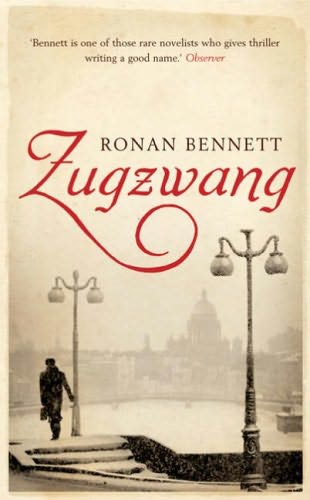
It’s Monday, they’re reviews, to wit: “The writing of Irish crime novelist Declan Hughes captures much of Raymond Chandler’s mean streets’ poetry. Harder edged than the lyricism of James Lee Burke. With the possible exception of compatriot John Connolly, no one sets a mood better than Hughes … THE PRICE OF BLOOD [aka THE DYING BREED] continues Ed Loy’s progress into the first rank of contemporary mystery protagonists,” says Dana King at New Mystery Reader. Over at the LA Times, Sarah Weinman agrees: “[He] owes a literary debt less to Hammett and Chandler than to Ross Macdonald’s Lew Archer books, family melodrama disguised as P.I. fiction … If anything, THE PRICE OF BLOOD – Hughes’ third go-round with private eye Ed Loy – tips its narrative hat to Sophocles and other purveyors of Greek tragedy.” Lovely. Over at Soapstone’s Studio, Soapstone likes Ronan Bennett’s ZUGZWANG: “The villains and allies seem complex in their intersecting schemes, but in a way, they begin to seem like clones of each other, crossing and double-crossing everyone like the round robin tournament that is the backdrop. But at least they are competent, respectable villains … I wholeheartedly recommend ZUGZWANG, especially for (adult) chess players.” They’re still coming in for Twenty Major’s debut: “The humour in THE ORDER OF THE PHOENIX PARK is gleefully silly in the manner of cult comedy The Jerk … Throughout, the Major has irreverent jabs at numerous targets (including Hot Press, the bloody upstart) and keeps the story moving at a brisk pace. Overall, a highly entertaining read,” says Paul Nolan at Hot Press (no link). Max Warman at the Sunday Telegraph is bigging up Eoin Colfer’s latest, AIRMAN: “The “megaselling author” tells a Boys’ Own adventure that Biggles would be proud of … The only drawback is that in rushing to find out what happens next, it can be a struggle to read every word on every page.” Nice …
“[David] Park’s soulful story about buried secrets, tangled lies and manipulated memories may be a little abstract for readers who didn’t follow the Troubles, but this powerful fiction both humanizes and universalizes the civil war that gripped Ireland for so long,” says Publishers Weekly (via Powell’s Books) of THE TRUTH COMMISSIONER. They’re in broad agreement at the Irish Voice: “Park’s beautifully written new book vividly reminds us that the war on the streets may have ended, but it endures in hearts and minds, and we’d be foolish to ignore the fact.” But hold! What news of Benny Blanco’s THE SILVER SWAN? “Although Black is a beautiful writer, with characters as vividly drawn as any in fiction, as a crime novelist he falls a bit flat. Coincidence plays too big a role in the plot … Ultimately, such plot failings may not matter. Black has created a wonderful protagonist in Quirke,” says Clea Simon at the Boston Globe. “A bit dark, a bit gruesome, but really good literary mystery,” says Bluestocking LA. “I don’t ordinarily read mystery novels, but THE SILVER SWAN is no ordinary mystery. Banville’s command of prose is arresting, and though this is a difficult book to put down because it is so expertly plotted, it is also impossible not to savour,” reckons Tessa at Powells’ Staff Picks. Meanwhile, Susan Illis at New Mystery Reader likes CHRISTINE FALLS: “Quirke is not only a deeply flawed but an untrustworthy protagonist. It’s hard to believe that the same island that brought us chick lit also produces these endlessly dyspeptic mystery and suspense novels that are absorbing on such a different level.” Upward and onward to Catherine O’Flynn’s WHAT WAS LOST: “This book is splendid in so many ways. A page-turning, compelling story, as well as witty, touching, and altogether wonderful … My only complaint is that the ending felt a little rushed, and the solution to the mystery a little contrived; the build-up was better than the resolution.
But when the build-up is this good, that is a small complaint,” says Leena at Vulpes Libris. Yet more hup-yas for Sir Kenneth of Bruen: “It takes only a couple of hours to read AMMUNITION, and for fans of James Ellroy or Elmore Leonard, they are hours agreeably spent. In fact, Bruen continues to revere Ed McBain, and even opens the novel with a sort of homage to the master, who died between the composition of CALIBRE and that of AMMUNITION. For the hard-boiled cop novel, the beat goes on,” says Lection. Over at Revish, Mack Lundy likes CROSS: “The writing in CROSS is lean and finely honed. His observations on the Irish and the Church are trenchant and often wryly amusing as always … If you do have a tolerance for despair and seeing a man about a step away from the abyss and like a finely crafted story, then you can’t get better than these.” Here at Crime Always Pays, Colman Keane cast an approving eye over Gene Kerrigan’s LITTLE CRIMINALS: “The story unfolds at pace and the author’s skilful storytelling had me hooked. I’ve rarely read a book that has me turning the pages to reach the conclusion swiftly, whilst at the same time regretting the approach of the last page.” Over at Tonight, Peter Sullivan is just about in favour of Julie Parson’s I SAW YOU: “Michael McLoughlin is an endearing detective, one with many faults, but a certain doggedness. The book’s action is not fast, but keeps the reader’s interest.” Finally, and sans links, a trio of big-ups for Sam Millar’s latest, BLOODSTORM:
“Millar is rapidly building a reputation for pacy thrillers in the crime noir genre … this is a violent tale of murder and revenge told in brutal prose that makes no concessions to the faint-hearted,” says the Irish Independent. “Millar’s ability to tap into the dark recesses of the human mind is brilliantly constructed, page after nerve-shattering page. BLOODSTORM is a triumph from a master storyteller,” reckons the Irish News. And the Irish Mail on Sunday is no less impressed: “Millar whips up a storm in this brilliant, fast-paced thriller. Gritty and gripping, BLOODSTORM is a real page-turner … The promise of more to come from this chilling and dark series should keep Millar’s growing army of fans content – at least for the time being.” What time is it, people? Yep, it’s Millar time …
Friday
Funky Friday’s Freaky-Deak
Yup, it’s the weekly interlude where we do our damnedest to raise irrelevant frippery to an art-form, to wit: Euro Crime’s critics included Brian McGilloway, John Connolly, Ken Bruen, Tana French, Gene Kerrigan and Benjamin Black in their Picks of 2007 … Declan Hughes has a rather spiffy new cover for THE COLOUR OF BLOOD (right) … Pan Macmillan are offering free copies of Julie Parson’s latest I SAW YOU over at their interweb yokeybus … Martin Edwards has a good pontificate on the nature of Benjamin Black-alias-John Banville over at Do You Write Under Your Own Name … The next John Connolly novel after THE REAPERS will be a Parker story (working title: THE LOVERS) which is due in 2009, according to Sons of Spade … Kevin Lavelle won the Over The Hedge ‘New Writer Of The Year Award’ for his short story ‘Bury Me In The Garden’, and the story is available at the Galway Arts Centre interweb thingy … There’s a nice audio sample of Adrian McKinty’s THE BLOOMSDAY DEAD up on Audiobooks Instantly … The much-missed Siobhan Dowd and Derek Landy both turned up on the Publishers’ Weekly Best 15 Kids’ Books for 2007, for A SWIFT PURE CRY and SKULDUGGERY PLEASANT respectively … And finally, we’ve used the vid before on occasion, but we think it’s hilarious and it’s our blog, so there. Cue Bernard Black’s rejection of a publisher’s rejection letter … Monday
The Monday Review
It’s Monday, they’re reviews, to wit: “With, at times, echoes of the legend of Icarus and strongly redolent of a Victorian boys’ adventure story, AIRMAN really is a ripping yarn, with some excellent writing, notably in its concluding chapters,” says Robert Dunbar in the Irish Times (no link) about Eoin Colfer’s latest standalone. Over at The Arts Fuse, Harvey Blume likes Ronan Bennett’s latest: “ZUGZWANG is rich in historical detail … an historical thriller that makes good use of the fact that chess games are thrillers, too.” The inevitable John Connolly hup-ya runneth thusly: “THE UNQUIET takes a step back from the myth-building of THE BLACK ANGEL, and tells a smaller story, the closest thing to a straightforward investigation that the series has presented … The supernatural overtones are not forgotten, and are represented by the terrifying Hollow Men lurking on the edges of Parker’s vision, controlled by a shadowy figure he has met before,” says Richard Wright … Derek Landy’s SKULDUGGERY PLEASANT has been nominated for a Cybil, aka the 2007 Science Fiction & Fantasy Finalists: “This smart novel is full of humour, action, and a real sense of danger – and has a sly wit that would appeal to a wide age range,” reckons Sarah via the Cybils Blog … A couple of big-ups for Benny Blanco, starting with CHRISTINE FALLS: “I really enjoyed this and look forward to more.
Definitely not a formulaic mystery; very well written,” says Beth at Paradise is a Library. Meanwhile, John Spain at the Irish Independent likes THE SILVER SWAN: “Black’s imagery perfectly evokes the stale and smoky Dublin of the time. Brilliant writing makes the leisurely pace a pleasure.” Staying with John Spain in the Indo, and his verdict on Julie Parson’s I SAW YOU: “As connections surface it all gets very murky and chilling in a story of love, revenge and atonement.” Sarah Harker at the Crewe Guardian likes Tana French’s IN THE WOODS, to wit: “Touching and poignant, thrilling and fast paced, this debut novel by Tana French is a unique read that will leave you up all night and hungry for more. Beautifully written, with a twist that you won’t see coming, IN THE WOODS is a stunning debut.” Over at Crime Reports, Adam Colclough can barely contain himself over Ingrid Black’s latest: “THE JUDAS HEART is a truly superior thriller with an original setting and a plot that keeps the reader guessing until the last moment … By far the best feature of this and Black’s other novels is the laconic but always touchingly human voice of Saxon herself, making her one of the most consistently realised serial characters in modern crime fiction and offering a potentially
Oscar-winning role for some lucky Hollywood star in the almost inevitable film adaptation of this or one of Black’s other novels … Ingrid Black stands out as being the real deal.” Crikey! Finally, the Florida flag-flyer for Irish crime fiction, Michael Haskins, has Mr & Mrs Kirkus (no link) poring over his debut CHASIN’ THE WIND: “If the plot sounds outlandish, blame it on all the booze Mad Mick and his pals imbibe as they rescue a tortured lady, shoot it out with those Cubans and … sail off to Castro’s paradise to settle the score, although not to the complete satisfaction of the feds.” The question being, of course, whether anything is ever settled to the complete satisfaction of the feds …
Friday
“I Say, I Say, Essay – Have You Heard The One About Irish Crime Fiction Writing?”
Crimes and Misdemeanours
How the Celtic Tiger kick-started the burgeoning genre of Irish crime-writing, by Bert Wright
Murder, kidnapping, extortion, robbery, conspiracy, fraud, racketeering – sounds like Tony Soprano’s rap-sheet but it’s not.
It’s the strapline from a promotional poster in a bookstore window display – 3 for 2 on selected True Crime and Crime Fiction titles, Take your pick! Little bit tabloid, perhaps, but what does it tell us? First, it tells us that in commercial terms, crime pays; and second, it assumes a crossover between the fiction and non-fiction sides of those death-dealing mean streets. This is interesting for in the past, I suspect, many people who read Agatha Christie or Patricia Highsmith found the real life stuff a little too déclassé to be caught dead reading on a bus or a beach. No longer! Sales of both genres are buoyant, according to industry insiders.
Should we be surprised? No, check out the bestsellers and what you’ll find are thriller writers dominating the fiction charts and here in Ireland, certainly, true crime titles featured prominently in the non-fiction charts. Of the world’s bestselling brand authors, a huge percentage would be crime writers. If you’re reading this on an airplane or in an airport terminal look around and see if someone within a twenty-feet radius isn’t reading John Grisham, Patricia Cornwell, or Michael Connelly. See what I mean? As one writer recently suggested, “today, suspense, not sex, is the engine that drives popular fiction.”
At a time when most of what we wear, watch, and listen to derives from American popular culture it would be foolish to expect reading habits to be different but here in the land of saints, scholars and skinny lattes there is one essential difference. Not only do we have our own distinctive crime genre now, we also have the mise-en-scène to contextualise it. As Ken Bruen (right), one of our most highly-rated crime writers wrote: “I didn’t want to write about Ireland until we got mean streets. We sure got ’em now.”
Some would say there’s no more crime than before, just more sensational crime reporting. This is not what most people think. Most of us instinctually believe that crime is not just more widespread but more vicious. With George Orwell we’d share the view – expressed in “The Decline of the English Murder” - that murder ain’t what it used to be, by which he meant that “the old domestic poisoning dramas, product of a stable society” had given way to the casual violence born of “the dance-halls and the false values of the American film.” (Orwell could be impossibly quaint when the humour was on him.)
And arguably something similar has happened here. Thirty to forty years ago, crime in Ireland might involve an ageing farmer murdered over an inheritance dispute, sweet nothings in the ballroom of romance turning to violence in a country lane. Now we have teenage drug barons plugged in cold blood on quiet suburban streets, headless torsos fished out of canals, contract killings as an extension of the services sector, and most notoriously, a fearless crime reporter executed in her car at a busy intersection.
Sociological extrapolations are risky, of course, but would it be a stretch to suggest that the combustible mixture of windfall economics, easy money and the ancient impulse to acquire lots of it, by whatever means, has fuelled the crime explosion?
Surely not, and the explosion of Irish crime writing has followed as naturally as a gumshoe trailing a hot lead. Suddenly Irish crime writing is hip and edgy and everyone wants a piece of the action.
Most readers could name-check established writers such as John Connolly, Paul Carson, or Julie Parsons, but scan the innumerable Irish crime websites and you’ll find listed seventy to a hundred active crime writers! Admittedly, they cheat by stretching the genus – Edna O’Brien, William Trevor, Hugo Hamilton, crime writers? – but nevertheless, it’s clear that many writers have raised a finger and tacked into the prevailing wind that’s currently powering the crime boom.
Among the most interesting recruits are John Banville (writing as Benjamin Black) and Declan Hughes. Hughes, a successful playwright and screenwriter, recently parlayed his fascination with American crime heavyweights such as Chandler, Macdonald and Hammett into a new career as a crime writer. “I’d always wanted to write crime, and then one day I was sent a series of crime novels a production company wanted me to adapt, and I thought: I can do better myself.” A three-book contract with London publisher John Murray soon followed and after a warm critical reception, Hughes’ Ed Loy series, set in his native South Dublin, looks set to propel its creator onto the international stage.
But it’s the spectacle of John Banville,
Booker Prize winner and perhaps the most self-consciously literary of Irish writers, parking his tank-sized reputation right in front of the precinct house that has generated screeds of newsprint as critics attempt to make sense of the writer’s curve-ball career move. (Conveniently, it’s forgotten that Banville has form, his 1989 novel THE BOOK OF EVIDENCE, having brilliantly dramatised the celebrated Malcolm Macarthur murder case.)
The resentment and conspicuous lack of fraternity, however, has been amusing to witness. In a faux-Wildean flourish, one crime website declared “Blandville’s” novel “as boring as a dog’s ass.”* In fact, CHRISTINE FALLS, his first novel under the Benjamin Black pseudonym, is a masterly exercise in period noir, evoking the sounds, smells and manners of 1950s’ Dublin with the acuity and panache which is conspicuously missing from too much genre fiction.
But there is a darker side to all of this that raises questions about the way we view the New Ireland. Anatomising the frequently grim reality of Irish criminality has been the task of a coterie of journalists and writers for the past decade or more.
The most successful of the true crime writers, Paul Williams of The Sunday World, more or less invented the genre with THE GENERAL (O’Brien Press, 1995.) Since then, through the efforts of Williams and other writers – Paul Reynolds, Michael Sheridan, Gene Kerrigan and Niamh O’Connor – Ireland has become a country intimately acquainted with the misdeeds of its most heinous criminals, from John Gilligan to The Scissor Sisters. (The craic in the book-biz, incidentally, is that these are the most-robbed books in history with weaselly gurriers frequently spotted browsing the crime section to see whether they’ve been name-checked in the latest bestseller.)
But free-sampling aside, who actually buys crime books, propelling them time after time into the upper reaches of the charts? (To date THE GENERAL has sold a massive 130,000 copies.) A vast cross-sectional demographic is the answer, but why? Wherein, one wonders, lies the enduring appeal of crime writing? Well, of course, the fascination with dark deeds is older than Sophocles and Shakespeare but a contemporary slant suggests that we read these books to sublimate our very real fear of ever being involved in such terrifying situations ourselves.
Or, simply put, we tell each other horror stories to ward off the bogeyman. Declan Hughes (right) puts it even more simply. “What’s not to like?” he asks. “I love the very stuff of crime fiction: the smoking gun, the hard drinking, the femme fatale, the merciless gangster, the chase through the night-time streets.”
Equally interesting (and more disturbing to contemplate) is the possibility that we freely accept burgeoning crime as the price of economic success. There’s an ambivalence at work; nobody wants to experience violent crime first-hand but having your own mean streets, now that’s pretty cool. Add to the mix white-collar and lifestyle crime, financial corruption and recreational cocaine use, and you begin to see how Ireland has, in a perverse sense, come of age. We got the lattes, the land cruisers, and the lap dancers, so why wouldn’t we read about the really nasty side of the affluence deal?
“It’s part of the tradition too,” declares Declan Hughes. “The hardboiled novel always depended on boomtowns where money was to be made and corners to be cut: twenties San Francisco for Hammett, forties LA for Chandler.” And now, early twenty-first century Dublin for a whole host of Irish crime writers, he might have added.- Bert Wright
This article was first published in Connections Magazine
* Yup, that was us. And we’d like to take this opportunity to unreservedly apologise to dogs’ asses everywhere. Wea woofy culpa, or words to that effect.
How the Celtic Tiger kick-started the burgeoning genre of Irish crime-writing, by Bert Wright
Murder, kidnapping, extortion, robbery, conspiracy, fraud, racketeering – sounds like Tony Soprano’s rap-sheet but it’s not.
It’s the strapline from a promotional poster in a bookstore window display – 3 for 2 on selected True Crime and Crime Fiction titles, Take your pick! Little bit tabloid, perhaps, but what does it tell us? First, it tells us that in commercial terms, crime pays; and second, it assumes a crossover between the fiction and non-fiction sides of those death-dealing mean streets. This is interesting for in the past, I suspect, many people who read Agatha Christie or Patricia Highsmith found the real life stuff a little too déclassé to be caught dead reading on a bus or a beach. No longer! Sales of both genres are buoyant, according to industry insiders.Should we be surprised? No, check out the bestsellers and what you’ll find are thriller writers dominating the fiction charts and here in Ireland, certainly, true crime titles featured prominently in the non-fiction charts. Of the world’s bestselling brand authors, a huge percentage would be crime writers. If you’re reading this on an airplane or in an airport terminal look around and see if someone within a twenty-feet radius isn’t reading John Grisham, Patricia Cornwell, or Michael Connelly. See what I mean? As one writer recently suggested, “today, suspense, not sex, is the engine that drives popular fiction.”
At a time when most of what we wear, watch, and listen to derives from American popular culture it would be foolish to expect reading habits to be different but here in the land of saints, scholars and skinny lattes there is one essential difference. Not only do we have our own distinctive crime genre now, we also have the mise-en-scène to contextualise it. As Ken Bruen (right), one of our most highly-rated crime writers wrote: “I didn’t want to write about Ireland until we got mean streets. We sure got ’em now.” Some would say there’s no more crime than before, just more sensational crime reporting. This is not what most people think. Most of us instinctually believe that crime is not just more widespread but more vicious. With George Orwell we’d share the view – expressed in “The Decline of the English Murder” - that murder ain’t what it used to be, by which he meant that “the old domestic poisoning dramas, product of a stable society” had given way to the casual violence born of “the dance-halls and the false values of the American film.” (Orwell could be impossibly quaint when the humour was on him.)
And arguably something similar has happened here. Thirty to forty years ago, crime in Ireland might involve an ageing farmer murdered over an inheritance dispute, sweet nothings in the ballroom of romance turning to violence in a country lane. Now we have teenage drug barons plugged in cold blood on quiet suburban streets, headless torsos fished out of canals, contract killings as an extension of the services sector, and most notoriously, a fearless crime reporter executed in her car at a busy intersection.
Sociological extrapolations are risky, of course, but would it be a stretch to suggest that the combustible mixture of windfall economics, easy money and the ancient impulse to acquire lots of it, by whatever means, has fuelled the crime explosion?
Surely not, and the explosion of Irish crime writing has followed as naturally as a gumshoe trailing a hot lead. Suddenly Irish crime writing is hip and edgy and everyone wants a piece of the action.Most readers could name-check established writers such as John Connolly, Paul Carson, or Julie Parsons, but scan the innumerable Irish crime websites and you’ll find listed seventy to a hundred active crime writers! Admittedly, they cheat by stretching the genus – Edna O’Brien, William Trevor, Hugo Hamilton, crime writers? – but nevertheless, it’s clear that many writers have raised a finger and tacked into the prevailing wind that’s currently powering the crime boom.
Among the most interesting recruits are John Banville (writing as Benjamin Black) and Declan Hughes. Hughes, a successful playwright and screenwriter, recently parlayed his fascination with American crime heavyweights such as Chandler, Macdonald and Hammett into a new career as a crime writer. “I’d always wanted to write crime, and then one day I was sent a series of crime novels a production company wanted me to adapt, and I thought: I can do better myself.” A three-book contract with London publisher John Murray soon followed and after a warm critical reception, Hughes’ Ed Loy series, set in his native South Dublin, looks set to propel its creator onto the international stage.
But it’s the spectacle of John Banville,
Booker Prize winner and perhaps the most self-consciously literary of Irish writers, parking his tank-sized reputation right in front of the precinct house that has generated screeds of newsprint as critics attempt to make sense of the writer’s curve-ball career move. (Conveniently, it’s forgotten that Banville has form, his 1989 novel THE BOOK OF EVIDENCE, having brilliantly dramatised the celebrated Malcolm Macarthur murder case.) The resentment and conspicuous lack of fraternity, however, has been amusing to witness. In a faux-Wildean flourish, one crime website declared “Blandville’s” novel “as boring as a dog’s ass.”* In fact, CHRISTINE FALLS, his first novel under the Benjamin Black pseudonym, is a masterly exercise in period noir, evoking the sounds, smells and manners of 1950s’ Dublin with the acuity and panache which is conspicuously missing from too much genre fiction.
But there is a darker side to all of this that raises questions about the way we view the New Ireland. Anatomising the frequently grim reality of Irish criminality has been the task of a coterie of journalists and writers for the past decade or more.
The most successful of the true crime writers, Paul Williams of The Sunday World, more or less invented the genre with THE GENERAL (O’Brien Press, 1995.) Since then, through the efforts of Williams and other writers – Paul Reynolds, Michael Sheridan, Gene Kerrigan and Niamh O’Connor – Ireland has become a country intimately acquainted with the misdeeds of its most heinous criminals, from John Gilligan to The Scissor Sisters. (The craic in the book-biz, incidentally, is that these are the most-robbed books in history with weaselly gurriers frequently spotted browsing the crime section to see whether they’ve been name-checked in the latest bestseller.) But free-sampling aside, who actually buys crime books, propelling them time after time into the upper reaches of the charts? (To date THE GENERAL has sold a massive 130,000 copies.) A vast cross-sectional demographic is the answer, but why? Wherein, one wonders, lies the enduring appeal of crime writing? Well, of course, the fascination with dark deeds is older than Sophocles and Shakespeare but a contemporary slant suggests that we read these books to sublimate our very real fear of ever being involved in such terrifying situations ourselves.
Or, simply put, we tell each other horror stories to ward off the bogeyman. Declan Hughes (right) puts it even more simply. “What’s not to like?” he asks. “I love the very stuff of crime fiction: the smoking gun, the hard drinking, the femme fatale, the merciless gangster, the chase through the night-time streets.”Equally interesting (and more disturbing to contemplate) is the possibility that we freely accept burgeoning crime as the price of economic success. There’s an ambivalence at work; nobody wants to experience violent crime first-hand but having your own mean streets, now that’s pretty cool. Add to the mix white-collar and lifestyle crime, financial corruption and recreational cocaine use, and you begin to see how Ireland has, in a perverse sense, come of age. We got the lattes, the land cruisers, and the lap dancers, so why wouldn’t we read about the really nasty side of the affluence deal?
“It’s part of the tradition too,” declares Declan Hughes. “The hardboiled novel always depended on boomtowns where money was to be made and corners to be cut: twenties San Francisco for Hammett, forties LA for Chandler.” And now, early twenty-first century Dublin for a whole host of Irish crime writers, he might have added.- Bert Wright
This article was first published in Connections Magazine
* Yup, that was us. And we’d like to take this opportunity to unreservedly apologise to dogs’ asses everywhere. Wea woofy culpa, or words to that effect.
Monday
The Monday Review
It’s Monday, they’re reviews, to wit: “Not quite another coming of age novel – more a densely plotted, fast-paced and action packed adventure story with characters so real you feel as though you could reach out and touch them. I enjoyed [ARTEMIS FOWL AND] THE LOST COLONY immensely. It gave me a few hours of enjoyment that I recall from my youthful days, when I had more time to sit and read for the sheer pleasure of it. Colfer speaks to the teenager in all of us and manages to help us come to terms with the discomfort we once felt at that difficult time in our own lives. The strangeness and newness of it. Absolute brilliance!” raves Pseudo at The Truth About Books. Over at Everyday Reads, Lightheaded is largely in agreement: “Wherever Colfer gets his ideas I sure hope as hell it doesn’t run dry. He continually surprises with plots that seem to come out of nowhere, grab and shake you to the core while still making you believe that hopefully, things will turn out right in the end.” Staying with the Eoin vibe, Sarah Weinman picks Eoin McNamee’s 12:23 as one of her reads of the year at The Millions: “If Graham Greene had lived to write about the death of [Princess] Di, this would have been the result.” As for Eoin’s alter-ego, John Creed, Mark Timlin at the Independent on Sunday likes BLACK CAT, BLACK DOG: “An intriguing mystery full of violence and double crosses … Creed writes like a master, and this is as good an espionage novel as I’ve read for years.” Lovely. Peter Guttridge at The Observer includes Cuddly Dudley Edwards’ MURDERING AMERICANS in his yearly round-up, to wit: “Edwards delights in bashing political correctness in US academia but there’s a skilfully plotted mystery behind all the jokes.” Another yearly round-up, this time in the Village Voice, finds Elizabeth Hand lauding John Connolly’s latest: “Anyone still yearning for a fix of something cold and dark should turn to Irish novelist John Connolly’s taut, disturbing THE UNQUIET, the latest in his series about Maine P.I. Charlie Parker … THE UNQUIET deals with supernatural tropes in a realistic milieu, though Connolly sides with the dark angels when it comes to this exceptional novel’s denouement.” Speaking of supernatural tropes: “I’d like to recommend an absolutely fantabulous book to you peoples – SKULDUGGERY PLEASANT by Derek Landy. Finished it last night and it was freakin’ greatness, it was! I mean, skeletons, detectives, wizards and good ol’ wisecracks are fab on their own, but mush them all together and you’ve got yourself some AWESOME!” reckons Lydia at Crazy Crazy Monkey …
And now a brace for SLIDE, starting with Craig at Craig’s Book Club: “SLIDE is extremely dark fun all the way. [Ken] Bruen and [Jason] Starr put their characters (who are hardly likeable, even on their best days) through wringer after wringer (a Bruen specialty) just for their and our amusement. And it is quite a ride.” Over at International Noir, Glenn Harper sounds a tongue-in-cheek warning note: “The pulp end of the crime fiction spectrum is so stylized, in the pure form of the genre, that an author constantly risks tipping his story over into parody … Parody can be a lot of fun, but there’s a risk that comes along with it: can the reader ever again take pulp-noir fiction seriously after experiencing its comic travesty in a book like SLIDE?” New York Entertainment is isniffily mpressed by Gene Kerrigan’s THE MIDNIGHT CHOIR: “With crime novels, you can usually be satisfied if a couple of things go right, but here the author does everything well. He conveys beautifully the rituals of cops and their quarry, while evoking the feel of a city where new yuppie affluence rubs up against the remnants of a seedy, savage past.” And while we’re on the subject of seedy and savage: “Declan Hughes has written an amazing mystery … The characters are convincing, the dialogue is crisp, the setting is wonderful, and the villains are brutal, and chilling. Irish Noir at its best! Highly recommended!” parps our old friend Bob the Wordless about THE WRONG KIND OF BLOOD. “The story is slow to start – much of the first half is taken up with flashbacks to the earlier story and the past of the current one. But once it finally takes off, it gallops like a hunt through the hills, and readers will whip through the final pages, unable to sleep for dread,” reckons Lucille Redmond at Heatseeker Reviews of Julie Parsons’ latest, I SAW YOU … “Satisfyingly plotted and resolved … Sinister priests and baby-smuggling rings might tempt lesser men to melodrama, but Black swathes the action in near-Beckettian gloom,”
says Alexis Soloski at Village Voice (via the Charleston City Paper, for some reason) about Benny Blanco’s CHRISTINE FALLS. Finally, they just won’t quit for Tana French’s IN THE WOODS: “Beautifully written, this intelligent thriller is laden with an atmosphere that blends shades of the gothic novel with the modern mystery. French keeps the suspense taut while never stooping to violence or cheap theatrics. This is subtle storytelling that steadily accelerates with each paragraph, as the author makes us deeply care about the characters as the story closes in on a surprising finale … IN THE WOODS is an exquisite debut,” purrs Oline H. Cogdill at the Florida Sun-Sentinel. It is most definitely that, ma’am …
The Monday Review. But Lawks! ’Tis A Tuesday!
It’s Monday, they’re reviews, to wit: “[Ken] Bruen’s brilliant, machine-gun quick dialogue and furious pacing makes him one of my all-time favourites and a perennial pick for the Notable list,” reckons Seth Marko of AMMUNITION at The Book Catapult’s End-of-Year Notable list. Over at Spinetingler Magazine, Sandra Ruttan agrees: “Far too many authors mistake volume for detail, and waste a lot of words never saying what Bruen can nail in a single sentence. He’s taken the lesson of writing short stories – that every single word must count – applied it to writing novels, and the result is stories that pull you into them and refuse to let you go until you’ve finished the last page. Somehow, Bruen also manages to pull off the difficult task of having an ensemble cast that never feels too large, weaves several storylines together in a way that seems effortless, and makes his lead a character who is completely unlikeable, and yet somehow endearing.” Brant endearing? Criminy … Onward to The Saturday Review, and Dan’s take on Andrew Pepper’s THE LAST DAYS OF NEWGATE: “Pyke is the very definition of anti-hero. Normally I am not attracted to amoral protagonists, preferring my heroes to be a little cleaner cut, but for some reason I really took to Pyke, and will certainly attempt to follow him on any subsequent adventures.” Which is nice … “The original characters (mainly Skulduggery and Stephanie but also the secondary characters) and the witty dialogue between them strengthen the basic good-triumphs-over-evil plot,” says Laura Baas at the Library and Literary Miscellany of Derek Landy’s SKULDUGGERY PLEASANT … They’re starting to trickle in for Julie Parson’s latest, I SAW YOU: “Madness, revenge and atonement all intermingle, as the pace of the novel increases towards a violent and bloody climax. Julie Parsons has written a page-turner that will keep the reader fascinated right to the very end,” says Vincent Banville at the Irish Times. Staying with Fab Vinnie, this time on Ruth Dudley Edwards’ latest: “MURDERING AMERICANS, as well as being a mystery thriller, casts a bleary satiric eye on the institutionalised correctness of American academia. Lovely stuff.”
And now for something completely ZUGZWANG: “Bennett deftly evokes the atmosphere of a society in which an international chess tournament can seize the attention of the local populace while terrorist bombs are exploding around the city … ZUGZWANG moves quickly – there is not a moment when history gets in the way of the plot [take that, Marx!] – and yet the underlying message comes through quite clearly: The real madness in St. Petersburg is not in Dr. Spethmann’s office,” says Michael Wade at Execupundit. Over at Wynne’s World of Books, Wynne – for lo! It is he! – agrees: “The plot is convoluted with lots of twists and turns involving revolutionary and counter-revolutionary plots – all great fun but infused with political and ethical dilemmas … A really great read – highly recommended.” The Sunday Tribune carried a yearly round-up of best books which included Gerard Donovan’s JULIUS WINSOME: “A dark, vivid, and gently powerful novel about revenge and loneliness … delivered in precise prose as cold, sharp, and evocative as the shot described ringing out in the cold Maine October afternoon at the beginning of the book. O’Donovan’s narrator … is much more complicated than the normal run of the mill vengeful protagonist … and this is a book about the nature of revenge which is satisfyingly complex.” The Trib also liked Tana French’s IN THE WOODS, to wit: “The prose manages to be smart and satisfying without falling into the easy trap of being overly literary, making this the perfect antidote to the more pedestrian efforts which clog up the market. A very satisfying debut with a rich feel for character.” Sean Moncrieff’s THE HISTORY OF THINGS also went down a treat with the Trib: “A novel which is fully rounded and imbued with a sense of imminent doom … The various miseries inflicted upon Dalton are described with the kind of subtle detail that makes your skin crawl, and Moncrieff has a pitch-perfect feel for describing the aftermath of a broken marriage, and the slow steady disintegration of a mind under stress.” As for Declan Hughes’ THE COLOUR OF BLOOD, don’t get them Trib-types started. Ooops, too late: “This is a book that could so easily have become an unconvincing pastiche, maybe two parts Chinatown to one part Jim Rockford; but Hughes’s writing has the intelligence and integrity to allow him to create something which stands assuredly on its own two feet. If you like your detective fiction written with smarts, and a meaty, mature, and satisfying edge to it, then this book is for you.”
Finally, Benny Blanco’s THE SILVER SWAN is still hauling in the big-ups, starting with Tom Adair in The Scotsman: “You sense that Banville / Black found it easy and wrote it quickly, wrote it with relish – one of the reasons you enjoy it, despite a nagging feeling of hunger for something meatier on the inside. Its descriptive power is delicious … all in all it’s a romp of a read, a compelling fix.” Over at The Telegraph, Tom Fleming is largely in agreement: “The writing and characterisation are enough to sustain the attention when the plot occasionally stalls. This is a literary thriller that merits the name.” And that, we’re almost entirely certain, is a very good thing …
Subscribe to:
Posts (Atom)


