Wednesday

It’s Good to Talk: Why Dialogue is Fundamental

The reasons why humans developed complex speech are still contested, but as a writer it doesn’t really matter if it’s due to a uniquely shaped hyoid bone, a descended larynx or the FOXP2 gene. What matters is that the brain of ‘the speaking animal’ is hard-wired to respond to speech.
 Humans have been talking to one another for anywhere between 70,000 and 200,000 years, which really isn’t that long, evolutionarily speaking. But it’s still a lot longer than the 5,000 years or so that we’ve been writing things down.
 It took another couple thousand years before the Iliad, originally an oral epic told by wandering bards, was written down circa 750 BCE. And then – sticking with the Western canon – it was another few hundred years before Greek tragedy and comedy tiptoed onto the stage.
 About 1,500 years after that, Murasaki Shikibu wrote The Tale of Genji, with which she effectively invented the novel form; although in The True Story of the Novel, Margaret Anne Doody argues that the ‘ancient novel’ first appeared a thousand years earlier, in Greece and Rome, courtesy of – among others – Xenophon, Chariton and Petronius.
 Either way, the novel has been around for a long time, but nowhere as long as we’ve been talking to one another. And there’s a very good chance that this is why, as Elmore Leonard says, no one ever skips dialogue. It also goes a long way towards explaining the visceral immediacy of the theatrical experience, and why cinema is the most lucrative art form in history.
 It also suggests that as writers, as novelists, we should be trying to tell our stories through dialogue as much as is practicably possible. That’s not to say we’re shoe-horning in casual chats for the sake of breaking up the prose; it means that we’re progressing the story and developing our characters in their own words.
 Why is direct speech more valuable than reported speech? Because, just as we’re hard-wired to respond to speech, we’re also predisposed to believe people when they speak. To quote Tony Davies, from his book Humanism:
“If, as was often said, man is the speaking animal, then we exist most fully not in the intimate interiority of private thought and feeling but in the communality of linguistic exchange. ‘Language most shows a man,’ wrote Ben Jonson, in a vivid phrase borrowed from the Spanish humanist Juan Luis Vives: ‘Speak, that I may see thee.’ […] The human being is fashioned and defined in language, and belongs inseparably, in its public and private aspects alike, to the medium of discourse.”

Sunday

The Big Why

The essentials of a good story are who, what, where, when and why. The who is your character(s), the what is the plot, the where / when your setting, and the why is by some distance the most important aspect. This is because the why is not only your character’s guiding motive (wanting to escape a marriage / planet, say, or commit / investigate a murder) and their psychology (the unique thinking that has brought them to this crucial juncture), but the reason you’re telling the story.
 As a species in general, but especially as readers, we are obsessed with why. That’s probably because, as a species, we’ve successfully answered the questions of who we are, and what we are, our where and when. The why, however, will likely remain unanswerable.
 But even if the implicit promise of some ultimate revelation is the most important element of storytelling, a good story is the Buddhist principle of pratītyasamutpāda in action. Pratītyasamutpāda is the principle of dependent arising, or dependent co-arising, where all phenomena – physical, mental, psychological – arise in dependence on multiple causes and conditions. Nothing, the principle tells us, exists on its own or forever; everything is related and interlinked with everything else.
 Most stories foreground character; good writers understand that character and plot are essentially a Möbius strip; the setting goes a long way to defining a character, either because she belongs there or because she finds herself in opposition to the world around her (or both); and the why – the character’s motivation, and that of the author – will shape the character, the plot and the setting.
 That sounds like a lot to juggle all at once. The good news is that you don’t need to know the why starting out. As often as not, the whole point of your writing the story is to discover the why.

Friday

The Blank Page and the Dizziness of Freedom

‘Anxiety,’ Kierkegaard said, ‘is the dizziness of freedom.’ Normally I’d disagree; for me, anxiety is more of a response to the claustrophobia that comes with a dearth of options. But if you’re starting a new book, as I am, then Kierkegaard’s concept of anxiety makes sense.
 The dazzle of the blank page can certainly be disorientating. There are too many options and no wrong answers; the whole world is available for inspiration; and just as there is no wrong way to tell your story, there are myriad ways in which you might start. Who are your characters? How do they speak? Who is telling their story, and why? Why is it being told now, in this way?
 Too many options can cause writer’s block just as surely as too few. Visualise it and it makes sense: a host of ideas, all struggling to emerge at once, can very easily create a mental bottleneck.
 And the danger there is that, in our rush to say something – anything, just to feel like we’re not wasting this precious time we’ve eked out for writing – we can fall back on the tried and tested. Echoing another writer’s style or phrasing, repeating clichés, allowing ourselves to slip back into those well-worn grooves that are the deadly enemy of good writing.
 At times like these, it’s worth remembering that we have been told all our lives how to behave. That we are conditioned to seek out the rules so as not to break them, to ask for permission to proceed. We are socialised, and perhaps even hard-wired, to act according to the accepted conventions, to fit in, to adapt to the prevailing wisdoms.
 The problem there, of course, is that this all runs contrary to the writing of interesting fiction.
 I’m not saying that good fiction requires the breaking of every rule, or a wilful disregard for every single literary convention. What I’m saying is that the blank page is both a challenge and an opportunity, and that every interesting writer implicitly understands what Laurel Thatcher Ulrich made explicit: that well-behaved women seldom make history.

Wednesday

Setting: If You Build It, They Will Come

A story can take place across a span of galaxies or it can take place at the bottom of a well. Every story, unless it’s an especially experimental tale, has to take place in some kind of physical environment – we need to give the characters somewhere to stand (or, if it’s taking place in space, or underwater, float).
 In some cases, the setting may be crucial to the story; this is why, for example, world-building is considered an integral part of the sci-fi author’s skill-set. In other cases, the setting may not be as important to a story as its characters and plot, but we still need to afford it the attention to detail that will persuade the reader that they have stepped into what John Gardner calls the ‘vivid, continuous dream’.
 If you’re a writer like me, you simply won’t be able to start a story without having a very clear idea of where it takes place. In fact, it’s frequently happened that I had no idea for a story, nor any plan for writing one, until a setting presented itself. In a way, it’s the equivalent of a bare stage when the curtains are pulled back, and we know that the actors will soon appear. Once I feel the dart of recognition – that this place, this very particular place, would be a wonderful setting for a story – then I know it’s only a matter of time before the characters will start strolling into place. If you build it, they will come …
 Oddly enough, the initial setting, the one that provides the inspiration, isn’t necessarily where the story takes place. I first got the idea for The Lammisters while we were on holidays in Donegal, visiting an old stately home where the Anglo-Irish owner would host Hollywood stars from the 1920s. It seemed to me the ideal spot for a PG Wodehouse kind of novel; but for the purpose of the story, I needed, as it began, for Young Archie, the foolish third son, to travel to Los Angeles to encounter some Hollywood stars. And so the story opens on the terrace of Musso’s in Los Angeles; but Young Archie and I both enjoyed our brief sojourn in Los Angeles so much that we never made it back to Donegal, and the whole novel played out in Hollywood.
 But that initial setting gave the story a kind of palimpsest quality. Its physical environment and its history, its economics and its culture, set the tone for who Young Archie was, and what he needed to escape, and what he wanted to achieve. It was as if that setting underpinned the story’s immediate setting of Hollywood in the Silent Era, invisible but informing Archie’s motives and aspirations.
 Setting isn’t just about giving your characters a place to stand. Setting is what your characters emerge from, where they’ve evolved, the place they learned to speak and think, where their loves and hates and prejudices were formed. If you’re prepared to look and listen – to observe, as Joyce Carol Oates says, with reverence – then your setting will tell you more about your characters than you realise you know.

Friday

The Tyranny of Perfection

Reading Peter Godfrey-Smith’s Other Minds recently, I was reminded of an Intro I wrote for Knock and Enter, a book I edited during my stint as Writer-in-Residence with UNESCO / Dublin City Libraries. To wit:
I’ve always thought that an octopus would make for an ideal Editor, with its eight arms and a complex nervous system that consists of one main brain and eight mini-brains that operate each arm independently.
 Of course, most writers would likely also wish that their editors were octopuses, given that octopodes possess three hearts, one of which might be given over to compassion for those who toil at the coalface creating the imperishable prose which the editor, having nothing better to do, then proceeds to blithely deface with his or her ‘suggestions’ and ‘advice’.
 Happily, whilst all octopuses are venomous, only the blue-ringed octopus is actually deadly to humans. And while the business of writing can feel like a tiresome chore – planning and writing and editing, and rewriting, and re-editing, and then rewriting some more – it very rarely proves fatal.

 Writing advice is hedged about with clichés (‘Write what you know’; ‘Read, read, read,’ etc.) but some clichés have their kernel of truth, and none more so than ‘Writing is re-writing’ – and if you’re a writer who doesn’t like the idea of reworking your stuff, then you’re in for a long, hard uphill slog.
 There are very good reasons, of course, why new writers might resist the idea of re-writing. Whether it’s schoolwork or sport, or life itself, we’re socialised from a very young age to get it right first time (‘Do you want it quick or do you want it good? Both, you say? I see.’) and to view mistakes as some kind of personal failing. And we’re all time-poor these days; if we can only get it right at the first attempt, think of all the time we can save.
 Except getting ‘it’ right – when ‘it’ is the creation of a whole new world peopled with complex characters – is virtually impossible. Even if you’ve plotted your story out before you begin, even if you know exactly who your characters are and will become, there’s simply too much to get exactly right at exactly the right time.
 This might sound like something of a downer; in fact, it’s one of the great opportunities that writing offers. In life, we have no choice but to stumble ever onwards, tripping over our mistakes and fixing them on the hoof (or ignoring them and hoping no one notices); in writing (or re-writing, rather) we get to go back in and fix it until we’re happy (happy-ish).
 Accepting that you’re not going to get it right first time might come as something of a blow to the old ego, but it does allow for an enormous amount of freedom. The freedom to get it not quite right; to make and acknowledge mistakes; to allow yourself, for the purpose of this draft at least, to be less than perfect (‘Perfect is the enemy of good’).
 We can waste a lot of our energy in worrying about getting it immediately right, turning what should be a positive (creativity, imagination) into a negative (the grinding, Sisyphean pursuit of perfection). But perfection can wait. Instead, take a deep breath, open yourself up to the inevitability of temporary failure, and allow yourself the delicious freedom (dare we call it fun?) of getting it wrong for now.

Wednesday

Mailer, Democracy and Huckleberry Finn

Norman Mailer’s The Spooky Art (2003) is a rattlebag of memoir, criticism and testosterone-fuelled opinion (sensitive readers might wish to skip his piece on Last Tango in Paris), one of the highlights of which is the essay ‘Huckleberry Finn – Alive at 100’, which concludes like this:
What else is greatness but the indestructible wealth it leaves in the mind’s recollection after hope has soured and our passions are spent? It is always the hope of democracy that our wealth will be there to spend again, and the ongoing treasure of Huckleberry Finn is that it frees us to think of democracy and its sublime, terrifying premise: Let the passions and cupidities and dreams and kinks and ideals and greed and hopes and foul corruptions of all men and women have their day and the world will still be better off, for there is more good than bad in the sum of us and our workings. Mark Twain, whole embodiment of that democratic human, understood the premise in every turn of his pen, and how he tested it, how he twisted and tantalized and tested it until we are weak all over again with our love for the idea. – Norman Mailer, The Spooky Art

Sunday

On Cliché and the Reader-Writer Contract

A sure sign that a writer has yet to develop confidence in his or her use of language, and perhaps the most obvious, is the use of cliché. But which is worse: the unintended cliché, or the one deliberately used?
 A cliché used unintentionally, simply because the phrase has become so polished by popular use that it slips unnoticed through the beginning writer’s neural network, is just about forgivable – let’s call it a venial sin. A minor offence, and one more to be pitied than censured (is ‘more pitied that censured’ a cliché?); moreover, it’s a fault that can be easily remedied, providing the writer is willing to bear down and pay close attention, and be worthy of the words they choose.
 A cliché used deliberately, on the other hand, can only be regarded as the blackest of mortal sins. For the writer who chooses to employ hackneyed phrases, and with malice aforethought to boot, there can be no forgiveness nor redemption; for such writers there is only Dante’s inferno, suspended somewhere in the outer dark between levels seven (violence against neighbours and/or God) and eight (fraud and deception).
 The beginning writer, of course, might feel that this is all rather strong stuff, and that the occasional lapse into platitude might even be expected – there must be a reason, after all (possibly because they contain their kernel of truth), why clichés became clichés in the first place.
 The issue for the experienced reader, however, is overly familiar phrases are bum notes; and should they go clanging and banging about in our inner ear, we will immediately know that the writer-reader contract is being violated. Implicit in the writer-reader relationship is the idea that, should a reader choose to read a particular book, she will be offered a new way of seeing the world, or at the very least get a distinctive perspective on whatever subject the writer has chosen to offer. Clichés are the laziest kind of plagiarism, and a very strong hint that the writer is more interested in sounding like a writer than being an actual writer, which is to say delivering original insights derived from the writer’s unique take on the world.

Thursday

Writing Advice: Highsmith, Plotting and (Re)Living Your Dreams

One of the main issues that tends to come up when I’m teaching creative writing is that of plot – as in, many new and aspiring writers generally believe that they don’t know how to plot and/or tell a story. And it’s no use telling them that they’ve been listening to stories since before they knew they were listening to stories, or that they have been absorbing plots ever since they first started watching TV, or that our species thrived, evolutionarily speaking, because our minds are hardwired to think in narrative terms. Most new writers are conditioned to believe that the secret to great writing is plotting, and they’re depending on me to reveal the great secret.
 There is no great secret, of course, but because people appreciate concrete detail and examples, I’m very happy to break down the basic plot mechanics and talk about seven-point plot arcs (other plot arcs are available) – I tend to use Patricia Highsmith’s The Talented Mr Ripley as a case study, because (a) it’s a brilliant book and (b) it allows for a neat contrast between the novel and Anthony Minghella’s film due to one crucial scene change (no spoilers, etc.) in Minghella’s adaptation.
 And then, at the end of that class, I’ll give them a task: remember a dream and write down as much of it as you can, trying to capture its weirdness and bright colours and its random twists and turns (if you dream in seven-point plot arcs, so much the better).
 Some of them follow through on this homework, some of them don’t (some people, like me, rarely remember their dreams). And some of the results can be fantastic. But none of the results are anywhere near as fantastic as the wild idea that humans are so hardwired to tell stories that we do it even when we’re asleep; that even when we’re unconscious, we’re still telling ourselves stories.
 Do we know how and why it happens? I’ll wager that most of us don’t, and – unless the dreams become traumatising nightmares – we don’t much care. And in this context it really doesn’t matter. All that matters is that we understand we already know everything we know about the storytelling basics at the unconscious level; that we appreciate and accept that, in our most fundamental sense of self, we are storytelling beings.

Tuesday

Writing as Conversation: Exactly Who Are You Talking To?

As a teenager with (very) vague ambitions to be a writer, I surprised and gratified to be taken seriously by my Uncle Jim (that’s him on the right, in a self-portrait). I didn’t get to see Jim very often, because he lived on other side of the country, but he was the family’s resident intellectual – a designer with Waterford Glass, an amateur painter, and as well-read as he was well-travelled. I vividly recall a rainy spring afternoon when I was 14 or thereabouts: Jim had come to visit for a few days, and we spent the afternoon sitting in front of the fire having a long, rambling conversation about books, writing and all that jazz. The following day he went off for a walk and came back with a second-hand copy of Ulysses (he hadn’t been able to find a new copy anywhere in town), into which he’d slipped an encouraging note written on brown wrapping paper.
 I still have that note, and that copy of Ulysses. Over the years it became something of a totem for me, a touchstone, a tangible article of faith, even it would be years before I finally gathered to courage to read it. More importantly, though, I still have that memory of being taken seriously as a writer, which is why Jim’s self-portrait hangs above my desk. Because no matter what book I’m working on, and regardless of its genre, it’s always my Uncle Jim I’m talking to.
 When you’re starting out telling a story, focusing on a single person can be hugely helpful in terms of pinning down exactly what it is you’re trying to say, and why, and the best way to say it (i.e., the narrative voice). That person could be a friend or your sister, a writer you’d like to impress or some philistine from your past you desperately want to prove wrong. It might even be your own uncle, long gone but still a friendly presence at your elbow. But it doesn’t really matter who that person is, just so long as you feel you can speak directly to them as you tell your story.
 The most concise version of this idea came to me courtesy of the wonderful PD James, which I came across in her short but brilliant non-fiction title Talking about Detective Fiction:
“A book is a conversation with a reader, singular; not readers; have an ideal reader in mind; regardless of first-person or third-person voice, you’re telling that story to one person.” – PD James

 If you find yourself stuck in your writing, or struggling to get started, try this: stop writing, pick someone you know will care, and start telling them the story in the way you know they’ll like best. You’ll be amazed at how quickly the words start to come.

Monday

Daniel Woodrell: Love What You Do

Daniel Woodrell (right) is probably best known for his novel Winter’s Bone, although really you could pick any of his novels and make a reasonable argument that it is his finest work. Or was his finest work, as we should probably say now, given that Daniel passed late last November – although, as with all the great writers (and Daniel Woodrell was most certainly a great writer), he’ll never truly be gone so long as his novels are still read.
 I was lucky enough to meet with Daniel way back in 2012, when we were interviewed together for the Mountains to Sea Festival in Dun Laoghaire, when I took the opportunity to interview him for the Irish Times. To wit:
Back in September I had the very great pleasure of reading alongside Daniel Woodrell during the Mountains to Sea Festival in Dun Laoghaire. Even more enjoyable was the couple of hours before the event, when we sat down for a chat over some lunch, conducted an interview for the Irish Times, and then sat around some more, talking books and writing and whatnot.
 He’s a good guy, Daniel Woodrell. Understated, funny, with no affectations. The kind of quietly spoken that comes with carrying a big stick – or in his case, a big, big talent. I liked him a lot. And then, last week, after the interview finally appeared in the Irish Times, I received an email from him to say thanks, he liked the piece. A classy touch, and a pleasant surprise, but not really surprising, if you follow my drift.

 Naturally, it was that afternoon that sprang to mind when I first heard of Daniel’s passing. And while I – like many, I’d imagine – immediately resolved to go back and reread some of his novels, what has stuck with me ever since was what he said when I was concluding the interview with the standard question about advice for aspiring authors. Daniel thought for a little, then said:

‘Make sure you love what you do, because that might be all you get out of it.’

 Sage advice if you’re working on a novel, because if you don’t love your story and your characters, you’ll probably end up hating them over the course of a 100,000-word marathon, and that’s a scenario that rarely ends well.
 But that advice also applies to the bigger picture. Like most writers, I don’t earn a huge amount of money from my fiction (and by ‘don’t earn a huge amount’ I mean that most of the advances for my novels over the years just about paid my mortgage for that month). And that’s okay, from my point of view, because I didn’t start out writing fiction with any great plan to make a living from it – back then, if I’m honest, my main ambition was to write books that other writers would like, the idea there being that if other writers liked it, it was probably a decent book.
 It wasn’t until the brutally isolating days of the Covid pandemic, when everyone was shut up at home and baking banana bread and talking about mindfulness, that I belatedly discovered what writing truly meant to me. Writing was and always had been my form of mindfulness, I realised, my way of (partly) self-medicating for mental health. I didn’t just love what I did, I did it because I loved doing it, and because – imperceptibly, day after day after day – the process boosts my self-esteem, gets the synapses fizzing and the serotonin bubbling up nicely.
 ‘Make sure you love what you do, because that might be all you get out of it.’ No arguments here, Daniel, except to say that that ‘all’ contains multitudes. But you knew that too.

Sunday

Writing Advice: Plotting, Buddhism and Marrying Millionaires

I’ve been seeking out writing advice for about 40 years at this point, and I’ve yet to find anything more succinct than that (reportedly) offered by John Gardner in On Becoming a Novelist: ‘Marry a millionaire who thinks you’re a genius.’
 Sounds cute, but what Gardner actually says is this:
‘The best way a writer can find to keep himself going is to live off his (or her) spouse. The trouble is that, psychologically at least, it’s hard. Even if one’s spouse is rich, it’s hard. Our culture teaches none of its false lessons so carefully than it teaches that one should never be dependent.’
 Not every writer gets to move in the 1% circles, of course, so even if you can overcome the whole dependence bit, Gardner’s isn’t the most practical advice you’ll ever get. Happily, writers tend to be quite generous when it comes to talking about their process, so there’s a whole world of tips and suggestions available to anyone willing to read author interviews.
 One of the most common questions that comes up when I’m teaching has to do with plotting. Should the entire novel be plotted out in advance before we begin? Is it okay not to know everything in advance?
 ‘Not necessarily,’ and ‘Yes,’ are the answers to those questions, respectively, and especially if you’re George Saunders, who has just published the excellent Vigil and who had this to say on the business of plotting when discussing Lincoln in the Bardo in an Observer interview titled ‘How Buddhism Made George Saunders a Better Writer’:
“To answer truthfully, I don’t really do a lot of pre-deciding,” Saunders said. “It’s more like wading into it, trying to make good line-to-line energy, and then trusting that that will decide for you. So in this case, that weird form came out of a series of obstructions that I ran into, and then thinking, How can I do this without sucking? How can I avoid this move that I think is going to produce a boring text?”
 Wading in, making good line-to-line energy, and not being boring: start with that and you won’t go too far wrong. John Gardner’s On Becoming a Novelist, by the way, is aimed at “the beginning novelist who has already figured out that it is far more satisfying to write well than simply to write well enough to get published.” Which is you. Right?

Saturday

Don Quixote and the Art of Storytelling

Don Quixote isn’t simply one of the greatest novels ever published, it’s a masterclass in the art of storytelling. In ‘Don Quixote as Theatre’, Dale Wasserman writes persuasively about Cervantes the playwright, and how the author’s failure in the domain of theatre led to creation of the timeless Knight of the Doleful Countenance. To wit:

Miguel de Cervantes was passionately and pre-eminently a man of the theatre. Very logically, his literary creation was an actor quite aware of the role he was playing. […] A playwright has no problem identifying the techniques of theatre in the novel Don Quixote. There is the creation of living, breathing characters; the manufacture of a world better than the one we have been born to; the search for concise yet poetic expression of that world; the difficulties of realization which never measure so splendidly as the dimensions in one’s mind.

 Wasserman also quotes my own favourite lines from the novel, and which, in a nutshell, sum up Quixote’s character and his abiding appeal:

‘When life itself seems lunatic, who knows where madness lies? Perhaps to be too practical is madness. To seek treasure where there is only trash. Too much sanity may be madness. And maddest of all, to see life as it is and not as it might be.’

 For more, click here.

Friday

The Lammisters by Declan Burke

THE LAMMISTERS was published by No Alibis Press in 2019. To wit:
Hollywood, 1923. Having ascended into the pantheon of America’s Most Wanted by dispatching his mortal foes to the holding pens where Cecil B. DeMille keeps his expendable extras, Irish bootlegger Rusty McGrew goes on the lam with the shimmering goddess Vanessa Hopgood, her enraptured swain Sir Archibald l’Estrange-B’stard and Edward ‘Bugs’ Dooley, the hapless motion picture playwright who has stepped through the looking-glass into his very own Jazz Age adaptation of The Pilgrim’s Progress.

Delighting in rapid-fire dialogue, subversive genre-bending and metafictional digressions, The Lammisters will likely be declared a wholly original comedy classic by anyone who has yet to read Flann O’Brien, Jane Austen, PG Wodehouse or Laurence Sterne.

Praise for The Lammisters:
“Declan Burke is his own genre. The Lammisters dazzles, beguiles and transcends. Virtuoso from start to finish.” – Eoin McNamee “This bourbon-smooth riot of jazz-age excess, high satire and Wodehouse flamboyance is a pitch-perfect bullseye of comic brilliance.” – Irish Independent Books of the Year 2019 “This rapid-fire novel deserves a place on any bookshelf that grants asylum to PG Wodehouse, Flann O’Brien or Kyril Bonfiglioli.” – Eoin Colfer, Guardian Best Books of the Year 2019 “The funniest book of the year.” – Sunday Independent “Declan Burke is one funny bastard. The Lammisters ... conducts a forensic analysis on the anatomy of a story.” – Liz Nugent “Burke’s exuberant prose takes centre stage … He plays with language like a jazz soloist stretching the boundaries of musical theory.” – Totally Dublin “A mega-meta smorgasbord of inventive language ... linguistic verve not just on every page but every line.” – Irish Times “Above all, The Lammisters gives the impression of a writer enjoying himself. And so, dear reader, should you.” – Sunday Times “A triumph of absurdity, which burlesques the literary canon from Shakespeare, Pope and Austen to Flann O’Brien … The Lammisters is very clever indeed.” – The Guardian

Monday

On Writing and Jazz

Set during the Jazz Age, THE LAMMISTERS is a novel that plunders the literary canon in the manner of a starved child let loose in a sweetshop. Of all its influences, though, the strongest is that of jazz itself, although not the jazz of that era, but that of the post-bebop period: throughout the writing, I was listening to a playlist made up of Davis, Coltrane, Mingus, Coleman, et al. Being no scholar of music, all I can say is that I love the playful irreverence, the ceaseless reinvention, the sense of an ongoing homage to the history of jazz even as the music itself is bent out of shape and transformed into new forms and styles. You don’t always understand what it is you’re trying to achieve when you’re doing it, of course; Ted Gioia, writing about free jazz, shed some retrospective light:
Freedom stood out as a politically charged word in American public discourse during the late 1950s and early 1960s […] It is impossible to comprehend the free jazz movement of these same years without understanding how it fed upon this powerful cultural shift in American society. Its practitioners advocated much more than freedom from harmonic structures or compositional forms – although that too was an essential part of their vision of jazz. Many of them saw their music as inherently political. They believed that they could, indeed must, choose between participating in the existing structures – in society, in the entertainment industry, in the jazz world – or rebelling against them. The aesthetic could no longer be isolated from these cultural currents. ~ Ted Gioia, ‘Freedom and Fusion’, THE HISTORY OF JAZZ

Friday

Review: UNDERLAND by Robert Macfarlane

“An aversion to the underland is buried in language,” writes Robert Macfarlane in Underland (Hamish Hamilton). “To be ‘uplifted’ is preferable to being ‘depressed’ or ‘pulled down’. ‘Catastrophe’ literally means a ‘downwards turn’, ‘cataclysm’ a ‘downwards violence’.” Thus, he says, we are rarely inspired to look down; the human instinct is to look around, or up, as Macfarlane documented in his magisterial Mountains of the Mind (2008).
  But even our fascination with the world’s upper reaches is a relatively recent development. Before the Age of Enlightenment, only a madman would seek to find beauty amid the highest peaks. Our reluctant obsession with the underland, however, is far more ancient, and manifests itself in many different and sometimes contradictory ways. “Into the underland,” Macfarlane writes, “we have long placed that which we fear and wish to lose, and that which we love and wish to save.”
  Underland unfolds in three parts, each representing a new underground chamber which Macfarlane explores – an exploration that is at once physical, mental, psychological and emotional. In a wide-ranging opening section, he touches on the various ways in which humans have engaged with what lies beneath. “Why go low? It is a counter-intuitive action, running against the grain of sense and the gradient of the spirit. Deliberately to place something in the underland is almost always a strategy to shield it from easy view. Actively to retrieve something from the underland almost always requires effortful work.”
  Down through the millennia, humans have used the underworld for tombs and sacred spaces, to bury treasure or the killing poisons of radioactive waste, to daub their idealised version of the upper world on the walls of pitch-black caves. The underland has served as the homes of our earliest ancestors; as a metaphor for hell; as the setting – in The Odyssey or The Epic of Gilgamesh, or in Dante’s Divine Comedy – for the triumph of the indomitable human spirit. And, should the worst come to the worst, as is the worst’s wont, and the planet succumbs to man-made disaster, it is the Svalbard Global Seed Vault, buried deep beneath the ice on the Arctic island of Spitsbergen, that will serve as the repository of the natural world’s eventual regeneration.
  Drawing from a wide range of inspirations and sources, Robert Macfarlane weaves an utterly absorbing account of humanity’s obsession with that vast and largely unexplored space beneath our feet. There is, at times, a danger of information overload; but Macfarlane is a patient and meticulous writer, as befits a man who is gripped by the concept of ‘deep time’. “Deep time is measured in units that humble the human instant: epochs and aeons, instead of minutes and years. Deep time is kept by stone, ice, stalactites, seabed sediments and the drift of tectonic plates. Deep time opens into the future as well as the past. […] We stand with our toes, as well as our heels, on a brink.”
  That brink, of course, is the tipping point of climate change, and a recurring motif is Macfarlane’s quoting of Dr. Jonas Salk, who rhetorically asked, ‘Are we being good ancestors?’ While there is much that is comforting and uplifting in Underland’s exploration of our historical engagement with the world below, and particularly in terms of Macfarlane’s eye for the telling detail when recording the impact of an inquisitive and restlessly curious humanity on the largely unchanging landscape, his writing on the melting permafrost, for example, is deeply depressing. Long buried spores, believed extinct, are being released into the atmosphere; Cold War toxic waste is leaching to the surface; glaciers are evaporating at an unprecedented rate. That we are living through the ‘Anthropocene era’, in which humans have evolved to the point where they can significantly impact the Earth’s future, should be a source of pride. Instead, writes Macfarlane, “It is, perhaps, best imagined as an epoch of loss – of species, places and people – for which we are seeking a language of grief and, even harder to find, a language of hope.”
  The importance of language is a recurring motif. One of the most fascinating chapters details the difficulty in burying radioactive waste deeply enough for the millions of years it will take for it to be rendered safe, and, crucially, how best to devise a language, or some as yet unimagined mode of communication, that will alert future species, or perhaps some alien Howard Carter, to the danger of plundering these particular tombs.
  And yet, despite the long shadow humanity throws over its own future, Underland is for the most part an engrossing account of our ever-changing relationship with the subterranean landscape, and one which also embraces those who predated us. “The earliest-known works of cave art in Europe – taking the form of painted ladders, dots and hand stencils on the walls of Spanish caves – have been dated to around 65,000 years ago, some 20,000 years before Homo sapiens are believed to have first arrived in Europe from Africa. Neanderthal artists left these images.”
  All told, Underland represents a fabulously kaleidoscopic view of the world as Robert Macfarlane sees it, a singular vision that somehow incorporates Minecraft and the ‘mirror’ city beneath Paris, dark matter and Mithraism, post-human architecture and Virgil’s Aeneid, neo-Nazism and the secret life of fungi. And there’s more, much more: in a chapter on the ‘understorey’ of forest life, set in the ‘relic greenwood magic’ of London’s Epping Forest, Macfarlane writes about ‘the wood wide web’, a relatively new concept which proposes that forests are not composed of individual shrubs, trees, mushrooms and grasses, et al, but is instead a single entity facilitated by a tree-fungi mutualism which allows a forest to divert resources from healthy specimens to ailing trees along an underground fungi network, which network benefits in turn by siphoning off the nutrients it requires to flourish.
  As is perhaps inevitable in a book of 420-plus pages, there are longueurs; the lengthy chapter on the invisible city beneath Paris, for example, might have been shorter, as Macfarlane, with an experienced cataphile, or guide, spends days beneath Paris investigating its subterranean nooks and crannies. Indeed, anyone who suffers from claustrophobia might want to skip this chapter entirely; Macfarlane captures the experience of underground living, and the lung-clenching trauma of finding yourself trapped in rock, a little too acutely for comfort (“I feel my skull scrape on rock as I ease through, my head turned sideways for clearance, my face pressed against the stone-sand …”).
  Ultimately, Underland is rooted, as all of Robert Macfarlane’s books are, in the relationship between the natural landscape and the human heart; if this book is more concerned than usual with what is hidden and obscure, it is because Underland is a deep dive not only into the depths of our planet’s underworld, but a plumbing of the labyrinth of the human mind. It is an intoxicating blend of geology and psychoanalysis, physics and philosophy; if a more interesting book is published this year, it will have been a very good year indeed. ~ Declan Burke

  This review was first published in the Irish Examiner.

Thursday

Review: WHAT YOU DID by Claire McGowan

Claire McGowan established a very strong reputation with her Northern Ireland-set series featuring the forensic psychologist Paula Maguire, but What You Did (Thomas & Mercer) is a standalone domestic noir which opens with six friends convening for a cosy Saturday night college reunion, which is blown apart by a shocking allegation of rape. The novel’s narrator, Ali, is horrified – but should she believe her husband, Mike, who denies the allegation, or should she believe her best friend, Karen? There’s enough plot there to generate a whole novel, and especially as Ali is the Chair of her local Women’s Refuge, but Claire McGowan piles twist upon twist, riddling the story with moral dilemmas to the point where Ali despairs that ‘the events set in motion on Saturday night were like a Greek tragedy, and would continue to unfurl until everything was destroyed.’ Not content with that, McGowan folds in a sub-plot from the friends’ time in Oxford, ‘when the six of us had brushed against something dark, and come away intact.’ The result, a story rooted in #metoo and #timesup, is unapologetically political, and one of the most engrossing Irish crime novels in years. ~ Declan Burke

  This review appeared in the Irish Times last Saturday, as part of my latest crime fiction column. Other titles reviewed include REWIND by Catherine Ryan Howard, WITCHFINDER by Andrew Williams, 47 SECONDS by Jane Ryan, and HEAVEN, MY HOME by Attica Locke. For the full column, clickety-click here …

Wednesday

Public Interview: Jeffery Deaver

I’m hugely looking forward to interviewing Jeffery Deaver later this month, as part of the Midsummer Murder One mini-festival. Jeffery will be appearing at City Hall on May 24th at 7.30pm. Quoth the blurb elves:
Jeffery Deaver is the No.1 international bestselling author of more than thirty novels, three collections of short stories, and a nonfiction law book. His books are sold in 150 countries and translated into 25 languages. His first novel featuring Lincoln Rhyme, The Bone Collector, was made into a major motion picture starring Denzel Washington and Angelina Jolie.
  Deaver’s stunning new thriller, The Never Game, the first in an exciting series featuring enigmatic investigator Colter Shaw, is out on 16th May.
  For all the details, including how to book your tickets, clickety-click here …

Creative Writing: ‘The Art of Murder’ at the IWC

I’m delighted to be hosting ‘The Art of Murder’ at the Irish Writers’ Centre this summer, an eight-week course focusing on the crime novel which starts on May 8th. Quoth the blurb elves:
From the whodunit to domestic noir, private eyes to comedy capers, police procedurals to serial killers, the crime / mystery genre is a very broad church. ‘The Simple Art of Murder’ is an eight-week course covering those elements integral to all novels – plot and character, language, voice and setting – while paying particular attention to those aspects of the crime / mystery novel which make it the most popular genre in the world. This practical course will involve weekly assignments and interactive feedback, and will provide aspiring writers with an overview of the crime fiction genre and the means by which they can adapt their unique skills to the genre’s demands.
  For all the details, including how to book, clickety-click here …

Thursday

Review: THE SCHOLAR by Dervla McTiernan

Dervla McTiernan’s debut, The Ruin (2018), introduced Detective Cormac Reilly, recently relocated to Galway from Dublin. In her follow-up, The Scholar (Sphere, €15.99), Cormac’s partner Emma discovers the body of a young woman who has been killed, and badly disfigured, during a hit-and-run outside the Galway laboratories of Darcy Therapeutics. The victim is initially thought to be Carline Darcy, the granddaughter of billionaire pharmacist John Darcy and reputed to be one of the finest young scientific minds of her generation – but when the victim’s true identity is learned, Emma herself becomes a suspect in Cormac’s case. There are shades of Ross Macdonald in McTiernan’s sophomore novel: an austere patriarch, successive generations of a family manifesting the same flawed gene, a self-crippling lust for power, money and status (‘To Carline they were the bloody Kennedys. Everything Carline did, she did because she was trying to earn a ticket to Camelot.’). McTiernan employs the police procedural form rather than that of the private eye, however, and where a single private detective might have been able to turn a blind eye to Emma’s possible involvement in murder, Cormac Reilly has obligations to a more public code of conduct. The result is a complex, densely plotted murder investigation in which the investigators are professionally and emotionally compromised, not least because their opinion of the fabulously wealthy Darcy family is nowhere as impartial as it should be: ‘There was always something morbidly fascinating about the super-rich. It was like sniffing at a piece of meat that had been hung a bit too long, that had a taint of rot about it.’ ~ Declan Burke

  This review appeared in the Irish Times’ crime fiction column for March, which also included new titles from Jo Spain, Stina Jackson, William Boyle and Sofie Laguna.

Tuesday

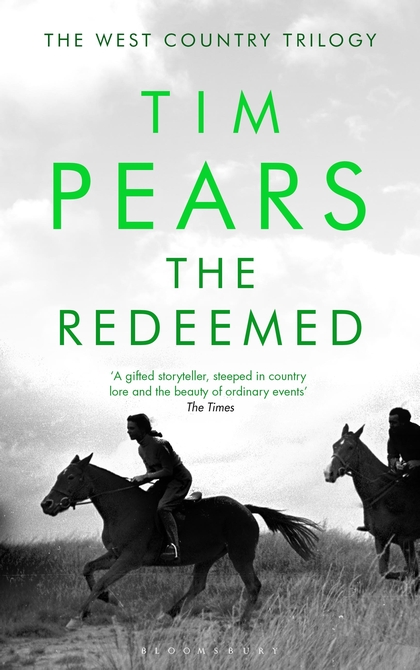
Review: THE REDEEMED by Tim Pears

Banished from the rural idyll of the West Country in the years leading up to the First World War, young Leo Sercombe – The Horseman of the first volume of Tim Pears’ trilogy, and subsequently one of The Wanderers of the second novel, and now, we presume, one of The Redeemed (Bloomsbury) in the concluding volume – must walk through fire if he is to return to his beloved Devon and the landscape that Leo, acutely attuned to nature’s rhythms, has always instinctively associated with a divine presence.
  The Redeemed, however, opens a long way from the West Country. Catapulted into the flames of the North Sea when the ship on which he is serving is shelled during the Battle of Scapa Flow, the half-drowned Leo rails bitterly against the God that has forsaken him. The prelapsarian paradise of The Horseman has long since been lost: ‘The horsemen who had been foretold had come. Fire and smoke and sulphur would issue from the horses’ mouths.’
  Whilst Leo grapples with Revelations and apocalyptic visions, Lottie – Lord Prideaux’s daughter, whom the young Leo dared to befriend before being beaten and exiled for his familiarity – has grown into an accomplished veterinarian. But the West Country is no longer the arcadian ideal Leo left behind. ‘Reproduction is the most extraordinary miracle in the whole of nature,’ Lottie’s mentor Patrick Jago tells her, but it’s also ‘a savage business’. A savagery that is by no means the sole preserve of the animals she treats; men, as the unprotected Lottie quickly discovers, are capable of cruelties that animals couldn’t even imagine.
  Told in parallel narratives which chart Leo and Lottie’s tortuous journey towards their destiny together, The Redeemed is a hugely satisfying conclusion to the West Country trilogy. Tim Pears’ language is as spare and evocative as ever – Leo, smelling the sweat of men readying for battle, realises the musky, rank stench comes from ‘deeper pores, primitive glands, some true authentic depth of their being’ – and his eye for the telling detail is undiminished: ‘the carter tugged with all his force, and the fore-leg was yanked and ripped off the body of the dead foal so abruptly that it came slithering out of the vagina of the mare and the carter staggered backwards across the wet straw of the loose box with the severed limb, like a man astounded by what he’d been given, struggling to retain his balance.’
  The theme is one of rebirth, of endlessly renewing possibilities. ‘We may be an old species nearin the end a days,’ says Leo, ‘or we may be a young species with heaven on earth ahead of us.’ The future, whatever it holds, will be far more complex than the simple certainties that defined Leo’s childhood: ‘I want to work with horses … Just as tractors is takin over.’
  But even as new technologies, and the war to end all wars, and the wisdom of age all combine to erode Lottie and Leo’s belief in the established order of things, a hard-won faith in themselves and their place in the natural cycle prevails. It is a shared vision derived from their mutual love of, and understanding of, horses:
  Lottie said that when she looked into the eyes of a horse, she acknowledged that it does not see as much as humans do, nor understand much of what it sees. ‘But I have the feeling I glimpse what is behind the horse,’ she said. ‘What made him.’
  ‘God?’
  ‘I don’t know. Is there a need to name it?’
  Leo shook his head in agreement.
  This review was first published in the Irish Times.