Showing posts sorted by relevance for query Kevin McCarthy. Sort by date Show all posts

Monday

Can We Fit Just One More E Into PEELER?

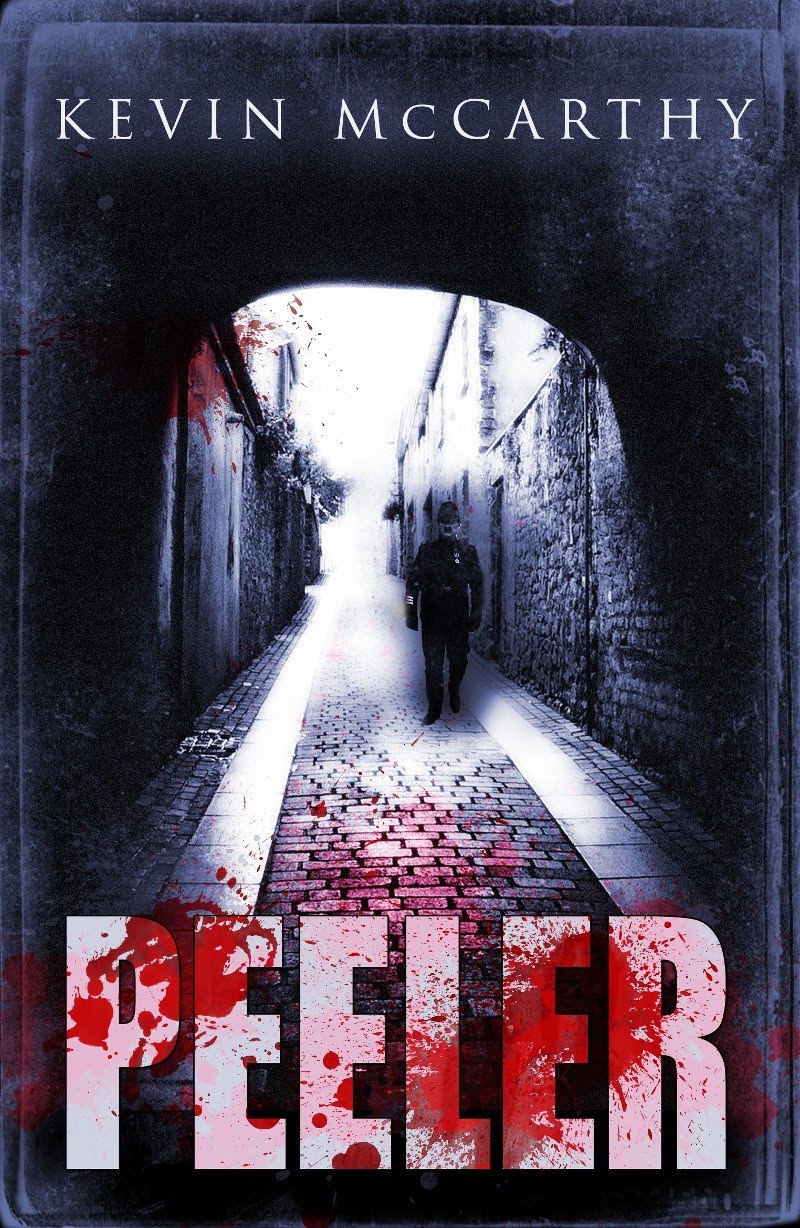
It’s going to be a lot tougher to keep up with Irish crime fiction now that writers are bypassing the traditional structures and going directly to the e-market - see Alexander O’Hara here, and Ruby Barnes here. And that’s on top of the writers who are conventionally published but are also availing of the e-option, such as Kevin McCarthy, whose debut novel PEELER is now available in electronic form.
  Here’s a quick review of PEELER I contributed to January Magazine’s end-of-year round-up of the best books of 2010. To wit:
PEELER by Kevin McCarthy

Eoin McNamee, Benjamin Black and Cora Harrison are among those who write historical Irish crime fiction, and Kevin McCarthy’s PEELER (Mercier Press) deserves to be mentioned in the same breath. Set in Cork in 1920, during the Irish War of Independence, the novel has for its main protagonist Acting Sergeant Sean O’Keefe, a man who is not only a policeman with the hated Royal Irish Constabulary, but also a veteran of the Great War. McCarthy has made things doubly difficult for himself by choosing such a man for his hero, as Ireland’s relationship remains conflicted even today with the men who served in the RIC and fought for Britain during WWI. It’s a testament to his skill as a storyteller, then, that the complex O’Keefe - who considers himself as Irish as the next man, and is considered suspect by his superiors for that very reason - is such a sympathetic character as, aided and abetted by the despised Black-and-Tans, he pursues a killer who is also wanted by the IRA. McCarthy’s historical detail is excellent as he weaves a backdrop of black ops and blacker propaganda, with O’Keefe often a lone voice of reason and law-and-order while about him move squads of killers, both rebel and state-sanctioned. The pace and tension are expertly handled in what is a traditional page-turner of a thriller, yet McCarthy invests the novel with occasional poetic flourishes that highlight the bleak environment in which O’Keefe operates. All told, it’s a remarkably assured debut. - Declan Burke
  Don’t take my word for it, though - check out the rather impressive array of readers’ reviews PEELER has already generated at Amazon US, and here at Amazon UK

Friday

Launch: WOLVES OF EDEN by Kevin McCarthy

Kevin McCarthy’s previous novels were set during the Irish Civil War, but his latest offering, WOLVES OF EDEN (W.W. Norton), opens in the wake of the American Civil War. Quoth the blurb elves:
Dakota Territory, 1866. Following the murders of a frontier fort’s politically connected sutler and his wife in their illicit off-post brothel, Lieutenant Martin Molloy and his long-suffering orderly, Corporal Daniel Kohn, are ordered to track down the killers and return with “boots for the gallows” to appease powerful figures in Washington. The men journey west to the distant outpost in a beautiful valley, where the soldiers inside the fort prove to be violently opposed to their investigations. Meanwhile, Irish immigrant brothers Michael and Thomas O’Driscoll have returned from the brutal front lines of the Civil War. Unable to adapt to life as migrant farm laborers in peacetime Ohio, they reenlist in the army and are shipped to Fort Phil Kearny in the heart of the Powder River Valley. Here they are thrown into merciless combat with Red Cloud’s coalition of Native tribes fighting American expansion into their hunting grounds. Amidst the daily carnage, Thomas finds a love that will lead to a moment of violence as brutal as any they have witnessed in battle-a moment that will change their lives forever. Blending intimate historical detail and emotional acuity, WOLVES OF EDEN sets these four men on a deadly collision course in a haunting narrative that explores the cruelty of warfare and the resilience of the human spirit.
  Kevin McCarthy launches WOLVES OF EDEN at the Central Hotel, Exchequer Street, Dublin 2, on Wednesday, November 14th. For more on Kevin McCarthy, clickety-click here

Saturday

Down These Green Streets: Kevin McCarthy on George V Higgins

Being the continuing stoooooooory of a quack who has gone to the - whoa. Different blog. This is the latest in an irregular series in which contributors to DOWN THESE GREEN STREETS pick their favourite Irish crime novel. Last week it was Ken Bruen on (koff) EIGHTBALL BOOGIE. This week, it’s Kevin McCarthy, the author of PEELER, on George V Higgins’ THE FRIENDS OF EDDIE COYLE. To wit:
“STRETCHING things a little, I have chosen George V Higgins’ THE FRIENDS OF EDDIE COYLE as my favourite Irish crime novel. Born in Boston to Irish immigrant parents, Higgins served as a federal prosecutor in the US District Attorney’s office, writing novels in his spare time. It is said that he had written 16 before his first, THE FRIENDS OF EDDIE COYLE, was published to great acclaim in 1972. Drawing on his experience as a prosecutor - Higgins worked many notorious mob cases in New England - the novel charts the progress of gun dealer Eddie Coyle as he brokers and buys weaponry for a crew of bank robbers, touts to cops and feds, and confides in his bartender friend Dillon. All this is as one might expect from a serving federal prosecutor, but stylistically - and this is where Higgins is particularly Irish - the novel owes more to Joyce than Chandler. From the opening page, the story is told almost entirely in dialogue:
Jackie Brown at twenty-six, with no expression on his face, said that he could get some guns. ‘I can get your pieces probably by tomorrow night. I can get you, probably, six pieces. Tomorrow night. In a week or so, maybe ten days, another dozen …’
  “Eddie and his friends ramble, digress, yarn and almost inadvertently add to the dense weave of the narrative. It is a novel that demands careful reading and faith in the novelist. It is dense, gripping, gritty and sad. It’s hard work that repays the reader with a smeared glimpse of how crime works in the real world, driven by self-interest, self-preservation and more than a little self-loathing. And that’s only the cops and feds ...” - Kevin McCarthy
  Kevin McCarthy’s PEELER is published by the Mercier Press.

Wednesday

Peeling Back The Layers

There was an interesting piece on Kevin McCarthy’s PEELER from Henry McDonald in last Friday’s Belfast Telegraph, which reviews the novel in the context of Ireland’s voluntary amnesia when it comes to the Royal Irish Constabulary. To wit:
The RIC was airbrushed from the Republic’s consciousness for 80 years. Artists have a role to play to ensure it doesn’t happen again, says Henry McDonald

Kevin McCarthy’s brilliant first novel, PEELER, rescues from the margins of Irish history a group that the future Free State and Official Ireland airbrushed from national memory: the Royal Irish Constabulary.
  When I was taught Irish history at grammar school back in the 1970s, this force was only referred to by a single and dismissive sobriquet -- they were merely the “eyes and ears” of the British Army which Michael Collins had so ruthlessly blinded and deafened in the War of Independence.
  At the time we knew nothing about what these officers were actually like, how the vast majority of them were Catholic Irish and what happened to them once the state was created and Ireland partitioned.
  In fact, compared with the details of fratricidal brutality wrought by the subsequent Civil War, students were given next to no information about the RIC, its casualty rates, its fate and the future for its members.
  PEELER fills that knowledge-gap. The story of its central character, RIC acting Sergeant Sean O’Keefe, was not just a hugely enjoyable read, but also socially and historically illuminating.
  McCarthy has turned these shadowy, ghostly figures relegated in history as the “eyes and ears” to fully-formed flesh and blood characters, whose lives were as complex and rich as the men in the Flying Columns who hunted them down.
  PEELER is, first of all, a detective novel, a hunt for a suspected serial-killer who has brutally murdered a young woman and abandoned her mutilated body in the remote West Cork countryside at the height of the war.
  While trying to survive one of Collins’ assassination squads, O’Keefe and his colleagues now find themselves searching for a murderer who has left the word ‘Traitor’ on the young woman’s body.
  That word prompts the British military-political establishment to think that the victim has been singled out by the West Cork IRA who suspected she has been passing on information to the RIC and the Army.
  Meanwhile, the IRA has set up its own parallel murder inquiry and has appointed West Cork Brigade intelligence officer Liam Farrell to head up the investigation.
  Farrell represents the coming power in the land, the guerrilla on the verge of taking over law and order, the republican poacher turning Free State game-keeper.
  To McCarthy’s credit, both O’Keefe and Farrell are sympathetic characters with deep internal lives. Farrell is tortured by the necessities of war, of its brutal imperatives.
  O’Keefe is also a victim, a mentally scarred veteran of the First World War, who witnessed his regiment being slaughtered at Suvla Bay by the Turks.
  Yet it is not just the two main rival Irish figures pitted against each other in a race to catch a serial murderer that are multi-dimensional characters.
  McCarthy even evokes sympathy for the English demobbed soldiers hastily drafted into an auxiliary military force to curb the armed insurrection or as they are more notoriously known, the Black and Tans.
  As a veteran whose brother fell beside him under Turkish machine gun fire, O’Keefe regards some of these men as brutes and others simply as brutalised by war and crushed into service in Ireland through poverty.
  McCarthy’s book indirectly provokes bigger questions about the legacy of Ireland’s violent past -- especially for those of us in Northern Ireland.
  At present, the devolved administration at Stormont and the British Government at Westminster are grappling with various notions of how to confront what happened in the north over the last 40 years.
  The approach thus far has been piecemeal with selective inquiries, the appointment of four Victims’ Commissioners and the Eames-Bradley process.
  It has been, in essence, confusing and misdirected probably because in the end any exploration into the past, let alone the ‘truth’ of the Troubles is to going to be politically loaded.
  Northern Ireland seemingly faces two options in terms of truth and reconciliation: it can go down the Spanish road towards the ‘pact of forgetting’, when all of Spain post-Franco agreed to put the crimes of the civil war aside, re-enter Europe and move on; or it could adopt a South African Truth and Reconciliation process, an official ‘national cleansing’ in front of the cameras, open to all.
  The reality is that there is going to be some cobbled together compromise, a third way of muddling through.
  While the victims and their families as a whole might receive some retrospective compensation, or even psychological help and support in a new Troubles-Trauma centre, there will neither be Spanish-amnesia or South African-style collective catharsis. The answer to questions such as ‘what or how did that all happen?’ cannot be properly offered by officialdom in any shape or form.
  Perhaps the only positive way to explain where we have come from will be in the guise of novels, plays, films, poetry, documentary and so on. (Time, by the way, for broadcasters -- particularly the BBC -- to lift the unofficial ‘embargo’ on Troubles-related themes and give artists the space and the support to explore some of the most important events of our lives over the last 40 years through the medium of film and drama.)
  Shelley once declared that poets are the unelected legislators of the world; they can also be their truth-tellers.
  Let’s just hope that all those untold stories of our conflict just past won’t have to be told eight decades later the way the narrative of the forgotten RIC have been finally brought back into public consciousness by Kevin McCarthy’s dark, brooding, multi-layered, morally complex masterpiece. - Henry McDonald

Friday

On Log-Rolling In An Istanbul Smoking Lounge

I was in the smoking lounge at Istanbul Airport a couple of weeks ago, as isn’t my wont, during a layover for our flight to Northern Cyprus, when I got an email from Kevin McCarthy, he of PEELER fame, that pretty much made my holiday even before it properly began. I’d given Kevin an m/s of my forthcoming ABSOLUTE ZERO COOL as part of my ongoing campaign to generate blurbs that might pique readers’ interest, with the proviso that if he didn’t like it, he was perfectly entitled to assert his right to remain silent and / or take the Fifth. I should also point out, in the interests of accountability and transparency, that I liked Kevin’s debut PEELER very much, and said so when I reviewed it for the Irish Times, and that I’ve since met with him a few times and shared a couple of beers. So you might want to factor in all the potential for log-rolling when I present Kevin’s verdict below. To wit:
“ABSOLUTE ZERO COOL is that rarest of things - a novel that makes you stop and think and scramble to finish at the same time. A novel of ideas as well as a first rate thriller, it sees Burke stretching the crime thriller genre until it snaps and then sewing it back together with some of the finest prose and funniest dialogue you’ll encounter this year. It’s a novel that reveals the perverse combination of anomie and lunatic optimism that all novelists feel when in the throes of creation. A brilliant x-ray revealing Greene’s shard of ice in the heart of every writer; the secret sharer in the dark cabin of the novelist’s imagination. Quite simply, one of the finest Irish novels written in a long time.” - Kevin McCarthy
  So there you have it. I thank you kindly, sir.
  By the way, the inimitable Critical Mick reviewed PEELER over at his interweb lair recently, with the verdict running thusly:
“Speaking as both a history nerd and a book nerd, there’s nothing better than discovering a new novelist who completely satisfies both interests. Kevin McCarthy has interwoven literature and historical research, fiction and reality. PEELER is a cracking good tale - an eye-opener in many ways. Consider it personally recommended from me to you - PEELER is the first addition to Critical Mick’s list of Best Books Read in 2011.”
  Meanwhile, and just as my spirits were flagging out in Cyprus, I got a google alert for Eoin Colfer, which proved to be an interview with Eoin published by Kirkus Reviews. The relevant (to me, at least) gist ran thusly:
PLUGGED nails that staccato noir style that keep crime novelists and airport bookstores in business. Stylistically, where do you draw inspiration for the writing of this novel?

“I have been immersing myself in this style for decades and for at least one of those would not read anything but crime. If nobody died horribly, I did not want to know. Of course I loved the classics, but we have our own classics standing the test of time right now: Michael Connelly and John Connolly, Ken Bruen, Mark Billingham, Ridley Pearson, Carl Hiaasen, Declan Burke, Colin Bateman … I want to get on a shelf with these guys and take a photo.” - Eoin Colfer
  Steady on, Tiger! Oh, you mean you want to take a photo of the books … right.
  Anyway, you can take it that I’m pretty damn flattered to be mentioned in such august company. Providing, of course, that Eoin wasn’t confusing me with either Declan Hughes or Edmund Burke. Which happens more often that you’d think. The latter, mostly.
  The Big Question: is log-rolling the new Irish national pastime and / or only growth industry in these benighted times, and should we lobby for it to be introduced as an Olympic sport? Over to you, people …

Tuesday

We Need Kevin To Talk About Kevin

If you’re in Dublin tomorrow, May 26th, you could a lot worse than toddle along to the launch of Kevin McCarthy’s PEELER, which takes place at the Gutter Bookshop in Temple Bar with festivities kicking off at 6.30pm. For what it’s worth, I’ve read the novel, and I think it’s a terrific debut. Meanwhile, the blurb elves have been wittering thusly:
West Cork. November 1920. The Irish War of Independence rages. The body of a young woman is found brutally murdered on a windswept hillside. A scrap board sign covering her mutilated body reads ‘TRATOR’. Traitor. Acting Sergeant Sean O’Keefe of the Royal Irish Constabulary (RIC), a wounded veteran of the Great War, is assigned to investigate the crime, aided by sinister detectives sent from Dublin Castle to ensure he finds the killer, just so long as the killer he finds best serves the purposes of the Crown in Ireland. The IRA has instigated its own investigation into the young woman’s death, assigning young Volunteer Liam Farrell - failed gunman and former law student - to the task of finding a killer it cannot allow to be one of its own. Unknown to each other, an RIC constable and an IRA Volunteer relentlessly pursue the truth behind the savage killing, their investigations taking them from the bullet-pocked lanes and thriving brothels of war-torn Cork city to the rugged, deadly hills of West Cork.
  Hats off, by the way, to Kevin McCarthy for doing it the hard way. In Ireland, attempting to create a sympathetic character from an RIC Sergeant - who works alongside Black-and-Tans - is a hard sell, even today. But then, Sean O’Keefe is a complex character. A police officer upholding law and order on behalf of the Crown, he’s nonetheless a proud Irishman and Catholic - and that’s before you get into the ramifications of a story in which the Crown and the IRA are after the same killer. It’s a volatile mix, and Kevin McCarthy does it full justice. I’m already looking forward to seeing his next offering …

Friday

The Best Things In Life Are Free Books: IRREGULARS by Kevin McCarthy

I was very impressed with Kevin McCarthy’s debut offering, PEELERS, and I’m delighted to be giving away a copy of Kevin’s new novel, IRREGULARS (New Island), to one lucky reader. First the blurb elves:
Dublin, 1922, as civil war sets brother against brother and Free State and Republican death squads stalk the streets and back lanes of Dublin, demobbed RIC-man, Sean O’Keefe, takes a break from life as a whiskey-soaked waster to search for the missing son of one of Monto’s most powerful brothel owners.
  Hired to find the boy amid the tumult and terror of a country at war with itself O’Keefe soon finds that the story is not as simple as it first seemed and that the truth can be hard to pin down.
  The second book in the O’Keefe series, IRREGULARS explores a fascinating and complex period of Irish history.
  Ken Bruen likes it, by the way:
“IRREGULARS is astounding. Kevin McCarthy is doing for Irish history what Dennis Lehane is doing for the history of Boston. Wonderfully written, tense, provocative and oh so highly entertaining. Shaping up to be THE SERIES of accessible Irish history. Cries out to be filmed.” – Ken Bruen
  To be in with a chance of winning a copy of IRREGULARS, just email me at dbrodb[at]gmail.com, putting ‘Irregulars’ in the subject line and – most important, folks – your postal address in the body text. The offer ends at noon on Saturday, June 15th. Et bon chance, mes amis

And JC Arose And Spoke To Many

Off with yours truly to the launch of John Connolly’s THE WHISPERERS last Wednesday evening, which was held in the very pleasant environs of the Gutter Bookshop in Dublin’s Temple Bar. Being a perverse kind of Dark Lord, JC refused to read from THE WHISPERERS (clickety-click here for the prologue), instead offering a snippet of his current project, which appears to be a follow-up to THE GATES, which is all sorts of good news. The snippet in question featured four of the seven dwarves (that’ll be the recession, then), some of whom were in mortal danger of being tossed due to their unnecessary aggressiveness, plus a boy-band, a crumbling castle and a pop video shoot, and suggests that the book will be a very funny one indeed.
  As always, JC was besieged by fans afterwards in an impromptu signing session; as always, and because the man seems incapable of signing a book without engaging in banter, the signing session took at least an hour. It’s hard to judge these things qualitatively, but from the sounds of it, JC was in even better form by the end of it all than he was at the start, and he was plenty lively at the start.
  (By the way - for those unfortunates still yet to escape from Direland, John Connolly features on The Late, Late Show tonight (Friday). If you miss it, the RTE iPlayer can be found here …)
  Meanwhile, lurking with intent in the vicinity were Arlene Hunt and Declan Hughes, and Kevin McCarthy and Ed O’Loughlin. Bob Burke was there too, apparently, but I managed to miss him. Boo. Bob Johnstone, the owner of the Gutter Bookshop, seems to be a nice bloke, and we can only wish him well with the new venture. Opening a bookshop in these straitened times, in Ireland, is either a case of counter-intuitive genius or noble lunacy. Either way, Bob gets our vote. Apparently he gets the thumbs up from The Artist Formerly Known As Colin Bateman too, for lo, Bateman is due to do an event at the Gutter Bookshop next month. When I know more, you’ll know more …
  In other updates - Kevin McCarthy publishes his debut, PEELER, next month, a potentially fascinating tale of a murder investigation set in Ireland in the 1920s, in which the IRA and the Black-and-Tans chase the same killer. It’s on my bookshelf and due a reading in the immediate future. Meanwhile, Ed O’Loughlin, who got himself a Booker long-list nomination for his debut, NOT UNTRUE & NOT UNKIND, had the news that his second novel, a dystopian sci-fi, will be published next year. Nice. Elsewhere, Arlene Hunt’s latest, BLOOD MONEY, you should know all about, while Declan Hughes’ new offering, THE CITY OF LOST GIRLS, is an absolutely tremendous read, even by his standards, and a whole new gear for one of the best crime writers around. Truly, it’s a terrific novel. Hughes fans are in for a real treat. He should be launching said tome next month too. Apparently there’s a review in Sunday’s New York Times …
  While outside for a crafty smoke, I also met Helen, who confessed - in public! - to having read THE BIG O. She also said very nice things about the Princess Lilyput, thus making herself a new friend for life, whether she wants one or not. I thank you kindly, ma’am.
  And as if all that wasn’t nice enough, the lovely Margaret Ward and the equally lovely people from Hodder Stoughton were good enough to promise me some tasty titles in the near future, one being the new Tana French, FAITHFUL PLACE, the other being David Mitchell’s eagerly anticipated THE THOUSAND AUTUMNS OF JACOB DE ZOET. Woot, etc.
  Finally, I decamped to the nearby Porterhouse in the company of Kevin McCarthy and Ed O’Loughlin for a very pleasant couple of hours chat about books ‘n’ suchlike over a few dry Pimms. Unfortunately, I was on the non-alcoholic Pimms, having been to the dentist on Tuesday in the throes of man-agony, there to discover I was suffering from an infection of an abscess. Picking up some super-strong antibiotics from the chemist (I’m immune to Penicillin, for some bizarre reason), the chemist warned me not to drink booze on top of the pills, which is something I usually do for the extra buzz, even if I hadn’t planned on drinking. ‘Of course I won’t,’ says I. ‘No,’ says she sternly, having caught a glint in my eye, ‘I’m serious - you’ll end up in hospital if you drink alcohol even two days after the course finishes.’ Now, staying off the booze shouldn’t be a huge problem, except my brother’s stag weekend takes place in Galway this weekend. And now I’m curious. Like, seriously - how strong can gum-healing antibiotics really be?
  There’s only one way to find out, isn’t there?

  Lately I have mostly been reading: THE CITY OF LOST GIRLS by Declan Hughes, 61 HOURS by Lee Child, and THE GOOD MAN JESUS AND THE SCOUNDREL CHRIST by Philip Pullman.

Wednesday

We Need To Talk About Kevin. Again

And now for something slightly different, people. Kevin McCarthy is an Irish writer on the verge of a big breakthrough – he’s already had stories published with Thuglit and Plots With Guns – and has just completed his first novel, PEELER, ‘a murder mystery / lit crime novel set during in West Cork during the War of Independence’. We herewith and hencely bring you chapter the first of PEELER, with our commendations. To wit:

PEELER
by
Kevin McCarthy

Chapter 1
Word of the body had come from the wife of a shopkeeper in Ballycarleton. It was a rumour only, she had told the young RIC constable as he collected the barracks’ newspapers from the rear of her husband’s newsagents. But she hadn’t the heart not to hand it on. Imagine, she had said. Some poor soul lying alone in the gorse and the heather, in the wind and rain of late autumn. Unclaimed. A young woman, she had told the constable, her hand resting on his forearm, speaking quickly, in a breathless whisper, eyes darting left and right lest someone should see her speaking to a Peeler. Just a rumour, mind. Passed by the friend of a cousin who grazed sheep in the hills.
  The same hills where they were now searching. Eleven cold, wet men in the open back of a Crossley tender. Acting Sergeant Seán O’Keefe of the Royal Irish Constabulary bumped shoulders with a private from his escort of eight Essex regiment soldiers out of Bandon. With him from the barracks were Constables Logan and Keane, O’Keefe only bringing the recently sworn in Keane because it was he who had taken the tip on the body from the newsagent’s wife.
  The Crossley’s engine strained, gears grinding as it climbed a rutted boreen used by farmers and their livestock. O’Keefe scanned the landscape for any sign of the body. The squaddies scanned the sky for rain through the chicken wire mesh that shrouded the back of the Crossley. The chicken wire kept out grenades but not the weather.
  The soldiers, O’Keefe knew, resented being there; dragged away from a warm fire to run escort for three Peelers searching for a body that probably didn’t exist. They smoked, cupping cigarettes in down turned hands, their Lee-Enfield rifles resting between their knees. O’Keefe considered ordering a pair of the men to stand watch to the front and rear of the lorry bed, arms at the ready, but didn’t have the heart. He wasn’t sure the soldiers would obey a Peeler’s order anyway.
  Fifty-five policemen killed in the previous four months in Ireland. Forty-nine disarmed and countless others wounded, shot at and beaten. West Cork had been the worst affected in the country. The constabulary needed army escorts to move around the county and the Army relied on the constabulary for local intelligence, but neither was willing to cede authority until something went sour. Until someone was killed on patrol or a shop was looted and torched, when suddenly it was the other lot who had been in charge. O’Keefe remained silent.
  Hills of deep green—mottled with rusty patches of dying bracken, clumps of spiny gorse and rock and studded with mountain-grazing sheep—rose gently on both sides of the boreen. Halfway up the hill to the west were the abandoned remains of a small cottage, most of the structure’s rotting thatched roof collapsed inwards.
  ‘There! Down from the cottage, there.’
  O’Keefe saw it a second after Keane did. Rumour become truth, some two hundred yards up the hill to the west, to the left of the ruin. The sheer, fleshy whiteness of it. The black, rifling attention of feeding crows.
  The soldiers followed Keane’s pointed finger, one or two taking up their rifles, assuming the young constable had spotted a sniper or party of ambushers. O’Keefe reached over into the cab, tapped the Crossley driver’s shoulder and the tender squeaked to a halt. The men jumped off the tailgate, leaping the low ditch at the edge of the narrow track, fanning out in rough, defensive positions.
  O’Keefe followed them down from the lorry and paused behind it, studying the landscape. It was an odd place to dump a body, he thought, even if it was left as bait for an ambush. The only places an attack could come from were the ruined cottage or the hilltop, where there was a ruck of wind-worn boulders that could act as a firing position. He would be exposed while he did his examinations of the scene, but O’Keefe had seen far better ambush sites: bodies laid at bends in roads bordered by high blackthorn hedges and dry-stone walls; bodies left in front of derelict buildings, darkened windows nesting snipers. This felt different. He waved over the Essex lance corporal in charge of the escort. The man came slowly, ducking low in the ditch but in no hurry. He was a hard-looking man, a tracery of fine white scarring on one side of his face. O’Keefe guessed this wasn’t his first war.
  ‘The boulders there, and the ruins….’ O’Keefe pointed. ‘Can you send a few lads up to clear them? Maybe leave two in wide positions and a couple with the Lewis gun on the tender. Doesn’t feel like an ambush, but…’—he felt a fool saying it—‘better safe than sorry.’
  The lance corporal looked as if he might disagree, then shrugged and bellowed four names. The men received their orders and began to trudge up the hill while the corporal set his remaining squad in positions facing north and south, up and down the boreen, with two men manning the Lewis machine gun on the Crossley’s bonnet.
  A breeze cooled the damp wool of O’Keefe’s bottle green uniform. Gooseflesh dimpled his back. Constable Keane jogged over and squatted beside him, gently setting an oiled leather camera case on the grass at the ditch’s rim.
  ‘Will we head up, Sergeant?’
  ‘No,’ O’Keefe said. ‘Wait til those boys clear the area. The body’s not going anywhere.’
  Keane nodded, rummaging in his trouser pocket for a tattered paper bag of sweets. He held it out to O’Keefe who shook his head.
  ‘Queer spot to leave it, all the same,’ the young constable said, palming sweets into his mouth and returning the bag to his pocket. ‘Have to lug the yoke a fair stretch to get it up there. And left in full view of the whole valley.’
  ‘No sense plugging someone if others can’t learn from it.’
O’Keefe watched as the Essex scouts disappeared into the derelict cottage halfway up the hill. Moments later they re-emerged, signalling an all clear and O’Keefe continued to track them as they climbed towards the boulders at the hilltop, the soldiers moving in a loose group of four instead of spreading out and working around from each side of the crest. They ambled, upright, Enfields held loosely at their hips. Like Sunday hillwalkers, O’Keefe thought. Too young to have fought in the war or they’d know better. ‘Where’s Logan?’ he said.
  Keane nodded back towards the Crossley. Constable Logan was leaning up against the lorry’s bonnet, pipe stem wedged in his mouth under the cover of a thick, white moustache. O’Keefe didn’t need to see his mouth to know that he was yarning. It was what Logan did. The man could talk paint off walls.
  O’Keefe could hardly believe the old constable hadn’t taken a bullet since the Troubles had started. Logan was from a different age of policing in Ireland. A time when a constable stopped for an auld natter with the people he served. For a hand or two of cards with the bachelor farmer, a short whisky on a cold night patrol, a mug of tea and a look-in at the dairyman’s newborn calf.
  Now, O’Keefe reflected, we police travel in packs and kick in the dairymen’s doors, hunt down their sons while their sons are hunting us. Logan had taught O’Keefe a lot of what had been good about the job in the days before the killing had started. He decided to leave him where he was, hoping that Logan would hear the shooting, if there was any, over the sound of his own voice.
  The four Essexes reappeared from behind the boulders and again signalled an all clear.
  ‘Right so, Constable.’ O’Keefe rose stiffly from the ditch.
  Keane picked up the camera case and took long strides up the hill, boots pressing a wake in the damp grass for O’Keefe to follow. As they climbed, O’Keefe took note of the ascent and estimated the distance from the Crossley to the body. The grade of the hillside was enough to make a reasonably fit man break into a sweat. A fitter man than himself, he thought, the scar on his face tensing in spasm with the effort of the climb. He rubbed it with his palm. Like the lance corporal, O’Keefe had his own curio from the war; a dark, pink rope of knotted tissue, from under his right eye to his neck. It played up under physical or mental strain. He had covered enough of it as he could with a thick brown moustache.
  ‘Fair climb, Sergeant.’ Keane was only twenty-two years old, a Donegal lad six months in the police. He had sharp blue eyes, sandy blond hair under his peaked uniform cap and the wispy beginnings of his own de rigueur RIC moustache. He was an athletic, handsome, if shorter, version of the thousands of men who had clamoured to join the RIC for generations. When the IRA had begun shooting RIC men, recruitment to the constabulary had understandably dropped. Out of necessity, age-old standards for height, girth, reading, writing and arithmetic had been relaxed, allowing men under five foot nine, such as Keane, to enlist.
  ‘It is,’ O’Keefe answered. ‘You’d reckon more than one to do the job—to haul it up there.’
  ‘And a motor,’ Keane said, ‘or cart and ass to get the body up the boreen. Sure, the village there…,’ the constable turned back from his climbing and pointed south-eastwards, ‘must be a mile or more away.’
  O’Keefe stopped and looked. The hamlet was clearly visible from where they stood on the hill. ‘Drumdoolin,’ he said. ‘Two of our lads were killed just outside it on cycle patrol last summer. O’Rourke and Cotton—good cons, God rest them.’ Con. RIC slang for constable. O’Keefe had heard that con was short for convict in America. He enjoyed the irony. ‘They boarded up Drumdoolin barracks shortly after. Divvied up the men between Bandon barracks and ourselves. IRA burned the shell of it last Easter.’
  Keane shook his head but didn’t appear surprised. It was all in the run of things for new RIC men and the rabble of Black and Tans brought in from across the water. Barrack mates shot in the face from behind stone walls, their guns and ammunition taken while they lay twitching and bleeding out on the road. Barrack mates kidnapped from dance halls and executed by moonlight, their bodies dumped in bog holes or left on the wet cobbles of town squares as a warning to prospective recruits to the constabulary. Keane would never have known West Cork when it wasn’t a place hated and feared by policemen.
  ‘You think the body had anything to do with the village?’ Keane said, turning back and continuing to climb.
  O’Keefe shrugged and followed. ‘If it did, we’ll probably never find out. Sure, murder’s as common as rain round here these days. And no one knows anything about it, even when they do.’
  They reached the body and several crows flapped and rose from it, angry at the intrusion. Even then, O’Keefe thought one had refused to flee its roost at the body’s mid-section. Only as he moved closer could he see that it was no crow covering the young girl’s hips and thighs.
  Keane blessed himself. ‘Jesus wept. Look at her…’ He swallowed. ‘Are those…feathers?’
  The young constable turned then and vomited into a scrag of heather.

© Kevin McCarthy, 2007

Kevin McCarthy is represented by the Jonathan Williams Literary Agency. Enquiries to: Jonathan Williams Literary Agency, Rosney Mews, Upper Glenageary Road, Glenageary, County Dublin, Ireland.

Tuesday

Reviews: Irish Times crime fiction column, December 2018

My crime fiction column for the Irish Times this month is an all-Irish affair, and features Kevin McCarthy, Tanya Farrelly, Fiona Gartland, Nessa O’Mahony and Ken Bruen. To wit:

Kevin McCarthy’s first two novels, Irregulars and Peeler, were set against the backdrop of the Irish Civil War, but Wolves of Eden (W.W. Norton) opens in the wake of the American Civil War, with the psychologically scarred Union Army veteran Lieutenant Molloy dispatched to Fort Phil Kearny in the Dakota Territory to ‘put boots on the gallows’ – i.e., investigate the apparent murder of the fort’s sutler and his wife. Molloy being an alcoholic determined to drink himself to death, the investigation is largely conducted by his second-in-command, Sergeant Kohn; woven through Kohn’s attempts to penetrate the code of omertà that pertains at Fort Kearny is a rambling, semi-literate confession written by Michael O’Driscoll, an Irish immigrant who has served with the Union Army during the recent War. A compelling tale of men who were ‘chucked into the roaring flames of history,’ Wolves of Eden is superbly detailed in its depiction of frontier soldiering, with Fort Kearny besieged by Chief Red Cloud and the story playing out against the events which led to the Fetterman Massacre of 1866. Flashing with shards of coal-black humour – Michael’s brother Tom, shot in the face at the battle of Chickamauga, has ‘a face that would make a funeral turn from a main road’ – Wolves of Eden is a brutal, blood-soaked and unsentimental account of the Old West that bears comparison with Cormac McCarthy’s Blood Meridian.
  Tanya Farrelly’s When Your Eyes Close (Killer Reads) is an audacious exercise in genre-blending. Nick Drake is an alcoholic who undergoes hypnotherapy in a desperate bid to curtail his boozing, only to witness himself committing multiple murders in what appears to be a previous life. Shaken to his core, and reluctantly believing himself to be the knife-wielding killer John Davis, Nick sets out to investigate what really happened – only to discover that Caitlin, the daughter he orphaned during his killing spree, is struggling to cope with the mysterious disappearance of her husband, David. Where Farrelly’s crime debut The Girl Behind the Lens came coated in gritty realism, When Your Eyes Close revels in its fantastical premise (even if much of Caitlin’s backstory is rooted in the ongoing homelessness crisis). The plot isn’t entirely seamless as Farrelly juggles her parallel time-lines, but the overall effect is an entertainingly off-beat account of a man determined to bring himself to justice.
  Big Pharma finds itself in the dock In the Court’s Hands (Poolbeg), the debut thriller from Irish Times journalist Fiona Gartland, which opens with Beatrice Barrington, a stenographer at the Dublin Criminal Court, observing a suspicious liaison in the Phoenix Park between Stephen O’Farrell, the accused in a high profile case, and the forewoman of the jury, Rachel Deere. When Rachel is subsequently found dead in her apartment, Beatrice suspects foul play, and enlists the help of ex-Garda detective Gabriel Ingram to help her investigate. There’s more than a hint of the Miss Marple about the prim, fussy and resolutely moral Beatrice Harrington, and In the Court’s Hands offers a neat blend of the courtroom drama and the amateur sleuth sub-genres, and even tosses in what appears to be an homage to Raymond Chandler as Beatrice, nosing around where she shouldn’t, finds herself drugged and incarcerated in a mental hospital. Regular flashbacks to the younger Beatrice’s life in 1980s Dublin leach tension from the main plot, but they are vividly rendered and contribute handsomely to a promising debut.
  Poet Nessa O’Mahony publishes her debut crime novel with The Branchman (Arlen House) which opens in 1925 with Michael Mackey, a detective officer in the newly formed Garda Special Branch, sent to the Garda barracks in Ballinasloe “to root out subversion”. Mackey, a veteran of numerous conflicts, isn’t fooled by the beauty of rural Galway: “It all looked innocent enough, but who knew what old animosities were lurking in those green fields?” There’s enough animosity to deliver a murder, certainly, and Mackey quickly discovers himself investigating the theft of a cache of stolen arms. O’Mahony is particularly strong on the everyday detail of a stranger negotiating a hazardous landscape – the character of Mackey is loosely based on her own grandfather, Michael McCann – and delivers a series of brief, intense chapters which generate a ferocious pace. Most fascinating, perhaps, is O’Mahony’s evocation of the wider political backdrop, that fragile, imperfect peace that took hold in the wake of the War of Independence and the Civil War.
  Jack Taylor returns in Ken Bruen’s In the Galway Silence (Head of Zeus), the 14th novel to feature the Galway-based private eye. Commissioned to investigate the bizarre murder of the anti-social Renaud twins, Jack quickly concludes that ‘It wasn’t a mystery as to them being killed but a mystery as to why it hadn’t happened sooner.’ The investigation, however, serves as springboard into a much wider exploration of the country’s ills, as Jack, self-described as ‘a broken PI’, wanders the mean streets of Galway lamenting the state of ‘the new broken Ireland.’ Post-modern to a fault, In the Galway Silence is littered with references to Jack Taylor’s preferred reading, which here includes the cult crime fiction authors Craig McDonald, Eddie Bunker and Daniel Woodrell, and further features the Galway-based author Scott Harden, whose ‘alleged stint in a South American jail had given him preternaturally totally white hair,’ and whose appearance causes Jack to believe that, ‘I could be looking at me fein (myself).’ Located on the literary spectrum somewhere between Charles Bukowski’s Pulp and the wilder extravagances of James Crumley’s private eye C.W. Sughrue, In the Galway Silence exudes a nihilistic thrill in smashing the crime fiction conventions to smithereens. ~ Declan Burke

  This column first appeared in the Irish Times.

Monday

New Hope For The Dead # 14: Kevin McCarthy

The latest Irish crime fiction up-'n'-comer to hit the streets is Kevin McCarthy, folks - he's putting the finishing touches to his novel Peeler as you read, a mystery set during the Irish War of Independence. The guy's got a way with words - check out his short story Work To Live over on the tough-as-shark-shit Thuglit (motto: Writing About Wrongs). Sample quote: "When the girl regained her balance under Jimmy Mack’s guiding hand, she smiled and he noticed she was wearing braces on her teeth. Might be a problem, he thought, time came to bake the Jimster premium, downhome sausage. But what the fuck? Girl was a weedho, no doubt. Other places, man can cook a sausage…" We’re thinking Pelecanos meets Willeford, people …

Friday

ABSOLUTE ZERO COOL: Destined To Become A Cult Classic, Apparently

You’ll forgive me again for indulging myself (again), I hope, but it’s been another fine week for ABSOLUTE ZERO COOL, with a number of flattering reviews popping up on the world wide web. First off, Kevin McCarthy - a very fine author in his own right - was good enough to take the time to post his thoughts to Amazon, in the latest five-star review for said tome. To wit:
“ABSOLUTE ZERO COOL is that rarest of things - a novel that makes you stop and think and scramble to finish at the same time … I generally cannot abide novels about men (it’s always men) writing novels, but ABSOLUTE ZERO COOL takes that tired premise, shoves a tank of Silene gas right up its you-know-what and sets the detonator. A novel of ideas as well as a first-rate thriller, ABSOLUTE ZERO COOL sees Burke stretching the crime thriller genre until it snaps and then sewing it back together with some of the finest prose and funniest dialogue you’ll encounter this year. I can’t recommend this book enough. Destined to be a cult classic.” - Kevin McCarthy
  I thank you kindly, sir. And then there was Marleen, over at More Than A Reading Journal:
“I know I’ve said it before, but this is most definitely a book unlike any I’ve read in the past … All the blurbs about this book describe it as being “laugh-out-loud funny”, “full of the blackest humour” and “outrageously funny”. I, however, didn’t get the humour in this book. I found the story to be original, disturbing, thought-provoking and inventive.” - Marleen, More Than A Reading Journal
  Funny, schmunny, right?
  Finally, uber-blogger and short story writer Paul D Brazill gave AZC a fair wind and calm seas over at Mean Streets, the gist running thusly:
“ABSOLUTE ZERO COOL is in the same capable hands that created the classic comic crime double header of THE BIG O and CRIME ALWAYS PAYS. The hands of a master storyteller. And with those hands, Declan Burke has crafted an exciting, hilarious, thoughtful and moving story that will surely stand up to - and deserve - a lot of re-reading. I’ve read a lot of cracking novels this year but ABSOLUTE ZERO COOL is my favourite. And it could well be yours, too.” - Paul D Brazill, Mean Streets
  As if all that wasn’t enough - and really, when is enough ever enough - there were also a couple of very nice mentions for DOWN THESE GREEN STREETS, the first coming courtesy of Laura Root at Euro Crime:
“DOWN THESE GREEN STREETS is an excellent, varied collection of essays and short stories, looking at Irish crime fiction in both its historical and present day context, with much of interest to anyone interested in modern day Ireland and its cultural life. It is very much a book to dip into, rather than to read straight through in one setting. The authors by and large convey their wealth of knowledge in a highly readable, enjoyable style, and it's a great idea to include short stories in this compilation, as a nice counterpoint to the various analyses of Irish fiction.” - Laura Root, Euro Crime
  We thank you kindly, ma’am. And Jon L. Breen at Mystery Scene Magazine was also impressed, his review kicking off in a vein like this:
“This is one of the most entertaining, informative, and critically astute recent books on crime and mystery fiction, all from an Irish point of view and written in variants of that eloquent and melodic national prose style.” - Jon L. Breen, Mystery Scene Magazine
  So there you have it. ABSOLUTE ZERO COOL and DOWN THESE GREEN STREETS - good vibes all round, and yours truly set up for a very pleasant weekend indeed. I sincerely hope yours is just as good …

Sunday

Go North, Young-Ish Man


Off with us yesterday to Belfast for the second launch of DOWN THESE GREEN STREETS, and a marvellous day out it was too. The launch was incorporated into the Belfast Books Festival, and thus took place at the Crescent Arts Centre rather than the hallowed halls of No Alibis, which was initially something of a disappointment. Happily, the turn-out was such that No Alibis would have struggled to cope with the volume, and anyway David Torrans was on hand to MC proceedings, introduce the various speakers, and generally just about stopping short of clucking like a mother hen.
  Said turn-out included some of the Northern Irish contributors who couldn’t make the Dublin launch for GREEN STREETS, including Colin Bateman, Brian McGilloway, Stuart Neville and Eoin McNamee; Niamh O’Connor, who made the trip North having missed out on the Dublin launch; Kevin McCarthy and Cormac Millar, who’d been at the Dublin launch and was attending the Belfast Books Festival; Gerard Brennan, who’d ventured South for the first launch and couldn’t get enough GREEN STREETS; Belfast-based scribe Andrew Pepper, who had chaired a conversation between Eoin McNamee and David Peace on Friday night; and the aforementioned David Peace.
  Yours truly was up first to deliver some thanks on behalf of Liberties Press, and then David introduced Brian McGilloway, who provided something of an unexpected treat by reading not from his current tome, LITTLE GIRL LOST, as promised in the programme, but his next Inspector Devlin novel, ISLES OF THE BONES, which will be published next year. Stirring stuff it was too, and whetted the appetite for what sounds as if it will be the most fascinating Devlin story to date.
  David Torrans then introduced a panel composed of Brian, Colin Bateman and Stuart Neville (above), who took part in a Q&A on the past, present and future of the crime novel in Northern Ireland, in the process referencing their present and forthcoming offerings - LITTLE GIRL LOST for Brian, NINE INCHES for Colin, and STOLEN SOULS for Stuart. Great stuff it was too, as entertaining as it was insightful, and terrific value for money and time. All told, it was a hugely enjoyable evening, and many thanks to all who took part, facilitated and helped out in any way.
  Incidentally, I’ve written many times on these pages before about David Peace (right, with Kevin McCarthy), and how much I admire his Red Riding quartet, most recently on Friday, so it was lovely to actually meet him. It was slightly disconcerting to discover that he’s a disappointingly nice man in person - given the intensity of his prose, I was half-hoping he’d be mad, and as likely to bite as shake my hand. But no. He was the very model of friendly approachability, although it was more than surreal when he approached me, with a copy of GREEN STREETS in his hand, and asked me to sign it. Such moments are rare, folks, and I’ll be treasuring that one for a long time to come.
  Anyhoo, that’s the official functions for DOWN THESE GREEN STREETS finished, and there’s a certain amount of relief involved, given that it was a very busy fortnight, and that I was concerned first and foremost that the book, and my efforts on its behalf, would do justice to the very fine body of writers who contributed, and to Liberties Press for publishing it in such elegant fashion. Incidentally, Dave Torrans had all the Northern-based writers sign copies of GREEN STREETS, this on top of all those who signed copies at the Dublin launch, so anyone requiring a multiple-signed copy should clickety-click here
  Back now to the cave for yours truly and the rather more prosaic business of hacking a plausible narrative out of the wilderness I’ve managed to cultivate around my latest humble offering, working title THE BIG EMPTY, although experience tells me that a machete will hardly suffice, and it won’t be long before I’ll be reaching for the flame-thrower and napalm. I’ll keep you posted if and when any reviews of GREEN STREETS pop up, but hopefully the hard sell on said tome is over, and it’ll be business as usual. Well, until August rolls around, and Liberties Press publish my own novel, ABSOLUTE ZERO COOL. But that, dear friends, is a story for another day …

Tuesday

Going Up To Monto

I was very impressed with Kevin McCarthy’s debut, PEELER, a historical crime fiction novel set during the Irish War of Independence. It featured the RIC’s Sean O’Keefe, who returns in the novel’s sequel, IRREGULARS (New Island), which will be published later this year. To wit:
IRREGULARS is set during the Civil War in 1922 and deals with the search for the missing son of one of Monto’s most powerful brothel owners while Free State and Republican death squads stalk the streets and back lanes of Dublin. Sean O’Keefe, recently demobbed from the RIC, is hired to find the boy amid the tumult and terror of a country at war with itself.
  For updates, clickety-click on Kevin McCarthy’s blog.
  For my take on PEELERS, clickety-click here.

Saturday

Irish Crime Fiction: A Festival

The full line-up for November’s ‘Irish Crime Fiction: A Festival’ in Trinity College (see below) has been released, and it looks very much like this:

Friday 22 November (free tickets)

7.00pm-8.30pm: ‘A Short Introduction to Crime Fiction: Why We Write It, How We Write It, and Why We Read It’.
Panellists: Jane Casey, John Connolly, Alan Glynn, Declan Hughes, and Eoin McNamee.

Saturday 23 November (free tickets for daytime events)

10.00am-11.15am: ‘Historical Crime Fiction’.
Panelists: Kevin McCarthy, Eoin McNamee (chair), Stuart Neville, Peter Quinn, and Michael Russell.

11.30am-12.45am: ‘Irish Crime Fiction Abroad’.
Panelists: Declan Burke (chair), Jane Casey, John Connolly, Conor Fitzgerald, Alan Glynn, Arlene Hunt.

12.45pm-1.30pm: lunch

1.30-3.30pm: Surprise Film Screening

3.45pm-5pm: ‘Crime Fiction and Contemporary Ireland’.
Panelists: Paul Charles, Declan Hughes, Gene Kerrigan, Brian McGilloway (chair), Niamh O’Connor, Louise Phillips.

Saturday 23 November, Closing Event

6pm (doors open 5.30), Exam Hall, Trinity College (€6 tickets)
‘An Evening With Michael Connelly’.
John Connolly will be interviewing Michael, who will be signing books, including his newest novel The Gods of Guilt, which will have its Irish launch at this event.

Irish Crime Fiction: A Festival

I’m very much looking forward to ‘Irish Crime Fiction: A Festival’, which takes place at Trinity College Dublin over the weekend of November 22nd / 23rd. It should be a terrific event, blending as it does some new voices with established international best-sellers, although the highlight will undoubtedly be John Connolly in conversation with Michael Connelly (I believe Michael slips in under FIFA’s ‘grandparent rule’; his Irish roots are to be found in north Cork, I think).
  The blurb:
Irish Crime Fiction: A Festival
Trinity College Dublin and New York University are holding a festival devoted to Irish crime fiction, featuring more than a dozen of the most exciting Irish crime novelists. This will be a memorable event, devoted to a key genre of contemporary Irish writing, with a wide events, so please make plans to join us.
  Among the confirmed participants are Declan Burke, Jane Casey, Paul Charles, John Connolly, Conor Fitzgerald, Alan Glynn, Declan Hughes, Arlene Hunt, Kevin McCarthy, Brian McGilloway, Eoin McNamee, Niamh O’Connor, Louise Phillips, Peter Quinn, Michael Russell and Stuart Neville.
  We’re particularly pleased to announce that our weekend will conclude with a major event: for the Irish launch of his newest novel, The Gods of Guilt (Orion Books, November 2013), Michael Connelly will be interviewed by John Connolly.
  For all the details, including how to book tickets for the Michael Connelly event, clickety-click here

Sunday

A Murder Less Ordinary

I had a review of Conor Brady’s A JUNE OF ORDINARY MURDERS published in the Irish Times yesterday, which could well have been a delicate commission, given that Conor Brady is a former editor of said Irish Times. I enjoyed the book tremendously, though, not least for its historical detail and setting, and for its complex protagonist, Detective Sergeant Joe Swallow, who reminded me very much of Kevin McCarthy’s RIC Sergeant O’Keefe in PEELER (2010).
  There have been some very interesting historical crime novels set in Ireland recently: Kevin McCarthy’s PEELER, as noted; Eoin McNamee’s novels from the 1950s, ’60s and ’70s; Benjamin Black’s novels, set in 1950s Dublin; Cora Harrison’s fifteenth century books set in Clare’s Burren country; Adrian McKinty’s THE COLD COLD GROUND, which is set during the hunger strikes of 1981.
  It’s a relatively small number of titles, but it makes for an interesting trend, and A JUNE OF ORDINARY MURDERS is a fine addition to the ranks. To wit:
DUBLIN SWELTERS IN the notorious heatwave of June 1887 as Conor Brady’s debut novel opens. The authorities at Dublin Castle are more concerned with the city’s simmering political tensions. With Prince Albert Victor due in Dublin to celebrate Queen Victoria’s golden jubilee against a backdrop of violent Land League agitation, the castle is concerned that any one of a number of subversive organisations might attempt an assassination.
  So when Det Sgt Joseph Swallow of Dublin Metropolitan Police’s G division is sent to the Chapelizod Gate in Phoenix Park to investigate the discovery of the badly mutilated bodies of a man and a young boy, the authorities are initially relieved that the murders are “ordinary” rather than politically motivated.
  In all the best crime fiction, however, a juicy murder tends to minimise the distance between the criminal fraternity and the higher echelons of society, and such is the case in A June of Ordinary Murders . The death of career criminal Cecelia “Pisspot Ces” Downes makes matters trickier for Swallow, as her grasping lieutenants jockey to fill the power vacuum left in her wake, and the subsequent discovery of a young woman’s body in the Grand Canal complicates things even more.
  Brady weaves a police procedural that does full justice to the complex nature of the social, political and criminal labyrinth that was Dublin in the summer of 1887. He paints a vivid picture of the city as it bakes beneath the unrelenting sun, employing Joe Swallow’s sharp eye and the character’s ambitions as an amateur painter to deftly sketch both its landmarks and its less salubrious corners.
  The novel is set at the dawn of what we would now consider to be the age of forensic science, and we find Swallow dabbling in such radical innovations as ballistics and reconstructive portraiture. There’s also the occasional nugget of historical delight to be gleaned, such as the archaic notion of a “dying declaration”, a legal concept that held a man’s final words to be sound as evidence in court, on the basis that no dying man would knowingly lie.
  For the rest, clickety-click here

Wednesday

Mi Casa, Su Casa: Kevin McCarthy

Being the latest in a very occasional series in which the Grand Vizier reclines in his hammock with a jeroboam of Elf-Wonking Juice™ and lets proper writers have a say. This week: Kevin McCarthy (right), whose debut novel PEELER is published next week. To wit:

A Debasing Pastime;
or, Notes from a Darkened Room (On FA Cup Final Saturday)


“The funny thing about having a novel published is the number of people who you would categorise as friends—close friends even—who had no idea you wrote novels in the first place. It’s not something you tell people, when they ask you what you did at the weekend. Good weekend? Oh, yeah, I spent it in a darkened room by myself making stuff up.
  “I laughed aloud in recognition when I read a recent Guardian interview with novelist Nicola Barker. In it, she says, “Writing is kind of a debased pastime ...” It is, I thought. You slink off, alone, to a darkened room to engage with fantasy. You spend sunny weekends—and early mornings before work and every weekday afternoon and early evenings at it. You sometimes skip dinner to do it. You ignore the sprouting weeds and chipped paint and dysfunctional bathroom fan to do it. You feel guilty when you do it too much and terribly guilty when you don’t do it. Truly, debased.
  “So you don’t tell your friends that you spend your free time wallowing in the guilt ridden, guilt driven pastime that is novel writing until, that is, you want them to know about it so they’ll buy your book and make all that reclusive, brain-chafing effort, somehow worthwhile. And in that sense, when you’ve finally had a novel accepted for publication—over a year and a half ago and PEELER will finally hit the shelves next week—it’s as if you are coming out of that darkened room for the first time. Revealing something vaguely shameful about yourself. Dude, your friends say, you don’t strike me as the type to … you know. Write books. Can you hear the music? ‘I’m coming out, I want the world to know…’
  “The second thing, inevitably, your friends—or anyone, for that matter—asks when they discover you’ve written a novel that is about to be published is: What’s it about? To this, over time, you come up with a summary of sorts, that reduces the three years of work to a pitch line straight out of Altman’s The Player. It’s called PEELER. It’s about the brutal murder of a woman during the War of Independence. A good cop, an RIC man, a wounded veteran of the Great War, investigates the murder while the IRA investigates it from their side.
  “Sounds cool, your friend says. I didn’t know you studied Irish history…
  “I didn’t. But I did to write this book. Researching an historical novel is the fun part. It is where you take your general knowledge of a time and place in history, and read out from there and then, read in—primary sources, first hand accounts, police reports, diaries, letters—narrowing the focus until you get inside the heads and the hearts of the men and women who were living through it. How they acted. Why they acted. What they felt. In this, you get beneath the skin of the accepted versions we’re taught in school. Get to the underbelly, so to speak.
  “The accepted version is what you are, in essence, reading against and if you read enough, you find that this version merely skims the surface of the truth of history at best. Skims the surface wielding a large brush and bucket of green paint at worst. The interesting thing for me has always been the parts that this conventional, accepted history leaves out.
  “JG Farrell, the Liverpool-Irish novelist, renowned for his historical fictions and who died, too young, only a few miles from where I set PEELER in West Cork, wrote: ‘History leaves so much out … It leaves out the most important thing: the detail of what being alive is like.’ The best in popular history strive to uncover this ‘detail,’ lately, more and more. John Keegan, Anthony Beevor, Stephen Ambrose, John D Brewer, Dermot Ferriter, Michael Hopkinson, Peter Hart among others. It is a recent (and lucrative) and much needed step in the democratising of non-fiction historical narrative. But the best historical fiction has always done this. From Robert Graves to Stephen Crane to James Ellroy to Alan Furst. All of these writers scouring the margins, scraping and prodding at the underbelly of the time and place and characters they’ve used and invented to recreate the ‘detail of what being alive is like’—in Imperial Rome or a Civil War battlefield or wartime LA or wartime Bulgaria. With the exception of Graves, they write about the bit players in the larger historical dramas as if they were the grandest players on the stage of history and this is exactly how it should be, because this is how history is to every one of us as we are living through it. It is what I have attempted to do, in my no doubt flawed and modest way, in PEELER.
  “Get beyond the accepted version and the War of Independence becomes one fought at close range. More men were killed with revolvers than any other type of weapon. Shotguns were often used, again at close quarters. More often than not, killers knew their victims personally. A war of gangland style, tit for tat murders rather than pitched battles. A war of hitmen and death squads on both sides, hunting marked targets and targets of opportunity. It was a war mainly fought in alley ways and ditches and country lanes.
  “The version we are taught in school is one of set piece battles and masterfully planned ambushes; of outnumbered Flying Columns sending hardened British Army troops fleeing in retreat. These things happened, I learned, but rarely. The alley way, the darkened lane; the assassination set up in the brothel used by Crown troops, prostitutes tipping off gunmen and ‘donating’ money for the IRA arms fund. The underbelly.
  This is where the War of Independence was fought; this is also, it would seem obvious, where crime novels are set. It seemed only natural to go into the darkened room and come out with a crime novel about a PEELER trying to do his work as a policeman while dodging bullets and yearning openly for an end to the killing and an independent Ireland at the same time. This is how most RIC men felt, you learn in your researches. Charged with defending the Crown, most Peelers desired independence for Ireland. They were rightly terrified by the campaign of murder being waged against them by the IRA and yet felt only disgust for most of the Black and Tans and Auxiliaries brought to Ireland to help with ‘policing.’ Brilliant contradictions that are so human you can’t not write about them.
  “So you narrow the focus, writing now against the accepted version. Using what you have learned in your research, you find you have to write of such things because you are amazed when you read about them and want other people to know.
  Still, even in the darkened room, outside life intervenes. Making the ‘debasing pastime’, on occasion difficult, but more often than not, enriching it. As I sit here now (debasing myself!) I can hear the burping rattle of light and heavy machine guns from a live firing exercise at Gormanstown Army barracks, a couple of miles up the coast from my home. Throughout the writing of my new novel PEELER, this was often the case and oddly appropriate, given the subject matter of the book. There is one line in the book, in fact, that I wrote—not an important one, just a small line of atmospheric detail—just because I happened to hear the gunnery exercise that day when I was writing the scene. It is a post curfew prowl through the war ravaged streets of Cork city for the protagonist. In it, RIC sergeant, Séan O’Keefe … ‘made it back to the Daly house without seeing another soul in the streets, sticking to the shadows, using alleys and laneways when he could. Damp pavements. Shot out streetlamps. The distant roar of revving engines, bursts of machine gun fire.’ Of course, I have taken my description of war time Cork from any number of contemporary accounts, but I’m not sure if I would have included that last bit, the ‘bursts of machine gun fire’ had I not heard, just then from outside my window, the sustained, mechanical pop-pop-pop, stu-tt-tt-tter of the gunners in Gormanstown. The outside world intruding.
  “Before one even gets to the darkened room, however—forces him/herself there when the sun is (rarely) splitting the proverbials or the local is showing an Arabic broadcast of Man United on a wet Saturday afternoon that begs for the high stool and warm fire—it is outside life that determines what novel you will begin to write in the first place.
  “Time between novels—I had written three other as yet unpublished novels before PEELER—is like this: a restless, half-waking state where ideas for new projects come to you with all the promise of a sure thing and are tossed aside like crumpled betting slips before the initial elation has even faded. You find yourself staring blankly at Late Night Poker on the TV, thinking how you would have folded those eights, when suddenly you’re sitting up, scrabbling for pen and paper and scratching out lines of dialogue, scenes envisioned, plotlines, possibilities. Generally, it’s not long after you’ve done this that you realise you’ve just outlined the plot to HEART OF DARKNESS or LONESOME DOVE or DOG SOLDIERS or GOSHAWK SQUADRON; those favourite novels that lie dormant in the mind and influence, in some way, everything you write. But one day, you sit up and scratch out your ideas and say, Yeah, hold on. There’s something here…
  “Like all novels, I imagine, PEELER came from a serendipitous convergence things and events. For me: books stumbled upon, snippets of conversation, a plaque on a bridge.
  “With PEELER, I chanced upon Myles Dungan’s IRISH VOICES FROM THE GREAT WAR in the local library returned books stack. Entering the library, I always make my way to this pile first, for some reason and always have since I was a child, anxious to see what others have been reading. More often than not, it’s self-help and the driver’s theory test or Harry Potter novels, but the odd time, a gem like this one reveals itself. Halfway through the reading of Irish Voices—first hand accounts of WWI on all its fronts from the diaries and letters of those who fought, brilliantly compiled and contextualised—it occurred to me to write a fictional account of the bloody assault on V Beach by the Dublin and Munster Fusiliers in the Dardanelles in which over a thousand Irishmen died in a single morning. Fortunately I didn’t write it, as the book I outlined on the back of an envelope was strikingly similar to Sebastian Barry’s book, A LONG, LONG WAY which appeared halfway through the second draft of PEELER. But a seed was planted.
  “Luck would have it, however, that a second book landed in front of me at roughly the same time, courtesy of my mother-in-law’s research into her own father’s service in the Royal Irish Constabulary. Your father was an RIC man? I thought he owned a shop? He did, after he retired from the Peelers … He’s listed here, in this book …
  “Jim Herlihy’s THE ROYAL IRISH CONSTABULARY: A SHORT HISTORY AND GENEALOGICAL GUIDE is a fantastic history and compendium of the names and details of service of virtually every man who once served in the RIC. Reading this, I discovered that many RIC men had volunteered to serve in the Great War and returned—if they returned at all—to another more personalised sort of war in Ireland in which they were the primary targets of the IRA campaign for independence. I had known this. I had read of this before, but after having read the stories of the men who had fought in the trenches and beaches of Europe and the Dardanelles in Dungan’s book and now the story of the RIC men returning to home to another war, the story was slowly shifting and reshaping in my head. Questions arising, conflicting with my previous assumptions. Irish men killing other Irish men for the sake of Irish Independence? That was the Civil War, wasn’t it? No, not yet. It wasn’t just the IRA vs. brutal Black and Tans and the British Army? No. Yes. There is more to this, I felt. Dig deeper, go wider to the margins and then hone in, find the detail of what being a copper, a gunman, a Black and Tan was like.
  “Then, there was the plaque on the bridge in a nearby town. It is outside of a pub I drink in and I pass it every time I enter the pub. It reads: Near this spot Seamus Lawless and Sean Gibbons were Brutally Done to Death by British Forces while in their custody. September 20, 1920. An deis de go raib a n-anam.
  “It is well-known locally, that these Occupying Forces were trainee members of the Black and Tans based at the training depot at Gormanstown Aerodrome—now home to the Irish Army and the live firing exercises I can hear from my room—who sacked the town in revenge for the killing of an RIC man who had just been promoted to District Inspector. This RIC man had been drinking in a local bar with his brother, also an RIC man, to celebrate the promotion, when they became involved in an argument—politics, no doubt—with some members of the local IRA company. Drink had been taken, so the story goes—as do most in the crime reports from the local newspaper today—and a pistol was produced, a man shot dead, the town burnt to the ground and two men tortured, then bayoneted to death and left in the middle of the road at dawn amidst the smouldering ruins. What, I couldn’t help but thinking, were two armed policemen—men with a bounty on their heads throughout the country—doing drinking in a bar with armed republicans? What was it like living, drinking, working in a town where virtually anybody could be armed and there were more police per capita than almost any country in the world at the time and yet, common crime was rampant? What kind of war was the War of Independence?
  “It was the kind of war, I discovered, where the most violent and bloody of killings were carried out by men who then organised ceasefires for race meetings and market days. It was a war where women were targeted, tarred and feathered, stripped and raped and daubed with red and blue paint and sometimes murdered for associating with members of the Crown forces. It was a place where innocent men were dragged out of bed by members of an occupying army and shot dead ‘while trying to escape.’ It was a war fought by damaged men fresh from the slaughterhouse of the Great War unleashed at a pound a day upon the people of Ireland. It was a war fought by brave, idealistic, articulate and intelligent men on both sides; men who hated war fighting and policing alongside other men who weren’t living unless they were killing.
  “This is, really, what PEELER is about. But enough now. It’s sunny outside, for once. The FA Cup final is on the TV. Time to go back into the darkened room. Back to debasement!” - Kevin McCarthy

  Kevin McCarthy’s PEELER is published by Mercier Press.