Showing posts with label The Rising. Show all posts

Wednesday

Better The Devlin You Know

Here’s a Big Q that’s not very relevant in the grand scheme of things … Can an author’s voice change the way you read his or her books? I’m not talking about their authorial voice, but their actual, y’know, voice. If Lee Child, say, had a fey, high-pitched tone with a lisp, and you heard him giving a reading, would that impact on how you ‘heard’ Jack Reacher when reading his novels?
  I ask because Brian McGilloway is on RTE’s Arena arts show tonight (Wednesday, May 12th), yakking it up about his latest offering, THE RISING. Now, Donegal-based Brian is a mild-mannered teacher by day, and an equally mild-mannered crime writer by night, and his series protagonist, Inspector Benedict Devlin, is for the most part a mild-mannered Donegal cop. As it happens, I don’t hear Brian’s voice when I’m reading the Devlin novels, but it would be entirely appropriate if I did. Having heard James Ellroy perform in Belfast last year, on the other hand, will dramatically impact on how I ‘hear’ his characters next time I dip into an Ellroy novel.
  Anyone have any glaring mismatches between an author’s voice and how their characters sound?
  Meantime, there’s some nice reviews of THE RISING here, here and plenty more here. If you haven’t caught up with Brian McGilloway yet, THE RISING is the perfect place to start …

Monday

Nobody Move, This Is A Review: THE RISING by Brian McGilloway, BLOOD MONEY by Arlene Hunt, and THE CITY OF LOST GIRLS by Declan Hughes

You can call them genre conventions or you can call them clichés, but the male protagonists in crime novels tend to have a lot in common. Whether cops, private eyes, crusading journalists or ex-military veterans, they’re generally misanthropic loners with addiction issues - booze is the most popular - and while they rarely have trouble attracting women, they have huge problems holding on to them. They are, as Raymond Chandler dubbed them, the tarnished white knights, who go down those mean streets without becoming themselves mean, and whose sense of justice remains undimmed no matter how many beatings they take on our behalf.
  Three recent Irish crime novels have taken those conventions and tossed them out the window. Inspector Benedict Devlin, the main character in Brian McGilloway’s Donegal-set series of police procedurals, is as happily a married man as any married man is likely to be. Devlin has two kids, no addiction issues, and is no more cynical about the human race than any policeman is entitled to be having achieved the rank of Inspector. In all, he’s an unusually clean-cut credit to his family, his country and the Gardai.
  THE RISING is the fourth Devlin novel in the series, and as has been the case in the previous novels, Devlin is the juncture where personal and political collide. Here the political is provided by the eponymous Republican splinter group, which is gathering local support on both sides of the North / South border around Strabane and Lifford for its zero tolerance approach to drug dealing. One of the leading lights of The Rising is an old foe of Devlin’s, Vincent Morrison, who has served his prison term and emerged with his debt paid to society. When Devlin’s 11-year-old daughter Penny develops a crush on Morrison’s son, Devlin finds himself compromised in relation to the investigation he is conducting into the brutal murders of small-time drug dealers.
  Devlin is far removed from the by-all-means-necessary kind of copper to be found in crime fiction, and part of the enjoyment of THE RISING is seeing one of the consequences of the post-Good Friday peace process - that of ex-paramilitaries turning to more prosaic forms of crime - through the eyes of a family man who is as concerned for his daughter’s well-being as he is with conceptual notions of justice and accountability. That said, McGilloway claims no moral high ground for Devlin, who is on occasion moved to use his fists in brutal fashion when his domestic life is infringed upon.
  For all that the story is peppered with outbreaks of violence and murder, McGilloway, writing in the spare, unadorned style of classic noir tradition, never renders the violence lurid or gratuitous. Nor does he break faith with the reader by having his methodical inspector depend on hunches or gut instinct for his big breakthroughs. Instead the story imitates police procedural as closely as any entertaining novel is allowed, depending on the steady and stealthy accretion of detail and nuance rather than show-stopping flourishes designed to mythologise both the process and its protagonist. It’s an approach that whets the appetite even as it sates it. McGilloway improves with every novel, and the latest Inspector Devlin - Morse without the affectations, basically - is fast becoming an annual must-read.
  Arlene Hunt also plays with the conventions in her latest offering, BLOOD MONEY. In her previous novels, the QuicK Investigations partnership of Sarah Quigley and John Kenny has been dominated by Sarah, the cool and thoughtful yin to John’s impulsive and occasionally boneheaded yang.
  In BLOOD MONEY, as a result of events in the previous novel, Sarah has disappeared, leaving John to investigate a case of apparent suicide brought to him by a grieving mother. Alison Cooper is a dedicated doctor, a married woman and a loving mother. Although her husband Tom had an affair a year previously, the pragmatic Alison is highly unlikely to have taken her own life as a result. Has there been foul play? Hunt juxtaposes John’s investigation with a parallel tale in which Pavel Sunic, a Bosnian Roma, travels to Ireland to hunt down the person responsible for his sister’s death.
  It quickly becomes apparent that John and Pavel are both investigating the murky world of international organ trafficking. This gives the novel a contemporary flavour, and also imbues the tale with an uncomfortable moral conundrum - what would you do, the story asks implicitly, if it was your nearest and dearest who could well die waiting for an organ transplant to arrive through the conventional channels? Hunt, who personalises the theme in her acknowledgements, leaves the answers up to the reader. John Quigley is not a detective burning with a sense of justice undelivered. Instead he is a man who engages in his detective work because it is his job, his way of paying the bills, and if he is no less diligent for all that, his prosaic style - knocking on doors, taking statements where he’s let, accumulating tiny amounts of information that may or may not prove useful - has a powerful ring of authenticity, not least in terms of the number of petty obstacles he encounters on his travels.
  Ed Loy, Declan Hughes’ private detective who gets his fifth outing in THE CITY OF LOST GIRLS, comes closest to the Chandlerian notion of the tarnished white knight in Irish crime fiction. In the past Hughes has very deliberately cultivated Loy as an Irish version of Lew Archer, the private eye who featured in Ross Macdonald’s novels and made a speciality of investigating the skeletons in wealthy families’ closets.
  While families and their dark secrets play their part in THE CITY OF LOST GIRLS, here Hughes has Loy investigate a different kind of family, the so-called ‘Gang of Four’ led by Jack Donovan, an old friend of Loy’s and an Irish film director made good in Hollywood who has returned home to make his masterpiece on home soil. When two extras go missing from the movie set, Loy is called in to investigate their disappearance. Loy immediately remembers that three girls went missing, never to be found, on another Jack Donovan shoot, this one some 15 years previously in California, and suspects that a serial killer might be at work.
  Loy, previously a hard-drinking, self-torturing romantic, has mellowed somewhat since his last appearance, in ALL THE DEAD VOICES, when he met Anne Fogarty, a divorced woman with two children. Now settled into his own version of suburban bliss, the detective is more pragmatic about life in general, and is willing to overlook humanity’s faults in a way he might not have in previous outings. Nonetheless, Loy’s sense of justice remains undimmed, even if his reasons for pursuing it have changed.
  A compelling page-turner, THE CITY OF LOST GIRLS also marks a new departure for Hughes. Always a fine stylist, he has here brought an new maturity and assuredness to his blending of three separate voices - the first-person narration by Loy, Anne Fogarty’s third-person perception of Loy, and the serial killer’s first-person justification for his killings - to create a courageous, challenging and ambitious novel. There is also a subtle investigation of what it means to be Irish now, an attempt to sift some truth of who and what we are from all the doom-and-gloom headlines. In all, it is a powerful tale from a gifted storyteller. If there is to be a better Irish novel this year, it will be a very fine piece of work indeed. - Declan Burke

  This article first appeared in the Sunday Independent

Friday

Lawks, ’Tis A Successful Irish RISING

The Irish Times’ commitment to reviewing Irish crime fiction continues apace, with Peter Cunningham’s review of Brian McGilloway’s THE RISING featuring on yesterday’s op-ed pages. Cunningham picked some holes in the novel, but the gist runneth thusly:
Devlin is a good cop with a clear sense of justice, a sharp brain and a big fist. When his personal life and the crimes he is investigating begin to merge, as we know they will, our sympathy and respect for him, never in doubt, become acute. The climax of this well-paced story is left dangling enticingly.
  Having just slogged through the Stieg Larsson trilogy, mostly with enjoyment, it was nonetheless something of a relief to come upon a police thriller which is told in a bare yet skilful way and which does not lurch every hundred pages or so into political history.
  Garda investigation and forensics techniques are well researched and written, but not bludgeoned home.
  McGilloway has a healthy respect for his readers’ intelligence.
  For the rest, clickety-click here …
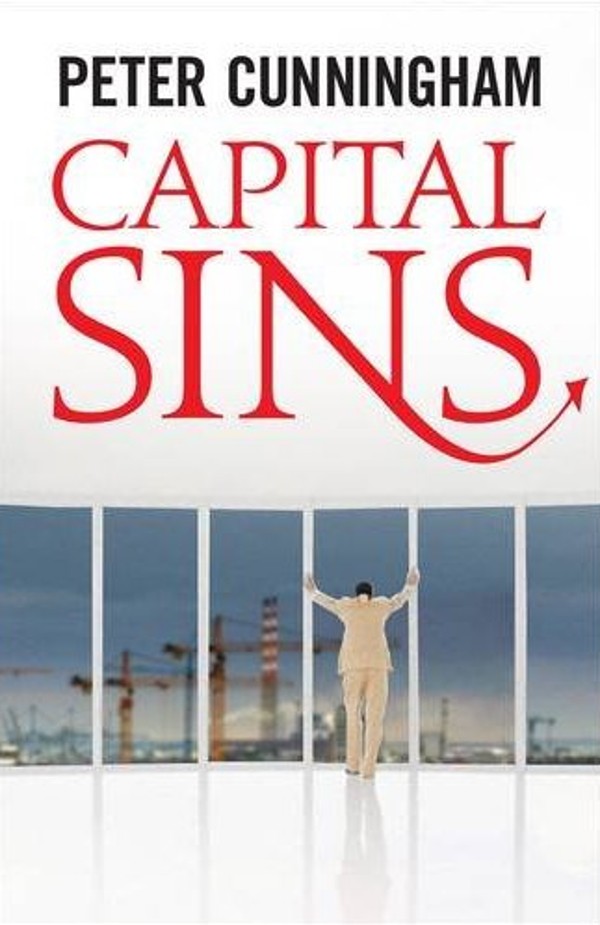
  Incidentally, Peter Cunningham is himself a purveyor of quality thrillers, such as THE TAOISEACH and WHO TRESPASS AGAINST US, so he knows of what he speaks. His latest offering, CAPITAL SINS, is due in mid-June, with the blurb elves wittering thusly:
Ireland, 2006. Financial hysteria grips the nation. No one can speak of anything but the price of property - it is impossible not to make money. Developers gorge on massive loans. Bankers, egged on by politicians, trample over each other in the stampede to lend more and more. Millionaires are created every day as the stock market soars and Ireland audaciously becomes one of the world’s wealthiest nations. But at the heart of this unholy multi-billion euro alliance between developers, politicians and bankers lies a hideous truth: the whole empire is built on sand. Two men face each other over the dark divide. One, Albert Barr, a developer, has everything to lose; the other, Lee Carew, a struggling journalist, suddenly realises that he has stumbled upon the story of a lifetime. And for the bankers, the developers and Ireland’s Celtic Tiger, time is rapidly running out. With devastating accuracy and savage humour, Peter Cunningham’s novel tells the story of the final year of the Celtic Tiger as it has never been told before.
  Nice. But will CAPITAL SINS measure up to Alan Glynn’s WINTERLAND? Only time, that irrepressibly gossiping canary, will tell …

Saturday

You Can’t Handle The Ruth

Good news for Ruth ‘Cuddly’ Dudley Edwards: AFTERMATH: THE OMAGH BOMBING AND THE FAMILIES’ PURSUIT OF JUSTICE makes it onto Crime Always Pays’ long-list for the Longest Subtitle of the Year, alongside Fintan O’Toole’s SHIP OF FOOLS: HOW CORRUPTION AND STUPIDITY KILLED THE CELTIC TIGER. That both have also been nominated for the Orwell Prize, an award which recognises excellence in political writing, is a nifty little coincidence, as Irish Publishing News fails to report in its otherwise excellent coverage.
  Elsewhere, Marcel Berlins reviews Brian McGilloway’s THE RISING over in The Times. To wit:
“THE RISING continues Brian McGilloway’s excellent run of novels featuring Benjamin Devlin, the Irish Garda inspector. He unsuccessfully tries to save the life of a man trapped in a burning barn; the victim turns out to be a drug dealer. He’s called by a former police colleague whose 15-year-old son is missing; that too involves drugs. As the inquiries become more complex, Devlin is faced with a life-or-death crisis very close to him. Devlin bucks the crime-fiction trend by being just a good ordinary cop, a sympathetic family man without too many hang-ups or foibles. The novel is no worse off for that.” – Marcel Berlins, The Times
  Brian, by the way, will be launching THE RISING at the Verbal Arts Centre in Derry on Wednesday evening, the 31st, at 6.30pm, and all are welcome, but particularly those with an excess of cash and a keen interest in purchasing a very fine novel.
  Meanwhile, your humble scribe had a review of Louise Welch’s NAMING THE BONES published in the Sunday Business Post a couple of weeks back, which kicks off like this:
The conventional crime novel tends to unfold over three acts, but Louise Welsh’s fourth novel, NAMING THE BONES, is very much a novel of two halves. In the first half it’s an understated academic novel detailing the travails of Dr Murray Watson, a University of Glasgow English lecturer intent on reviving the reputation of a little-known poet, Archie Lunan, and solving the mystery of his death on Lismore Island 30 years before. Frustrated as he tries to piece together the scanty details of Lunan’s life, Watson is also the dominated party in an affair he’s having with Rachel, the wife of his department head ...
  For the rest, clickety-click here …

Wednesday

The North Will Rise Again

Yon Norn Iron blokes have been busy lately. First up is Stuart Neville (right), who hasn’t been resting on the laurels garnered by his debut, THE TWELVE (aka THE GHOSTS OF BELFAST). Quoth the Scotland Herald:
Neville’s next novel, COLLUSION, is in part a sequel to THE TWELVE. It follows one of the minor characters from his debut, a policeman investigating his missing wife and child, but the novelist says the similarities between the new book and its predecessor end there. “The Twelve is about frustration, about knowing that people will never be held to account for what they did. COLLUSION will not touch on those issues. It has nothing to do with party politics or Stormont.”
  Decades of fatuous Hollywood IRA flicks may have given audiences Troubles fatigue, but there is now an appetite for understanding Northern Ireland. “I think the next 10 years are going to be a very interesting time,” Neville says. “You have to remember that great fiction never emerges until a conflict is over. Look at the Second World War: while that was going on, the only things coming out were propaganda films, but in the years after, it inspired so much. Part of the reason is that, after the fact, you don’t need to be so politically sensitive.”
  For the rest, clickety-click here. Meanwhile, COLLUSION is due in August, with the blurb elves wittering thusly:
Former paramilitary killer Gerry Fegan wanders New York City, hiding from a past he escaped at a terrible cost. But he made a fatal mistake: he spared the life of Bull O’Kane, a ruthless man who will stop at nothing to get his revenge. Too many witnesses survived a bloody battle at his border farm, and now he wants them silenced, whether man, woman or child. O’Kane calls the Traveller, an assassin without pity or remorse, a killer of the purest kind. Back in Belfast, Detective Inspector Jack Lennon, father of one the witnesses, is caught up in a web of official secrets and lies as he tries to uncover the whereabouts of his daughter. The closer he gets to the truth about the events on O’Kane’s border farm, the more his superiors instruct him to back off. When Fegan realises he can’t shake off the trail of violence that has followed him across the world, he has no choice but to return to Belfast and confront his past. The Traveller awaits Fegan’s return, ready for the fight of his life. A fast-paced thriller about duty and revenge, COLLUSION is a blistering sequel to THE TWELVE, one of the most highly acclaimed debuts of recent years.
  Elsewhere, Garbhan Downey has just published THE AMERICAN ENVOY, even though it seems no more than minutes since he brought you THE WAR OF THE BLUE ROSES. Quoth the blurb elves:
Money ... Power ... Drugs ... Women. Just another day at the office ... Boston journalist Dave Schumann is in line for a major posting from the US Secretary of State. But instead, his big smart mouth gets him exited to Derry, the rainiest city in Ireland. There, the new envoy is forced to contend with psychotic drug smugglers, a leftie shock-jock who wants to burn him live on air and a renegade security team who are monitoring his every move. Schumann’s letters to his father and friends reveal his increasingly precarious – and hilarious – struggle to cope with the most thankless job on earth. And that’s before he discovers there’s a spy in the camp who has dark plans for the Presidential visit.
  Finally, and even though his novels are set in the South of Ireland, Brian McGilloway was born in Derry, which makes him a Nordie whether he likes it or not. The video below has Brian wibbling on about the latest in the Inspector Devlin series, THE RISING, which hits a shelf near you next month. Roll it there, Collette ...

Monday

Mi Casa, Su Casa: Brian McGilloway On the Essence of Crime Fiction

A Grand Vizier writes: The motives behind ‘Mi Casa, Su Casa’ are twofold. First, the idea is to give guest bloggers the few molecules of oxygen of publicity Crime Always Pays can provide. Secondly, even we’re sick of listening only to ourselves, and we reckon some new voices will provide fresh perspectives on crime fiction in general, and Irish crime fiction in particular. And so, with minimum fanfare – a tiny tootle there, please, maestro – here’s Brian McGilloway (right) on the nexus between real and fictionalised crime.

‘The Obligation To Tell the Truth’

“This past week in Strabane, a 27-year-old man was abducted, taken just over the border, shot twice in the chest, and left to die outside a small Catholic church. The man’s murder caused outrage and rumour in equal measure in the local area.
  “Twenty miles away, a man, having served eight years of a 16-year sentence for the rape of a 91-year-old woman, who died two weeks later of a heart attack, perhaps precipitated by her ordeal, was released from prison and moved into a small farmhouse near a community with a number of lone, aged females. Those in the surrounding area have no control over who has moved into their midst. Some argue that the man has served his sentence. Others argue that his seeming lack of remorse and refusal to comply with police procedures make him unsafe in such a community.
  “These two events have, unsurprisingly, featured highly in our local media this past week. However, on a more personal level, in recent days, over a dozen of my colleagues have smiled knowingly at me and said; ‘That’s the plot of your next book taken care of then, eh?’
  “Whilst the comment was, for the most part, intended in a good-humoured way, and I’m not in the least egotistical enough to see a link between the two things, it did set me thinking. Firstly, I found the recent shooting both shocking and deeply frightening. Strabane/Lifford is a small, fairly tight-knit community. Murders happening in large cities are somehow more anonymous, although none the less horrible for that. In a small community though, it’s perfectly possible that the man who pulled the trigger that killed the 27-year-old Strabane man, or who raped a 91-year-old spinster, could be standing behind my wife and children in the corner shop, could be the person who drives the bus into town, offers you the Sign of Peace in Church. Someone who thought little of taking another person’s life in such a brutal and violent manner.
  “Secondly, the quip about the Devlin books also gave me pause for thought. As I started drafting book four, THE RISING, I found myself questioning the use of violence and crime in the books I write and those I read. In a time when Hollywood seems preoccupied with violence as the new pornography, is there something deeply flawed in using crime for entertainment?
  “But that, to my mind, disregards the purpose of crime fiction. I wrote my first novel around the time of the birth of my first son. I am convinced that that event was at least a catalyst in my writing. Nothing creates an awareness of the threats of the world quite as much as a new-born child. Particularly in post-Troubles Ireland, where a mixture of the Ceasefire and increased affluence has, paradoxically, seemed to create more criminal activity. And as the cases of this week show, all too often justice is not done, or those who commit crimes not necessarily brought to justice in a manner most people would like.
  “Yet crime fiction allows that to happen, imposing some form of morality and order on a world that seems increasingly lacking in both. Our detectives in books achieve clearance rates massively above the average in Ireland. And perhaps offer us some vicarious hope that good will always triumph. The books themselves allow us to safely face our fears, safe in the knowledge that some form of resolution will be imposed in a manner unlike real life, much as the ancient Greeks experienced catharsis watching dramatic tragedies.
  “Whilst I wouldn’t claim that crime fiction necessarily matches Greek Tragedy, its purpose and its appeal in raising difficult issues to a wide reading public far outstrips most literary novels. James Lee Burke [right] argues that it is the artist’s obligation to ‘tell the truth about the period he lives in and to expose those who exploit their fellow man.’ I believe few genres are as well placed to do this in modern Ireland than the crime novel and so, as I started writing THE RISING today, I did so not with a voyeuristic use of violence but a dedication to deal truthfully with issues that affect myself, my children, and those who live in Ireland in 2008. In this I believe I am no different from any other writer named in this blog over the past year.
  “And I am proud to be among their ranks.” – Brian McGilloway

Brian McGilloway’s GALLOWS LANE will be published on April 4