Benjamin Black’s – aka John Banville’s – series of mystery novels set in 1950s Dublin grow increasingly impressive, even as his protagonist, the pathologist Quirke, drifts further into existential ennui. Even the Dead (Penguin, €16.99), the seventh novel to feature Quirke, opens with this most reluctant of heroes on sabbatical, suffering from “mental blanks and momentary delusions” as a result of a beating he suffered two years previously. When a young man is discovered dead in suspicious circumstances in the Phoenix Park, however, Quirke rouses himself to go prowling “the mean and mendacious little city” with his companion in arms, Inspector Hackett. The pacing is as meandering as ever, as Black regularly digresses from the plot to explore Quirke’s bewilderment at the world and his place in it, and the story is again concerned with the malign power exercised by those who mix politics and religion that has proved fertile ground for Black in the past, but the lush prose (“the sky was an inverted bowl of bruised blue radiance, except in the west where the sunset looked like a fire-fight at sea”) is underpinned by a brutally noir moral relativism. Quirke, observes his daughter Phoebe, believes life consists of “going through the motions, observing the forms, doing the right thing.” That may be the case, but much like his creator, Quirke does the right thing in a deceptively effective way.
Freedom’s Child (Harper Fiction, €19.50), the debut thriller from Jax Miller, an American author domiciled in Ireland, opens in dramatic fashion with the line, “My name is Freedom Oliver and I killed my daughter.” Living under an assumed name in a witness protection programme in Oregon, Freedom – who describes herself as “a murderer, a cop killer, a fugitive, a drunk” – breaks cover for the first time in almost two decades when said daughter, Rebekah, goes missing. Hunted by the recently released Matthew Delaney, who went to prison for 18 years on the basis of Freedom’s testimony, Freedom travels to Kentucky to investigate the fanatical Christian cult established by the man who adopted Rebekah, Virgil Paul. Plausibility is at a premium in Freedom’s Child, and language is here a rather blunt instrument, but Miller is less concerned with narrative subtlety and delicate prose than she is with creating a propulsive, full-throttle tale of revenge and redemption. The overall effect is a kind of literary grind-house, with Freedom Oliver a larger-than-life avenging angel driven by a host of demons, a self-confessed promiscuous drunk and glutton for punishment who might well be Lisbeth Salander’s long-lost twin.
French author Dominique Sylvain’s second novel to be translated into English, Dirty War (Quercus, €13.99) opens in Paris with the horrific death of lawyer Florian Vidal, who has been tortured to death with a flaming tyre around his neck. When Commandant Sacha Duguin investigates, he discovers that Vidal is a business lawyer specialising in arms contracts for Richard Gratien, aka ‘Mr Africa’, a shadowy figure who has made a fortune from brokering deals in illegal weaponry to corrupt African regimes. It’s a fascinating set-up, and Sylvain expertly muddies the waters with a dispassionate account of the tensions that exist between the institutions – policing, political and judicial – responsible for counter-terrorism. Unfortunately, the novel is subtitled ‘A Lola and Ingrid Investigation’, and Lola and Ingrid – a former police Commissaire and an exotic dancer, respectively – repeatedly interrupt the narrative flow as Sylvain inserts them into the story to no great effect other than to duplicate Sacha Duguin’s investigations and to provide unnecessary exposition via dialogue.
Sinéad Crowley’s second novel, Are You Watching Me? (Quercus, €17.99), reprises the character of Detective Claire Boyle, who was heavily pregnant during Crowley’s debut, Can Anybody Help Me? (2014). Delighted to be back at work after maternity leave, the Dublin-based Boyle investigates the apparently pointless murder of the aging, gentle James Mannion in his home; meanwhile, Liz Cafferky, Ireland’s newest media star and the communications executive with Tír na nÓg, a drop-in centre for old men, finds herself stalked by Stephen, who believes that Liz’s smile “was aimed at him; her words meant for him alone.” Crowley returns to the themes that underpinned her debut – the chilling vulnerability of a woman targeted by a psychologically damaged man, and the anonymity afforded by modern communications technology – but this is a markedly more assured offering. There’s a passionate intensity (and a very neat plot twist to boot) in Crowley’s poignant depiction of a whole swathe of old men abandoned by society, while Stephen, ostensibly the villain of the piece, is given a surprisingly sympathetic reading. A compulsively readable thriller, Are You Watching Me? is an absorbing variation on the ‘domestic noir’ genre.
The Way of Sorrows (Blue Rider Press, €20.50) concludes Jon Steele’s ‘Angelus Trilogy’, and does so in very impressive style. The Watchers (2011) and Angel City (2013) established the scenario in which Harper, a private detective, discovers that he is in fact an angel in human form, and engaged in an aeons-long battle with the forces of darkness for possession of humanity’s soul. Here Harper sifts through the wreckage left behind by Evil’s onslaught at the end of Angel City, blending Chandleresque witticisms into a contemporary tale of the apocalypse as the action moves from Lausanne to Alaska and on through Russia to the explosive climax in Jerusalem, as Harper and his colleagues strive to make good on “a prophecy about a child conceived of light, born into the world to guide the creation through the next stage of evolution.” It’s an novel of jaw-dropping ambition and imagination – Zoroaster, the Egyptian pharaoh Akhenaton, Jesus Christ and the space probe Voyager all play their part – as Steele, formerly an award-winning journalist, gives Harper an appropriately fabulous, epic finale. ~ Declan Burke
This column was first published in the Irish Times.
Showing posts with label Jesus Christ. Show all posts
Sunday
Thursday
ZERO Hour # 2: That All-Important ABSOLUTE ZERO COOL Update
First off, and as some of the Three Regular Readers will be aware, I got in touch last week with the crime fiction community, craving a boon and asking that they might give my forthcoming tome a mention, if it wasn’t too much trouble. As always, the response to such a request has been little short of humbling, and if you’re a regular visitor to the on-line network of crime and mystery blogs, I apologise here and now if you’re already sick to death of hearing about ABSOLUTE ZERO COOL. By the same token, the small but perfectly formed Liberties Press is competing on the same playing field as publishing behemoths with literally millions to spend on promotion and marketing, so I really can’t afford not to throw myself upon the kindness of strangers. Should I feel embarrassed about relentlessly plugging AZC? Perhaps. Do I? Not in the slightest.
Because here’s the thing. I can’t guarantee you that you’ll love or even like AZC, but I can guarantee that it’s fresh and different, and ‘unlike anything else you’ll read all year’, as Ken Bruen says on the jacket cover. In other words, I’ve worked very hard to create a crime novel that doesn’t trade on the usual conventions and tropes, that doesn’t feature the latest world-weary and cynical boozy PI, or morosely introspective Scandinavian, or quasi-Bond hero defeating the forces of evil via one interminable helicopter chase after another. I can’t say it’s the best book you’ll read all year, and I can’t even say that you won’t have come across a similar story before; what I can say is that you won’t find in AZC what seems to me to have become, if I may be so bold as to make sweeping generalisations, the defining characteristic of the vast majority of contemporary crime novels, which is, however well written any book is, the simplistic pieties of some liberal sadist masquerading as an authentic exploration of modern society, but which is first and foremost designed to ring bells on cash registers.
Anyway, and back to my original point: a heartfelt thanks to all of you who have responded so positively to my request for a plug or a mention at your own on-line lairs. I thank you all kindly …
Meanwhile, I’ve been interviewed over at Speaking Volumes, and good fun it was too. Here be an excerpt:
Which fictional character would you most like to meet? What might you say / ask them?For the rest, clickety-click here …
“Jesus Christ. Which isn’t to say that Jesus of Nazareth is a fictional character per se; as far as I know, He did exist. What I’m fascinated by — and I’m not religious, or spiritual — I’m mostly fascinated by the narrative process and how Jesus of Nazareth became Jesus Christ. And I’d like to sit down with Him and find out what His real story was, what it was He hoped to achieve. Did He believe Himself at the time to be the Son of God, or is the metaphysical aspect of his mission and message the most potent case of historical revisionism ever written? And if so, to what extent?
“I’d love to know what Jesus of Nazareth Himself believed. Was He simply trying to reform the Jewish religion of the time? Was His message hijacked for political purposes? I think that would make for a fairly interesting conversation.”
Finally, the ever-radiant and very fine writer Arlene Hunt was kind enough to go the extra mile whilst plugging AZC, with the gist of her considered opinion running thusly:
“Laugh-out-loud funny in places, Twin Peaks-tastic in others, ABSOLUTE ZERO COOL kept me up a number of late nights snuffling and tittering as Billy Karlsson dragged me from one jaw-dropping scene to another … A cracking, adrenaline-popping rollercoaster of a novel. I heartily recommend it.” - Arlene HuntI thank you kindly, ma’am …
For anyone wondering what all the fuss is about, feel free to click on this link here …
Labels:
Absolute Zero Cool,
Arlene Hunt,
Declan Burke,
Jesus Christ,
Ken Bruen
Sunday
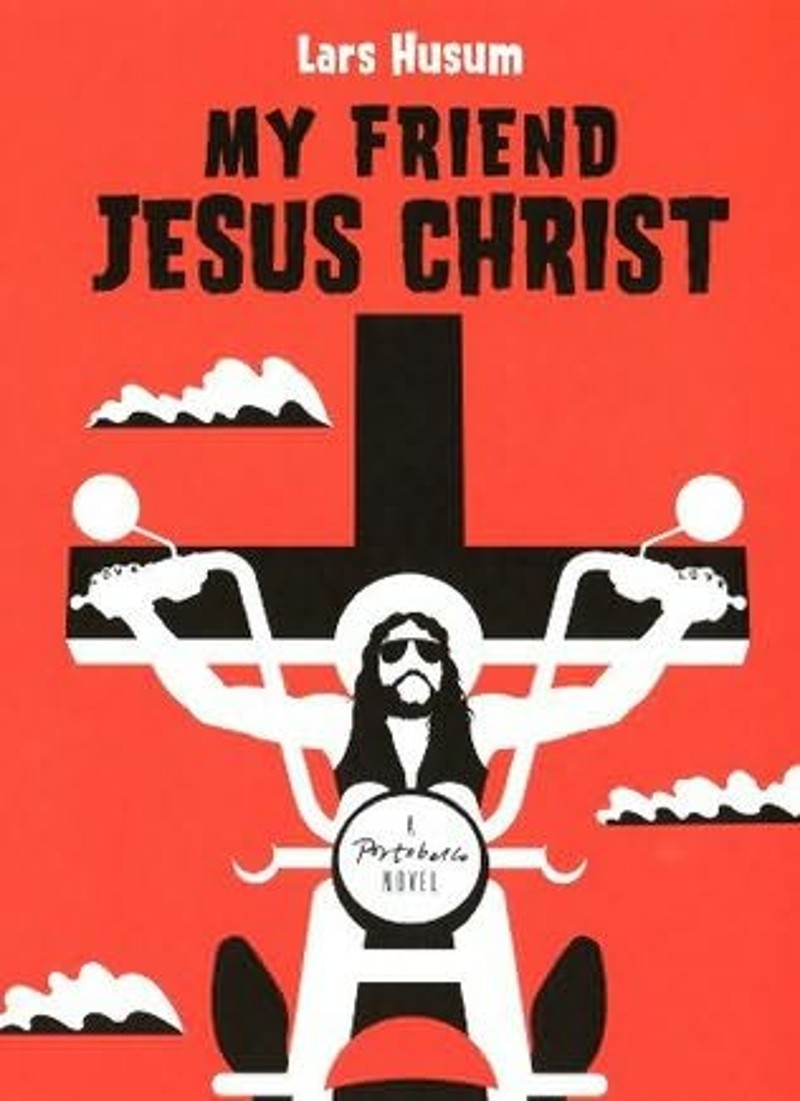
Nobody Move, This Is A Review: MY FRIEND JESUS CHRIST by Lars Husum
Danish 13-year-old Nikolaj - aka Niko - is orphaned when his parents die in a car crash. Reared by his older sister Sanne - aka Sis - Niko becomes dependent on Sis’s love, and resorts to self-harm and violence to ensure the dependence is mutual. The downward spiral into self-loathing culminates in Niko’s battering his girlfriend, Silje, the consequences of which eventually cause Sis to commit suicide. At the lowest moment of Niko’s life, a strange man appears in his living room, claiming to be Jesus Christ …Lars Husum’s debut is similar in tone to early work by Bret Easton Ellis (especially Less Than Zero) and Chuck Palahniuk. His protagonist, Niko, is a wilfully abrasive character intended to challenge conventional mores, as the potentially provocative title suggests. While his circumstances, and particularly the death of his parents at such a formative age, lend themselves to the reader’s sympathy, Niko is a bland kind of sociopath. A peeper and a stalker, he regularly provokes fights and mutilates himself.
All of this is perversely designed to strengthen the bond between Niko and his older sister, Sis, and Husum is effective in the early part of the novel at achieving his aim. The fact that Niko appears to lack the courage of his convictions, however, make him an irritating protagonist.
The fact that Niko’s mother was a much-loved pop star in her native Denmark plays a significant part in the story, especially near the end. It’s also quite convenient for Husum, given that Niko, who has in part inherited his mother’s fortune, has plenty of free time in which to indulge his navel-gazing.
In effect, we are presented with a bratty, self-absorbed rich kid with virtually no redeeming features other than his brutal honesty about his emotional and psychological shortcomings. This honesty, however, only reinforces those characteristics of Niko that were unlikeable to begin with.
Niko’s downward spiral into utter self-loathing finally reaches rock bottom when he batters his girlfriend, Silje, into a coma. When his long-suffering Sis hears the news, she finally gives up on Niko - and herself. Despite the fact that she is herself in a happy relationship, and has recently had a baby son, Sis commits suicide.
Shortly afterwards, Niko wakes up one morning to discover a hairy, sandal-wearing man in his apartment. The man tells Niko that he is Jesus Christ, and has come to help. Tough love is the order of the day.
In order to help himself, Niko must first help others. On Jesus’ advice, he leaves Copenhagen behind to move to Tarm, the rural part of Jutland where his mother grew up. Embraced by the locals, Niko establishes a team, or ‘family’, that will assist him in his ultimate goal - to rehabilitate the broken Silje.
Husum’s style is pleasingly direct, and not without a coarse but very effective black humour. The idea of dropping a Jesus Christ figure - Husum never confirms if the character is real or a figment of Niko’s imagination - into a modern city in a Western, secular world is a bold stroke, and throws up all manner of fascinating potential narrative strands.
Unfortunately, Husum fails to capitalise on the idea. The Christ character engages only fleetingly with Niko, and the conceit seems only half-realised. While the Christ character tells Niko that he is the Christ who ‘came with a sword’, for example, there is never any sense that there will be consequences for Niko if he fails to take Christ’s advice.
For that matter, and despite some superficial changes, Niko’s character hardly changes throughout the novel, a fact confirmed by the rather squalid finale. Nonetheless, and despite his reprehensible behaviour, and admitting to such, he appears to be universally loved by those he meets.
Niko isn’t particularly handsome, and he’s far from charming. Neither does he squander his money on his friends. In fact, we are given no good reason as to why people might want to spend time in his company, let alone actually like him.
It’s possible, of course, that Husum intends the novel to be a parody of the liberal Christian culture of contemporary Western civilisation. Hence the biker-style Jesus, and the Pollyanna characters who take the violent and self-absorbed Niko at his word when he asks for forgiveness. But while the novel is undoubtedly archly contrived, it lacks the persuasiveness of satire. Husum paints in broad strokes, and few of his characters have the kind of depth that might make them convincing acolytes to Niko’s very narrow definition of what constitutes redemption.
Another irritating aspect of the novel, the number of coincidences it contains, could also be considered an element of an archly contrived satire, and it’s probably best to steer clear of accusing a writer of MY FRIEND JESUS CHRIST of introducing deus ex machina. Unfortunately, this novel thrives on coincidence. Denmark has a population of roughly five million people, but Niko regularly bumps into characters on the street, or in wine shops, or finds that they have friends in common. The fact that Silje is a singer with a band would be sufficient to establish a meeting of minds when she and Niko first meet, given the fact that Niko’s mother was a famous pop singer; but Silje is not just a singer, she is the singer in a band that do cover versions of Niko’s mother’s songs.
MY FRIEND JESUS CHRIST is a potentially subversive conceit swamped by a self-indulgent and repetitive narrative. With a stronger editor on board, the novel could well have said important things about liberal Christianity in Western culture, and the West’s attitude to religion in general. At the very least it might have been an entertaining novel. As it stands, however, MY FRIEND JESUS CHRIST is a heavy-handed satire that lacks the wit and depth to truly offend or inspire. - Declan Burke
MY FRIEND JESUS CHRIST is published by Portobello Books.
Labels:
Jesus Christ,
Lars Husum,
My Friend Jesus Christ
Subscribe to:
Posts (Atom)