“Everything is very plain and modern now,” a dying man tells the author Jack London roughly halfway through Minds of Winter (riverrun), warning the writer against the gothic, supernatural excesses of the yarn he is spinning in a hospital ward. The reader may well laugh out loud; Ed O’Loughlin’s fourth novel is an uncompromising throwback to a time when story was king, a spellbinding tale of adventures and explorers, spies and outlaws, of derring-do, self-sacrifice and impossible feats of endurance.
The story opens with a Prologue provided by a feature published by journalist Maev Kennedy in The Guardian in 2009, in which Kennedy writes about the mystery of how a ‘chronometer which was supposed to have sunk with a ship on the Franklin North-West Passage expedition in 1845 … somehow ended up back in London as a carriage clock.’ The novel then moves forward to the present day, introducing Fay and Nelson, who are 120 miles inside the Canadian Arctic Circle. Strangers to one another, both are searching – although they don’t know it yet – for the elusive chronometer.
Another chapter, another leap through time and space: we find ourselves in Van Diemen’s Land in 1841, as Sir John Franklin prepares to host a ball on board his ship The Erebus, the ship fated to be lost four years later in the vain search for the North-West Passage. And on the novel goes, gambolling forward and back in time, a Russian doll of a novel in which stories fold into one another, leading on deeper into the mystery via Roald Amundsen’s search for the South Pole, Abwehr spies during WWII and Jack London’s adventures as a spy on the Korea-Manchuria border, all of it underpinned by O’Loughlin’s musings on the direction man might take once the tools of discovery – maps, compasses, chronometers – have fulfilled their promise and charted all there is to be known. “A globe was a globe and you could not fall off it,” observes Morgan, a cartographer. “But a map was a map, a metaphor, full of judgements and choices and victories and regrets; a map was built on hacks and heuristics and mistakes and lies, cracks through which you might, just maybe, someday slip away.”
It’s a theme O’Loughlin returns to frequently, such as when Amundsen, on the island of Madeira and undecided as to whether to strike out for the North or South Pole, pauses before making his final decision: “He could stay here forever, dissolved in this air. But some tiny flaw in the fabric of the universe, some original sin in space and time, determined that he was doomed to exist, to be one thing or another.”
It’s a beautifully written novel that blends a kind of pragmatic poetry with a lyrical interpretation of science – the Greenwich observatory, for example, is “a shrine … where time was substantiated from the sky and consecrated in chronometers, then served to the ships that passed down the reach.” O’Loughlin, whose debut novel Not Untrue & Not Unkind was longlisted for the Booker Prize in 2009, can knock out a well-turned line with the best of them, even when he is sabotaging his characters’ philosophical musings with a mischievous sense of humour. It’s hard to believe, for example, that the metaphor of the search for the missing chronometer, which relentlessly measures the fictional concept of linear time, is anything more than an old-fashioned McGuffin given the swirling ebb-and-flow nature of the narrative.
That said, there’s no doubt that Minds of Winter is a serious novel on an important theme. What makes it such an absorbing read is that O’Loughlin doesn’t believe that ‘serious’ and ‘entertaining’ are mutually exclusive concepts. In the sheer brio of its storytelling, it brings to mind Salman Rushdie’s The Enchantress of Florence or David Mitchell’s Cloud Atlas – profound, yes, but terrific fun too. ~ Declan Burke
This review was first published in the Irish Examiner.
Showing posts with label David Mitchell. Show all posts
Tuesday
Friday
And JC Arose And Spoke To Many
Off with yours truly to the launch of John Connolly’s THE WHISPERERS last Wednesday evening, which was held in the very pleasant environs of the Gutter Bookshop in Dublin’s Temple Bar. Being a perverse kind of Dark Lord, JC refused to read from THE WHISPERERS (clickety-click here for the prologue), instead offering a snippet of his current project, which appears to be a follow-up to THE GATES, which is all sorts of good news. The snippet in question featured four of the seven dwarves (that’ll be the recession, then), some of whom were in mortal danger of being tossed due to their unnecessary aggressiveness, plus a boy-band, a crumbling castle and a pop video shoot, and suggests that the book will be a very funny one indeed. As always, JC was besieged by fans afterwards in an impromptu signing session; as always, and because the man seems incapable of signing a book without engaging in banter, the signing session took at least an hour. It’s hard to judge these things qualitatively, but from the sounds of it, JC was in even better form by the end of it all than he was at the start, and he was plenty lively at the start.
(By the way - for those unfortunates still yet to escape from Direland, John Connolly features on The Late, Late Show tonight (Friday). If you miss it, the RTE iPlayer can be found here …)
Meanwhile, lurking with intent in the vicinity were Arlene Hunt and Declan Hughes, and Kevin McCarthy and Ed O’Loughlin. Bob Burke was there too, apparently, but I managed to miss him. Boo. Bob Johnstone, the owner of the Gutter Bookshop, seems to be a nice bloke, and we can only wish him well with the new venture. Opening a bookshop in these straitened times, in Ireland, is either a case of counter-intuitive genius or noble lunacy. Either way, Bob gets our vote. Apparently he gets the thumbs up from The Artist Formerly Known As Colin Bateman too, for lo, Bateman is due to do an event at the Gutter Bookshop next month.
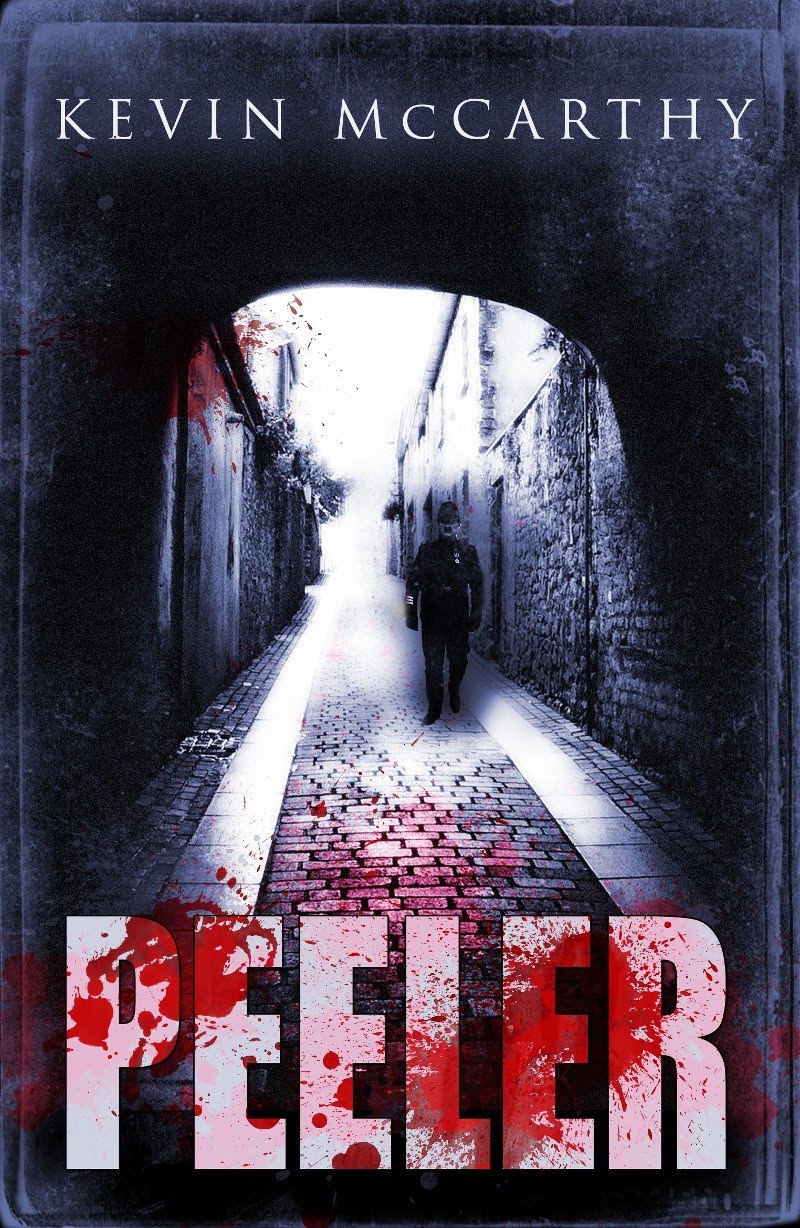
In other updates - Kevin McCarthy publishes his debut, PEELER, next month, a potentially fascinating tale of a murder investigation set in Ireland in the 1920s, in which the IRA and the Black-and-Tans chase the same killer. It’s on my bookshelf and due a reading in the immediate future. Meanwhile, Ed O’Loughlin, who got himself a Booker long-list nomination for his debut, NOT UNTRUE & NOT UNKIND, had the news that his second novel, a dystopian sci-fi, will be published next year. Nice. Elsewhere, Arlene Hunt’s latest, BLOOD MONEY, you should know all about, while Declan Hughes’ new offering, THE CITY OF LOST GIRLS, is an absolutely tremendous read, even by his standards, and a whole new gear for one of the best crime writers around. Truly, it’s a terrific novel. Hughes fans are in for a real treat. He should be launching said tome next month too. Apparently there’s a review in Sunday’s New York Times …
While outside for a crafty smoke, I also met Helen, who confessed - in public! - to having read THE BIG O. She also said very nice things about the Princess Lilyput, thus making herself a new friend for life, whether she wants one or not. I thank you kindly, ma’am.
And as if all that wasn’t nice enough, the lovely Margaret Ward and the equally lovely people from Hodder Stoughton were good enough to promise me some tasty titles in the near future, one being the new Tana French, FAITHFUL PLACE, the other being David Mitchell’s eagerly anticipated THE THOUSAND AUTUMNS OF JACOB DE ZOET.
Woot, etc.Finally, I decamped to the nearby Porterhouse in the company of Kevin McCarthy and Ed O’Loughlin for a very pleasant couple of hours chat about books ‘n’ suchlike over a few dry Pimms. Unfortunately, I was on the non-alcoholic Pimms, having been to the dentist on Tuesday in the throes of man-agony, there to discover I was suffering from an infection of an abscess. Picking up some super-strong antibiotics from the chemist (I’m immune to Penicillin, for some bizarre reason), the chemist warned me not to drink booze on top of the pills, which is something I usually do for the extra buzz, even if I hadn’t planned on drinking. ‘Of course I won’t,’ says I. ‘No,’ says she sternly, having caught a glint in my eye, ‘I’m serious - you’ll end up in hospital if you drink alcohol even two days after the course finishes.’ Now, staying off the booze shouldn’t be a huge problem, except my brother’s stag weekend takes place in Galway this weekend. And now I’m curious. Like, seriously - how strong can gum-healing antibiotics really be?
There’s only one way to find out, isn’t there?
Lately I have mostly been reading: THE CITY OF LOST GIRLS by Declan Hughes, 61 HOURS by Lee Child, and THE GOOD MAN JESUS AND THE SCOUNDREL CHRIST by Philip Pullman.
Tuesday
What Would Ray Chandler Do?
Last year, over coffee, a good friend of mine asked if I’d be interested in joining a book club, which request sent hot frothy milk spurting from my nose. No thanks, says I, as politely as you can after showering a lady friend in second-hand latte, I’m afraid I have trouble finding the time to read the books I already need to read without adding another to the list on a monthly basis. I also mumbled something about being a bloke, and not wanting my testosterone throwing its weight around the room. What I didn’t say is that my wife is in a book club, and most of the titles she brings home seem to reek of the most irritating kind of smug, middle-class respectability, which probably says a lot more about me than about the books in question. Anyway, the Irish bookseller chain Eason recently published their ‘Best Books of the Noughties’ Top 50, which list was voted on by the public in a poll conducted by the on-line Eason Book Club, and it’s mildly dispiriting but not entirely surprising to find that THE GIRL WITH THE DRAGON TATTOO and WHEN WILL THERE BE GOOD NEWS? are the only crime titles therein, unless you want to stretch the boundaries and include NO COUNTRY FOR OLD MEN and THE WHITE TIGER. Given the week that’s in it, it’s disappointing that the list featured no Irish crime writers at all, and this for a decade in which Irish crime fiction exploded onto the bookshelves, in a poll of Irish readers conducted by an Irish bookseller. Depressing stuff, although I’m not necessarily blaming anyone, because the list seems to be made up of the kind of stuff people are directed towards today, including a lot of Booker Prize nominees / winners, and the usual kind of Book Club bait you find in such company. That said, there’s some cracking novels there too – a couple of Banvilles, David Mitchell’s CLOUD ATLAS, two Cormac McCarthys, Sebastian Barry’s A LONG, LONG WAY, the Dark Materials trilogy, a Margaret Atwood, a John McGahern …
So what’s my beef? Well, I’m just wondering where the crime titles are. It’s either true that crime fiction is hugely popular or it’s not; and if it is, how come it never shows up on such lists? Is it the case that people tend to vote for the kind of thing they think they should be voting for, rather than what they like, and actually read? Were – just for random example – SHANTARAM, THE RELUCTANT FUNDAMENTALIST and I’M NOT SCARED really three of the fifty best novels of the last decade, or are they simply three of the novels people had shoved under their noses by a combination of booksellers, broadsheets and the arbiters of public taste? Or is the list simply skewed towards the conventional kind of Book Club book because it’s a Book Club list?
Yet more questions: does my antipathy to Book Clubs stem from the fact that I write books that are highly unlikely to feature on Book Club lists, even if I could get them published? Am I, in fact, a scruffy urchin shivering in the snow with my nose pressed up against the drawing-room windows, craving the warm glow of smug middle-class respectability?
I should say at this point, if you haven’t already guessed, that I’ve gone bi-polar about writing, mainly due to the pointlessness of the exercise. And it’s not just an up-and-down experience – it’s the kind of bi-polar in which you’re up and down at the same time, which makes for an interesting tone in the piece I’m working on at the moment. I have a guy who’s going through the Beckett thing of ‘I can’t go on, I’ll go on’, a kind of passive acceptance of his need for momentum, even as he concedes that his best efforts are a waste of time. He has his own reasons for not wanting to engage with the rest of the characters, and that’s fair enough, but I’m very much afraid that he’s as likely to just throw himself off the ferry he’s on right now as do something constructive, or destructive, or at least do something that’s interesting to potential readers. Maybe it’s the paralysing stasis that’s affecting Ireland right now, as it grinds to an economic halt with precious little direction from those responsible for such things, but there’s every chance the chap in the story will just down tools and call a sit-in protest on the top deck of the ferry, a kind of one-man campaign of civil disobedience against being forced to jump through hoops on behalf of an audience that simply doesn’t exist. What would Chandler do? He’d have a drink, and send a guy through a door with a gun already in his hand … but sometimes even that, or Chandler, isn’t enough to get the blood stirring.
Incidentally, my wife’s Book Club is this month reading FOR WHOM THE BELL TOLLS, on the basis that one of the ladies decided it was high time for some proper reading. Good for her.
Recently I have been reading: IF I NEVER SEE YOU AGAIN by Niamh O’Connor; THE RISING by Brian McGilloway; THE MARRIAGE OF CADMUS AND HARMONY by Robert Calasso; THE SNOWMAN by Jo Nesbø.
Sunday
Gonz, Baby, Gonz
A strange old week, folks. First off, heartfelt thanks to everyone who left a comment on the post below, and those of you who got in touch privately, promising to pledge money should I decide to go ahead and self-publish BAD FOR GOOD / A GONZO NOIR. The reaction was, for me, phenomenal: I’d have been delighted with twenty or so responses, and over the moon with thirty. To achieve more than double that gives me serious pause for thought, especially as so many people made multiple pledges (or pledged for multiple books). What began as a whimsical notion is now a practical option. But there’s more to it than hard cash. For someone struggling to have themselves heard, as most writers seem to be, that kind of support is literally invaluable. What I need to do now is spend some time researching the project meticulously, ensuring my figures are right, investigating the amount of time and energy the project will consume, and – most importantly – ensuring that there’s no possible glitch that could result in someone making a pledge and not receiving a book.
I also need to take on board more experienced voices than I, some of whom have cautioned against the amount of work involved in self-publishing, which will by necessity eat into my own writing time; some have very kindly suggested that BAD FOR GOOD / A GONZO NOIR is too good to ‘waste’ on self-publishing; while others have stated in no uncertain terms that self-publishing at this point in my ‘career’ (koff) would prove hugely detrimental in the long term. Now, I’m not sure how much more detrimental a self-published book could be when compared with no published books at all, but the advice was well-intentioned and has been accepted as such. I’ll keep you all posted as to how it’s panning out; and again, many thanks for all the support.
Meanwhile, in a not-unrelated matter, John McFetridge has taken my tentative suggestion about starting up a writers’ co-op and given it legs. In fact, he’s started a writer’s co-op, established a website, and already there seems to be a real buzz building around it. Seems to me that the real gonzo noir could well be coming together as we speak; I’ll be getting behind the project 100%. For more details, clickety-click here …
Finally, I got an early look at ‘The Girl With the Dragon Tattoo’ movie this week. I’m one of the very few people, apparently, who wasn’t overly impressed with the novel (I didn’t make it past page 120), but I tried to set that aside for the duration of the movie. What struck me most forcibly about it was how quaint it all seemed, if not old-fashioned: the wealthy industrialist Vanger commissioning Blomkist to investigate the disappearance of his niece was in effect the opening chapter of THE BIG SLEEP; the island where the disappearance took place has only one bridge in or out, making it a locked-room mystery; at one point, Blomkvist is called into a drawing room before the extended Vanger family, and I half-expected the (Nazi) Col. Mustard to be denounced as the killer, the foul deed taking place in the library, with a spanner. Apparently Stieg Larsson dotted the novel with references to Agatha Christie and Dorothy L. Sayers, et al, which suggests that the book is intended as an homage to the Golden Age of mystery writing; that’s all very well and good, but it hardly makes for cutting-edge fiction, nor movie. Michael Nyqvist, playing Blomkvist, is a terrific actor, and acquits himself very well, but I found it hard to believe in the chemistry between he and Lisbeth Salander; indeed, I found the character of Salander entirely artificial, an impenetrable and unlovely IT idiot savant given sullenness, body piercing and chain-smoking in lieu of any real rebellion. For a movie that runs almost two and a half hours (quite long for a movie thriller), there’s precious little by way of depth of characterisation; meanwhile, the most interesting aspect of the story, the establishment of a pro-Nazi organisation in neutral Sweden during WWII, was given only a cursory nod, just enough to taint the bad guys with evil. The story also suffers from the usual faults associated with the gifted amateur sleuth: despite the fact that the local cop has spent 40 years obsessing on the disappearance of Vanger’s niece, for example, Blomkvist finds a new lead almost immediately on taking the case; and it still makes no sense that an obscenely wealthy man, who could afford any investigator on the planet, would choose to employ a man whose name has been very publicly disgraced for getting his facts wrong. As for the more modern aspects of the movie: there’s a nasty and graphic scene involving Salander that leaves a bad taste in the mouth, all the more so that it’s unnecessary in terms of establishing character; and there’s far too much emphasis (not to mention trust) placed on the internet as a source of ‘clues’ whenever the story needs to be shunted along. And that’s my two cents.
This week I have been mostly reading: CLOUD ATLAS by David Mitchell (superb); THE MERCHANT OF VENICE by William Shakespeare; NAMING THE BONES by Louise Welch; and EARTH IN UPHEAVAL by Immanuel Velikovsky.
Tuesday
“No Crime Fiction, Please – We’re Irish” # 113
We’re in something of a quandary, folks. The good news is that of the six Irish writers nominated on the long-list for the €100,000 2008 International IMPAC Dublin Literary Award – Claire Kilroy, Patrick McCabe, Colum McCann, Alison Jameson, John Boyne and Michael Collins – Kilroy, Boyne and Collins tend to use crime plots to keep their pages turning. Trouble is, neither the delectable Ms Kilroy (TENDERWIRE) nor the pout-tastic Collins (THE SECRET LIFE OF ROBERT E. PENDLETON) are particularly impressed by crime fiction, while self-confessed crime nut Boyne has been nominated for THE BOY IN THE STRIPED PYJAMAS, which is acted out against the backdrop of one the greatest crimes of the 20th century but isn’t a crime novel itself. Boo, etc. Meanwhile, kudos to the Irish Times for milking every last green drop of Irishness out of the list thusly: “Three other nominees with Irish connections are Dane, Christian Jurgensen and English writer David Mitchell, who both live in Ireland; and Canadian Peter Behren, whose novel THE LAW OF DREAMS is set during the Famine.”Unfortunately, the Old Lady missed out on an Irish connection. But lo! The Irish Independent spotted the dropping ball and dived in to save the day, to wit:
“Another strong contender is Maggie O’Farrell [nominated for THE VANISHING ACT OF ESME LENNOX], who was born in Northern Ireland, and whose debut novel AFTER YOU’D GONE was a huge bestseller in Britain.”Phew! That was a close one. Hearty congrats to all nominees; the shortlist and winner will be announced early next year.
Subscribe to:
Posts (Atom)