When Bluebottle runs away from a religious institution to live on the streets of Dublin, he is taken in by Malcolm, an ageing sensualist with a penchant for younger boys. But lust soon turns into full-blown sexual obsession. There follows the first of a series of increasingly violent encounters which lead relentlessly to disfigurement and bloody murder. As the first of the six narrators warns: this murder is messy - a stone inside a stocking sticky with blood. Besides this brutal attack, there are beatings, betrayals, perverse and illicit desires, and even a disfigurement - the Judas Kiss of the title. Dark territory indeed. THE JUDAS KISS is dark and moody. But the tale is relieved throughout not only by a pervasive black humour, but by the emergence of love in all its various guises.That sounds like the good stuff, alright, and the fact that David Butler is a poet and short story writer who has previously lectured in Spanish literature and published AN AID TO READING ULYSSES suggests that THE JUDAS KISS will be a crime novel with a difference. There’s a copy en route to CAP Towers as you read, and as always, we’ll keep you posted …
Showing posts with label Sean Moncrieff. Show all posts
Friday
The Butler Who Did It
New Island appears to be in the mood to publish interesting Irish crime fiction novels of late - Sean Moncrieff’s latest offering being a case in point - and THE JUDAS KISS by David Butler is another. Quoth the blurb elves:
Funky Friday’s Freaky-Deak
It’s Friday, it’s funky, to wit: Marshal Zeringue subjected Declan Hughes’ latest, THE DYING BREED, to the Page 69 Test. Does the boy Hughes, along with virtually everyone else who takes the test, offer a variation on the phrase ‘Y’know, funnily enough, page 69 doesn’t really do the book justice’? Suck it and see … It’s not so long ago we were giving it socks about John Connolly not being nominated for awards. Now the guy can’t stop winning, the latest being the Crime Spree gong for THE UNQUIET. Huzzah! Karma, we call it – vote Connolly or get a CAP in yo ass … A small slew of Benny Blanco-related material: first up, an interview with the not noticeably modest Benny (aka John Banville) in the Village Voice (Q: Was there some surprise that it was THE SEA that you won [the Booker Prize] for and not THE BOOK OF EVIDENCE? A: “Oh, yeah, THE BOOK OF EVIDENCE should have won. THE UNTOUCHABLE [1997] should have won. That was a real Booker book. But that wasn’t even short-listed.”). And here’s Benny reading from THE SILVER SWAN and generally pretending he’s not raging that he has to write grubby genre fiction to earn a few bob at the oul’ scribbling … A couple of competition giveaways, people: My Village is giving away copies of DB Shan’s PROCESSION OF THE DEAD, while the Birmingham Mail is lashing out freebies of Scott Mariani’s THE ALCHEMIST’S SECRET … Catherine O’Flynn is looking for your vote for the Waterstone’s Newcomer of the Year in the Galaxy British Book Awards, for her debut novel WHAT WAS LOST, so get in there and vote early and often … There’s an interview with Sean Moncrieff, the author of THE HISTORY OF THINGS, over at the RTE Guide … There’ll be a fine crime fiction representation at the Wexford Book Festival (April 11-13), with Eoin Colfer, Derek Landy and John Banville turning up to wibble their cotton socks off, although Benny Blanco might have something to say about Banville being credited with writing THE SILVER SWAN …
Apropos of nothing at all, although Ray Banks might get a kick out of it, here’s Bobby Gillespie talking about Arthur Lee’s Love (cheers, Karlos) in the forthcoming documentary, ‘Love Story’ … Over at Critical Mick, the Critical One interviews THE CAT TRAP author KT McCaffrey, and if you ever wanted to know about anal bleaching, KT is a veritable font of knowledge, apparently … Meanwhile, Gerard Brennan at CSNI grills THE LOST CHORD author Tony Bailie … Patrick McCabe’s crime fiction-ish WINTERWOOD has been short-listed for the Impac Prize, which is worth €100,000 … Staying with shortlists, and The Artist Formerly Known As Colin Bateman’s TITANIC 2020 has been nominated for the Bisto Book of the Year shortlist – insert your own ‘gravy train’ punchline here … Finally, the vid below showcases Allan Guthrie doing what he does best – waffling at length about how his blend of hardboiled noir and black humour is never likely to sell many books, the prize-winning, self-deprecating swine. The book trailer is for SAVAGE NIGHT and if you don’t go out and buy it RIGHT THIS BLUMMIN’ SECOND, Allan will send Ray Banks around to taunt your children. Roll it there, Collette … Thursday
Irish Crime Fiction, Eh? Now That Is A Novel Idea …
John Spain, literary editor at the Irish Independent, lamented the State of the Irish Novel back at the end of December, the gist of his piece running thusly: “In that sense 2007 was another year in Irish fiction when not much emerged that was new or engaged with Celtic Tiger Ireland … It was more of the same misery, sexual unhappiness and navel-gazing. Isn’t it time our best writers got over themselves and started to tackle the Ireland of today? […] Non-fiction writers like historian Roy Foster and economist David McWilliams have been trying to capture the changes of the last 20 or 30 years in their most recent books. But so far our fiction writers – even the gifted [Anne] Enright – have dodged the challenge. It’s time to move on, guys.”Erm, John? You might want to try, in no particular order, Gene Kerrigan, Ken Bruen, Tana French, Declan Hughes, Brian McGilloway, Andrew Nugent, Ingrid Black, Sean Moncrieff, Mia Gallagher … Actually, it’s a pretty long list of diverse stories and storytellers, with a common theme being that they’re all investigating what makes the Ireland of today tick. Just thought we’d mention it …
Wednesday
The Best Things In Life Are Free … Books
The reviewing elves were very impressed with Sean Moncrieff’s latest novel THE HISTORY OF THINGS, and Ian O’Doherty at the Irish Independent reckoned it ‘arguably the best Irish novel of the year so far’, but you shouldn’t let either opinion put you off this perceptive offering, which skewers the pretensions of the Celtic Tiger with quiet, assured authority. Courtesy of the very generous people at New Island, we have three copies of THE HISTORY OF THINGS to give away, and to be in with a chance of winning one just answer the following question: Is history:Answers to dbrodb(at)gmail.com by noon on Monday, December 10, putting ‘Swearing is neither big nor clever unless you’re Alan Bennett’ in the subject line. Et bon chance, mes amis …
(a) bunk;
(b) a tissue of lies invented by old people to make themselves sound interesting;
(c) “just one fucking thing after another”(© Alan Bennett)?
Labels:
New Island,
Sean Moncrieff,
The History of Things
Monday
The Monday Review. But Lawks! ’Tis A Tuesday!
It’s Monday, they’re reviews, to wit: “[Ken] Bruen’s brilliant, machine-gun quick dialogue and furious pacing makes him one of my all-time favourites and a perennial pick for the Notable list,” reckons Seth Marko of AMMUNITION at The Book Catapult’s End-of-Year Notable list. Over at Spinetingler Magazine, Sandra Ruttan agrees: “Far too many authors mistake volume for detail, and waste a lot of words never saying what Bruen can nail in a single sentence. He’s taken the lesson of writing short stories – that every single word must count – applied it to writing novels, and the result is stories that pull you into them and refuse to let you go until you’ve finished the last page. Somehow, Bruen also manages to pull off the difficult task of having an ensemble cast that never feels too large, weaves several storylines together in a way that seems effortless, and makes his lead a character who is completely unlikeable, and yet somehow endearing.” Brant endearing? Criminy … Onward to The Saturday Review, and Dan’s take on Andrew Pepper’s THE LAST DAYS OF NEWGATE: “Pyke is the very definition of anti-hero. Normally I am not attracted to amoral protagonists, preferring my heroes to be a little cleaner cut, but for some reason I really took to Pyke, and will certainly attempt to follow him on any subsequent adventures.” Which is nice … “The original characters (mainly Skulduggery and Stephanie but also the secondary characters) and the witty dialogue between them strengthen the basic good-triumphs-over-evil plot,” says Laura Baas at the Library and Literary Miscellany of Derek Landy’s SKULDUGGERY PLEASANT … They’re starting to trickle in for Julie Parson’s latest, I SAW YOU: “Madness, revenge and atonement all intermingle, as the pace of the novel increases towards a violent and bloody climax. Julie Parsons has written a page-turner that will keep the reader fascinated right to the very end,” says Vincent Banville at the Irish Times. Staying with Fab Vinnie, this time on Ruth Dudley Edwards’ latest: “MURDERING AMERICANS, as well as being a mystery thriller, casts a bleary satiric eye on the institutionalised correctness of American academia. Lovely stuff.”
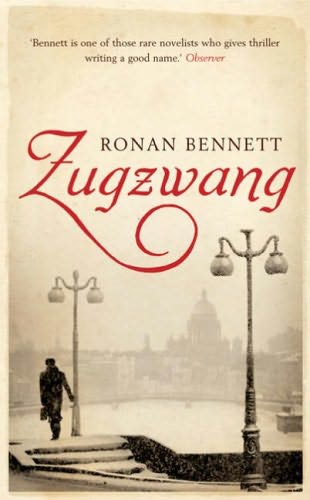
And now for something completely ZUGZWANG: “Bennett deftly evokes the atmosphere of a society in which an international chess tournament can seize the attention of the local populace while terrorist bombs are exploding around the city … ZUGZWANG moves quickly – there is not a moment when history gets in the way of the plot [take that, Marx!] – and yet the underlying message comes through quite clearly: The real madness in St. Petersburg is not in Dr. Spethmann’s office,” says Michael Wade at Execupundit. Over at Wynne’s World of Books, Wynne – for lo! It is he! – agrees: “The plot is convoluted with lots of twists and turns involving revolutionary and counter-revolutionary plots – all great fun but infused with political and ethical dilemmas … A really great read – highly recommended.” The Sunday Tribune carried a yearly round-up of best books which included Gerard Donovan’s JULIUS WINSOME: “A dark, vivid, and gently powerful novel about revenge and loneliness … delivered in precise prose as cold, sharp, and evocative as the shot described ringing out in the cold Maine October afternoon at the beginning of the book. O’Donovan’s narrator … is much more complicated than the normal run of the mill vengeful protagonist … and this is a book about the nature of revenge which is satisfyingly complex.” The Trib also liked Tana French’s IN THE WOODS, to wit: “The prose manages to be smart and satisfying without falling into the easy trap of being overly literary, making this the perfect antidote to the more pedestrian efforts which clog up the market. A very satisfying debut with a rich feel for character.” Sean Moncrieff’s THE HISTORY OF THINGS also went down a treat with the Trib: “A novel which is fully rounded and imbued with a sense of imminent doom … The various miseries inflicted upon Dalton are described with the kind of subtle detail that makes your skin crawl, and Moncrieff has a pitch-perfect feel for describing the aftermath of a broken marriage, and the slow steady disintegration of a mind under stress.” As for Declan Hughes’ THE COLOUR OF BLOOD, don’t get them Trib-types started. Ooops, too late: “This is a book that could so easily have become an unconvincing pastiche, maybe two parts Chinatown to one part Jim Rockford; but Hughes’s writing has the intelligence and integrity to allow him to create something which stands assuredly on its own two feet. If you like your detective fiction written with smarts, and a meaty, mature, and satisfying edge to it, then this book is for you.”
Finally, Benny Blanco’s THE SILVER SWAN is still hauling in the big-ups, starting with Tom Adair in The Scotsman: “You sense that Banville / Black found it easy and wrote it quickly, wrote it with relish – one of the reasons you enjoy it, despite a nagging feeling of hunger for something meatier on the inside. Its descriptive power is delicious … all in all it’s a romp of a read, a compelling fix.” Over at The Telegraph, Tom Fleming is largely in agreement: “The writing and characterisation are enough to sustain the attention when the plot occasionally stalls. This is a literary thriller that merits the name.” And that, we’re almost entirely certain, is a very good thing …
The Monday Review
Yet more cracking reviews for the latest Ken Bruen / Jason Starr collaboration, to wit: “What makes SLIDE a great book, of course, is the frenetic combination of Bruen and Starr, who write as if conjoined at the brain. Starr is a master at digging and probing into the molecules of the mortar that cements relationships for bad or worse, while Bruen’s ability to bring a stygian humour to the worst of humanity’s most malevolent foibles is unsurpassed.
Put them together in a room, and just like the back jacket says, SLIDE may be the most shocking book you’ll ever read. It may also be one of the best,” burbles a breathless Joe Hartlaub at Book Reporter. Over at the New York Sun, Otto Penzler concurs: “The New York chapters are clearly written by Mr Starr, and the Irish chapters by Mr Bruen, and they obviously had a lot of fun writing the outrageous scenes, the over-the-top violence and obscenity, and some of the funniest dialogue this side of Elmore Leonard. The books aren’t for anyone easily offended — nor for anyone offended with difficulty, come to think of it. For the rest of us, they are a blast.” Mmm, lovely. Meanwhile, Declan Hughes’ THE WRONG KIND OF BLOOD gets a big-up at Hell Notes, to wit: “The story, while fairly standard noir, is elevated by Hughes’ prose. His experience as a playwright is evident in setting scenes that come vibrantly to life, punctuated by excellent dialogue … a high body count, plenty of violence, and, as the title indicates, much to keep the sanguinary sort of reader happy. It packs a punch to the gut, and leaves a hole in the heart.” But where’s the inevitable John Connolly mention, you cry? Here: “NOCTURNES is the book I’d recommend to anyone new to Connolly’s work. On its face, it’s not much like any of his other books, except for THE BOOK OF LOST THINGS – but it’s a sort of tasting menu of all the things that interest him as an author, and already seems to hold the germ for whatever follows,” says Answer Girl …
They’re still coming in thick and fast for Eoin Colfer’s ARTEMIS FOWL AND THE LOST COLONY. First up, Karissa of Karissa’s Books: “For some reason I always start reading these books with a bit of reluctance because they are, after all, kids books. A few pages into the book though I am always hooked again; this continues to be the case … This is another fun book that further enhances the Artemis Fowl series. I look forward to reading the next book in the series.” Then there’s Amy at Blog 2013: “After reading the opening chapter of this book, I couldn’t wait to continue reading. The mention of time travel really piqued my interest because this is an interesting new theme for the Artemis Fowl series.” Hurrah! A pithy hup-ya from Alice at Random Musings for Gene Kerrigan’s THE MIDNIGHT CHOIR: “Really interesting, really well written … Highly recommended.” Can’t say fairer than that … Lesley at Skeins of Books likes Tana French’s debut: “IN THE WOODS was quite compelling, though somewhat flawed … but she is a compelling writer and I will definitely look for her next book.” Over at Mostly Fiction, Sudheer Apte is bigging up Ronan Bennett’s ZUGZWANG thusly: “This is a very fast-moving novel … an intense and satisfying thriller, but more than that, it shows the impossibility of love and controlling your own destiny in times of political turmoil.” The late, lamented Siobhan Dowd’s THE LONDON EYE MYSTERY wowed Laurina at We Love Children’s Books, to wit: “I was totally immersed in this story; the characterization of Ted is particularly well written; an intelligent mystery.”
Some belated reviews for Brian McGilloway’s BORDERLANDS, which we’re only finding now on his shiny new blog: “Brian McGilloway has got off to an excellent start … He has written a taut, well-paced story with strong characters and an ingenious plot that seizes the reader’s attention from page one and holds it to the last sentence. Along the way, he delivers a memorable debut novel that stands up there with the best,” trumpets Myles McWeeney at the Irish Independent, while The Book Place made it its Editor’s Choice: “BORDERLANDS has a maturity way beyond what the reader has a right to expect from a first novel … A fantastic start to a writing career that is set to flourish.” Beautiful. A swifty from Harriet Klausner at Genre Go Round Reviews for Jack Higgins’ latest: “Jack Higgins is the master of the espionage and political thriller,” and it’s onward to Sean Moncrieff’s THE HISTORY OF THINGS courtesy of Angela M Cornyn in the Sunday Independent: “This book reeled me in … It was refreshing to have a work of fiction focus on a hidden Ireland. It provided an informative, insightful, honest expose of the underbelly of the Celtic Tiger in the capital city.
The book is clear-eyed, astute and always entertaining with its generous sprinkling of quirky humour, delivered with a deft hand. A cracking good read.” Finally, The Artist Formerly Known As Colin Bateman’s I PREDICT A RIOT is jazzing ’em over at Amazon UK, to wit: “As a huge fan of Colin Bateman, and as with all of his books, I would not hesitate to recommend to anyone between the ages of 12 & 70,” quoth a reader’s review, while Margaret Cannon at the Globe and Mail is tossing bouquets: “Colin Bateman is one of Ireland’s many gifts to the world of crime and mystery. I PREDICT A RIOT is one of his best, which makes it about as smart, funny and convoluted as a crime novel can get … This one is definitely not to be missed.” Lovely stuff. More carrot cake, vicar?
Put them together in a room, and just like the back jacket says, SLIDE may be the most shocking book you’ll ever read. It may also be one of the best,” burbles a breathless Joe Hartlaub at Book Reporter. Over at the New York Sun, Otto Penzler concurs: “The New York chapters are clearly written by Mr Starr, and the Irish chapters by Mr Bruen, and they obviously had a lot of fun writing the outrageous scenes, the over-the-top violence and obscenity, and some of the funniest dialogue this side of Elmore Leonard. The books aren’t for anyone easily offended — nor for anyone offended with difficulty, come to think of it. For the rest of us, they are a blast.” Mmm, lovely. Meanwhile, Declan Hughes’ THE WRONG KIND OF BLOOD gets a big-up at Hell Notes, to wit: “The story, while fairly standard noir, is elevated by Hughes’ prose. His experience as a playwright is evident in setting scenes that come vibrantly to life, punctuated by excellent dialogue … a high body count, plenty of violence, and, as the title indicates, much to keep the sanguinary sort of reader happy. It packs a punch to the gut, and leaves a hole in the heart.” But where’s the inevitable John Connolly mention, you cry? Here: “NOCTURNES is the book I’d recommend to anyone new to Connolly’s work. On its face, it’s not much like any of his other books, except for THE BOOK OF LOST THINGS – but it’s a sort of tasting menu of all the things that interest him as an author, and already seems to hold the germ for whatever follows,” says Answer Girl …
They’re still coming in thick and fast for Eoin Colfer’s ARTEMIS FOWL AND THE LOST COLONY. First up, Karissa of Karissa’s Books: “For some reason I always start reading these books with a bit of reluctance because they are, after all, kids books. A few pages into the book though I am always hooked again; this continues to be the case … This is another fun book that further enhances the Artemis Fowl series. I look forward to reading the next book in the series.” Then there’s Amy at Blog 2013: “After reading the opening chapter of this book, I couldn’t wait to continue reading. The mention of time travel really piqued my interest because this is an interesting new theme for the Artemis Fowl series.” Hurrah! A pithy hup-ya from Alice at Random Musings for Gene Kerrigan’s THE MIDNIGHT CHOIR: “Really interesting, really well written … Highly recommended.” Can’t say fairer than that … Lesley at Skeins of Books likes Tana French’s debut: “IN THE WOODS was quite compelling, though somewhat flawed … but she is a compelling writer and I will definitely look for her next book.” Over at Mostly Fiction, Sudheer Apte is bigging up Ronan Bennett’s ZUGZWANG thusly: “This is a very fast-moving novel … an intense and satisfying thriller, but more than that, it shows the impossibility of love and controlling your own destiny in times of political turmoil.” The late, lamented Siobhan Dowd’s THE LONDON EYE MYSTERY wowed Laurina at We Love Children’s Books, to wit: “I was totally immersed in this story; the characterization of Ted is particularly well written; an intelligent mystery.”
The book is clear-eyed, astute and always entertaining with its generous sprinkling of quirky humour, delivered with a deft hand. A cracking good read.” Finally, The Artist Formerly Known As Colin Bateman’s I PREDICT A RIOT is jazzing ’em over at Amazon UK, to wit: “As a huge fan of Colin Bateman, and as with all of his books, I would not hesitate to recommend to anyone between the ages of 12 & 70,” quoth a reader’s review, while Margaret Cannon at the Globe and Mail is tossing bouquets: “Colin Bateman is one of Ireland’s many gifts to the world of crime and mystery. I PREDICT A RIOT is one of his best, which makes it about as smart, funny and convoluted as a crime novel can get … This one is definitely not to be missed.” Lovely stuff. More carrot cake, vicar?
The Monday Review
The Crime Always Pays elves are still a little wonky from celebrating Derek Landy’s win at the Richard and Judy Kids’ Books bunfight with their patented Elf-Wonking Juice, so what better way to kick off the review than with a few big-ups for SKULDUGGERY PLEASANT, to wit: “This novel is funny, action-packed, sarcastic, and impressive in the way the story unfolds. Reminds me of Harry Potter in many aspects,” says Mordistheve over ye olde Live Journal. There’s a certain Reading Fool who agrees: “What a thoroughly fun read this book is! And I do believe there’ll be more where this one came from, which is truly cause for cheering.” Huzzah, indeed. “As a novel JULIUS WINSOME is constructed and written extremely well, with each chapter journeying you through Julius’s mental states which alternate from grief to anger to detached madness … The story ends like it begins, mysterious and quaint. It really is a lovely piece of writing,” reckons Brienne Burnett of Gerard Donovan’s mini-epic at The Program … It’s not due until next month but they’re already starting to filter in for Benny Blanco’s THE SILVER SWAN, to wit: “Sadly this year Michael Dibdin, the creator of the wonderful Aurelio Zen and that tantalising blend of Italian society, crime and politics, died leaving a huge hole in crime fiction.
I think that Black and Quirke are filling that gap with this wholly gripping account of the shady, priest-ridden and blithely corrupt society of mid- 20th century Dublin,” says Tom Rosenthal at the Daily Mail. Meanwhile, the Chicago Sun Times likes the audio of CHRISTINE FALLS: “This is one of those rare occurrences when actor/narrator and prose suit each other so perfectly that the CD’s cost seems a small price to pay for the value of the performance.” Coolio. Onward to the inevitable John Connolly hup-yas: “Connolly writes convincingly of thugs, criminals and the supernatural, and Parker is a classic character who walks straight and tall like someone from the old west, and the reader knows all will be well once he arrives in town. THE UNQUIET just won’t let you put it down as the plot careers across the pages like a runaway train. Excellent!” burbles Mark Timlin of the Independent on Sunday, via Waterstones, where you'll also find that the Independent is no less impressed:
“Connolly’s books are shot through with bitter poetry, and couched in prose as elegant as most literary fiction ... there’s the sweeping canvas, more ambitious than most British-set crime thrillers. However, all of this is not the overriding reason why Connolly has risen above most of his peers. It’s because Connolly’s work has raised the stakes, beyond the quotidian concerns of most crime novels, into a grandiose conflict between the forces of good and evil, with religion and the paranormal stirred into the heady brew.” Mmmm, gorgeous. A hop, skip and jump across the electronic highway to Amazon for Laura Mullen’s big-up for Sean Moncrieff’s THE HISTORY OF THINGS, the gist of which runneth thusly: “This book is a complete revelation to me … The description of his father’s death was really beautiful – it brought tears to my eyes – and his various relationships were really well handled. I hope he writes much, much more.” As for Andrew Pepper, he’s got a brand new VBF in Skelde at Book Crossing: “THE LAST DAYS OF NEWGATE is a gripping, darkly atmospheric story with a fantastic, pragmatic – and reluctantly heroic – hero.” Over at the Mail on Sunday, Geoffrey Wansell assesses the nine millionth Jack Higgins offering, THE KILLING GROUND: “Dillon remains as cynical, dangerous and ferocious as he always was, but with a trace of Irish philosophy and wry humour that made him one of the most interesting action-heroes of the 1990s … The only flaw is that sometimes the action is so breathless, with the characters appearing so quickly, that it can take a little time to catch up.” Finally, a flurry of Ken Bruen, whose AMMUNITION is still garnering serious big-ups, to wit: “Fast-paced, short, sharp sentences, brutally funny, brutally violent, noir that is pitch black, a sheer ride that thrills. Inspector Brant scares the bejeezus outta me,” quavers Bob the Wordless at Why Can’t I Write?,
while Harriet Klausner pitches in with “The seventh Brant police procedural is a terrific action-packed thriller, but even with the return of Vixen, it is the avenging inspector who makes the mean streets of London meaner and more fun for fans of Mr Bruen, the heir to Mr McBain’s police station tales.” Lovely. But we’ll leave the last word this week to Bill Crider: “Some people prefer Ken Bruen’s novels about Jack Taylor, nothing wrong with that, but for me it’s Brant and his mates of the Southeast London Police Squad … I find them fast, furious, and hilarious.” And yon Bill, he knows of what he speaks …
The Monday Review
How long has it been since we mentioned Eoin Colfer on these pages? That’s right, too long. “Another entertaining adventure from Eoin Colfer that has time travel, demons, warlocks, pixies, centaurs, fairies, dwarves, hitmen, bodyguards, and not one, but two human genii. I’m looking forward to the next instalment,” says Grubsneerg at Book Crossing of THE LOST COLONY … Over at Reviewing the Evidence, Diana Sandberg likes Cora Harrison’s MY LADY JUDGE, to wit: “I enjoyed reading this book. Many readers of historical mystery will be immediately reminded of another female working within the Brehon laws, Peter Tremayne’s Sister Fidelma … The story would not suit a person looking for a thriller, it falls well into the realm of cozy, but many characters are well drawn and the historical and cultural information is nicely integrated into the story, not slathered on as some authors unfortunately do.” Which is lovely … “Despite being humourous, when it gets down to the nitty-gritty of magic and action, SKULDUGGERY PLEASANT delivers, and delivers in style … Incredibly witty, and immensely fun – put SKULDUGGERY PLEASANT to the top of your “To be read” pile!” raves Bookiemonster about Derek Landy’s debut … “There are … occasional examples of clumsy phrasing. But these are minor quibbles. They do not detract from the smoothly crafted unfolding of the mystery and its surprising denouement,” says Roy Greenslade of Paul Charles’ THE DUST OF DEATH in the latest issue of Verbal … “SLIDE is slick. With the follow up to last year’s BUST, Ken Bruen and Jason Starr have raised the bar. BUST … was a black comedy of errors; noir with a grin. The sequel is comic, but it’s not just slapstick. It’s satire,” asserts Nathan Cain over at Indie Crime …
The big-ups just won’t quit for Ronan Bennett’s ZUGZWANG, to wit: “It is tempting to place ZUGZWANG in the same company as CJ Sansom’s WINTER IN MADRID and Carlos Ruiz Zafon’s THE SHADOW OF THE WIND. What sets ZUGZWANG above those two works, however, is its complexity,” says Nick Greenslade in The Observer, although Julia Flynn, at The Telegraph, is rather less impressed: “I was bowled over by Bennett’s last novel, HAVOC IN ITS THIRD YEAR, but this one, despite excellent moments, does not scale the same heights. It is beautifully written, in lucid prose; but the story as a whole does not quite cohere.” Boo, etc. … They’re still coming in for Adrian McKinty’s latest: “Anyone in the mood for a few thrills need look no further than THE BLOOMSDAY DEAD … Literature buffs will enjoy McKinty’s numerous references to Joyce’s novel, which supplement the non-stop, and very bloody, excitement that Michael encounters on his own epic journey. Michael is an appealingly tough but tormented hero,” reckons Rebecca Oppenheimer at The Towerlight … And they just won’t stop coming for Tana French: “IN THE WOODS by Tana French is another solid debut novel … The ensuing psychological suspense tale has a teeny hint of the supernatural that provides a thrill of extra creepiness,” vouchsafes Ellen Datlow at her Live Journal … Benny Blanco’s latest, THE SILVER SWAN, isn’t due until next month, but Book Dwarf is already raving about it thusly: “Perhaps a stronger book than CHRISTINE FALLS (itself a strong debut in mystery), Black writes for an audience that doesn’t need all the answers handed to them … Black doesn’t rely on clichés and switchback plots to keep the book going. I hope he continues to write such gripping books.” … “A gripping follow-up to [Erin] Hart’s sensational debut, weaving together history, folklore, and forensics, and following in the evocative tradition of writers such as Elizabeth George and Daphne du Maurier, LAKE OF SORROWS is a passionate novel of suspense from a superbly gifted new crime-writing star,” raves Paperback Swap … Back to Verbal for Mia Gallagher’s HELLFIRE: “The book should be depressing since its rare moments of drug-free clarity portray a relentlessly harrowing world. Yet because of the author’s sheer ability with words and an abundance of characters that would have been the envy of Dickens, one reads on – perhaps white-knuckled,” says Sean McMahon.
Finally, Sean Moncrieff’s THE HISTORY OF THINGS received some well-deserved oxygen this weekend, first from the Irish Times: “Moncrieff is a fluid, confident writer who expertly creates a sense of genuine menace, and this very readable book is genuinely unnerving at times … The story’s oppressive, threatening atmosphere lingers in the reader’s mind long after the final page,” says Anna Carey. The Sunday Tribune liked it too: “This ability to pique interest and hold it is ably assisted by his clipped, concise sentences which subtly switch between genuinely hilarious riffs and seemingly throwaway lines that only add depth. Moncrieff often leaves both jokes and key events to hang in the air and enhance the emotion.” Okay, but can the boy Moncrieff juggle chainsaws underwater? Huh? He can? Oh …
Tuesday
“Ya Wanna Do It Here Or Down The Station, Punk?” # 499: Sean Moncrieff
Yep, it’s rubber-hose time, folks: a rapid-fire Q&A for those shifty-looking usual suspects ...What crime novel would you most like to have written?
Usually the last one I’ve read, if it’s any good. So with that in mind, I’d love to have written ASK THE PARROT by Richard Stark, whom I have only just discovered (I am a bit of a an innocent in the world of crime fiction). During the rugby world cup you may well have heard various television windbag-pundits use the phrase ‘get the basics right’ – well, the same applies for writers. Sometimes writers forget the basic rules (in as far as you can have rules) and become self-indulgent; a trend, alas, far too common in established authors. Philip Roth, though I love his work dearly, could do with a good editor and perhaps a bit of a bitch-slapping. Or he could read anything by Richard Stark. With Stark, you don’t find out what the sky looked like that morning or what colour the landscape was or even what anyone feels: you are straight into the story, and anything you are going to find out about the characters, it will be from what they say, and more importantly, what they do. Yet even with this minimal approach, Stark is able to imply a rich back story for his characters without even telling us anything about them: he gives the sense that the story has already begun, we’ve arrived late and need to catch up. And yes, yes, I know that the more-knowledgeable-than-me among you (which is probably all of you) are already screaming at your screen that Richard Stark is only a nom-de-plume. After I read my first Stark novel, I enjoyed it so much I didn’t Google him: I didn’t want to discover that he was in reality a portly 53-year-old man from Leicester who wears Jethro Tull tee-shirts and visits naturist beaches every summer. In my imagination, he was a grizzled old geezer who has churned out every sort of potboiler; honing his skills over decades. Because after all, good writing is good writing, no matter where it is found. Curiosity, of course, got the better of me - and brought me to one of those rare moments in life when things were actually as I imagined them: Richard Stark is Donald Westlake, a grizzled old New York geezer who has probably forgotten how many books he’s written - on his website, he can’t even remember all of the titles - as well as screenplays, most notably THE GRIFTERS and least notably a really terrible TV pilot called Supertrain (I’ve actually seen it). I like the idea of people like Donald Westlake: writers who are serious but not precious about what they do. Oh yes: and we can claim him too. He is 75 per cent Irish, though he was born on July 12th, a little fact which he says “led to my first awareness of comedy as a consumer.”
Who do you read for guilty pleasures?
Can’t really think of anything I’m guilty about reading, apart from pornography. And technically, that’s not reading. Like most people who give out about cultural snobbery, I’m a complete snob. If I don’t like the first page, I won’t read it.
Most satisfying writing moment?
Oh, just had one of those. I suppose it varies from person to person, but when I make the commitment to actually start writing a book, it’s a bit like committing to get married to someone you’ve just met on the bus. Who has just told you about her seven kids. And her psychopathic and extremely jealous ex-husband. In other words, I generally have no idea what is going to happen. Now this doesn’t mean I'm waiting for the spirit of the characters to inhabit me or some guff like that - I have a rough plan for where it should be going. But no matter how you ‘get the basics right’, you are still waiting for something to click, some ingredient X in there that lets you know that what you’ve written has the breath of life in it. And sometimes it doesn’t come. Sometimes the characters are wooden and the story is tedious, and you have to think of a way of fixing this or dumping it altogether. I’m currently ten thousand words into a new novel, and had convinced myself that it was utter crap - until I read it back for the first time and realised that it was OK and that my main character is headed in a very clear direction . So it was a mixture of huge relief that I’ve not been wasting my time and a Eureka-type realisation that another book is definitely on the way. With any book you hit various problems and the work slows down a bit, but at the moment it feels like I can’t get the words out fast enough. It’s the greatest of all buzzes.
The best Irish crime novel is …?
Oh, I dunno. Ken Bruen springs to mind. His work has a great sense of Irish melancholia. And I like the way his heroes are all a bit crap at what they do.
What Irish crime novel would make a great movie?
Ken Bruen again, though it would have to be done just right.
Worst / best thing about being a writer?
The best thing is you get to live inside your own head for long periods of time. The worst thing is you get to live inside your own head for long periods of time - which isn’t always so great if you occasionally have to emerge into the outside world and deal with spouses and kids, etc. I am lucky in that I split my time between writing in the morning and doing a radio show in the afternoon: two forms of work which, obviously, are quite different to each other, so I maintain some degree of balance.
The pitch for your next novel is …?
She cosies up to me on the bus seat, grinning slightly. “Why don’t we get married?” I say. She nods slowly, as if she’s just been thinking the same thing. “OK,” she whispers. “I mean, as long as my kids - I have seven - think it’s a good idea. And I suppose I’ll have to tell my ex-husband. He’s still extremely jealous. He’s getting out of prison next week. Who knows? Perhaps this time it’s done something to help him control his murderous temper.” I shrug, as if these are the sort of problems we all have to deal with, though mine is more imminent. We’ve only just met and already I can’t remember her name ...
Who are you reading right now?
I’m just finishing THE LAY OF THE LAND by Richard Ford. Wonderful, thoughtful, funny, loveable book, which to my mind is his best work. And by the standards of Richard Ford, it’s action packed.
The three best words to describe your own writing are …?
Notions about himself.
Sean Moncrieff’s THE HISTORY OF THINGS is available now.
Labels:
Sean Moncrieff,
The History of Things
Wednesday
Nobody Move, This Is A Review: The History Of Things by Sean Moncrieff
It’s not a conventional crime novel by any means, and there’s a strong chance that Sean Moncrieff (who has previously published the crime novel DUBLIN) didn’t set out to write crime fiction with THE HISTORY OF THINGS, but this is nonetheless a fascinating tale rooted in criminality. What is most interesting is that there’s no murders, rapes, gory tortures or bank jobs gone wrong on offer here: the criminality is of a low-level but persistent variety, the kind that doesn’t make it into the headlines but remains an integral part of many people’s lives. When the Irish-born film director, Tomas Dalton, relocates from London to Dublin in the wake of his divorce, he moves back to his childhood stomping ground in north inner-city Dublin. Half-expecting to be hailed as a returning hero, and quickly disappointed, Tomas soon becomes the target of pranks perpetrated by a trio of juvenile delinquents, the eldest no more than 10 years old. Tomas, applying his brand of logic to the situation, retaliates in kind, and soon the practical jokes take on a much more sinister tone, as the tit-for-tat spirals down into threats, destruction and actual violence. Meanwhile, Tomas is trying to come to make sense of his life and the world around him, specifically in terms of the function of memory, all the while painfully aware that his powers of recall are diminishing by the day. Very much a slow burner of a novel, THE HISTORY OF THINGS rewards patience. Traditionally, the private eye investigates the era and culture as much as he or she probes a given case, and Dalton is very much Moncrieff’s avatar as he casts a cold eye on the post-Celtic Tiger landscape of modern Ireland. The personification of Ireland's unwillingness to confront its recent past, and a classic unreliable narrator even to himself during his stream-of- consciousness ramblings, Dalton is one of the most intriguing protagonists to emerge from mainstream Irish fiction in quite some time. – Declan Burke
Labels:
Sean Moncrieff,
The History of Things
Tuesday
History: Officially No Longer Bunk
Broadcaster, writer and all-round Renaissance man Sean Moncrieff returns to the fray today, releasing The History of Things through New Island. What’s that scraping sound we hear? Could it possibly be the blurb elves sharpening their quills? Yep, t’would appear so: “Film director Tomas Dalton returns home to his North Inner City Dublin roots. However, the country he has returned to, with its new-found affluence and glamour, is unrecognisable from the one he left behind. But this version of Ireland has yet to reach Bass Avenue, where the mischievous welcome he receives from the local mob of children quickly grows into something far more sinister. Lost amongst the wreckage of a painful divorce, a chaotic film shoot and the manic advances of a fading Hollywood diva, Tomas is forced to protect the faded trophies of his life. By any means necessary.”Moncrieff’s previous outing, Dublin, garnered some very nice reviews indeed, to wit: “Moncrieff takes the well-worn images of warm and sleepy Dublin, pulls a plastic bag over their head and executes them,” reckoned the Evening Herald, while the Sunday Independent chipped in with “A telling portrait of smugness and disillusionment, of the festering underbelly of Celtic Tigerland.” Form an orderly queue, people: line-jumpers will be plastic-bagged and executed …
Labels:
Sean Moncrieff,
The History of Things
Subscribe to:
Posts (Atom)