Detective Edgar ‘Lefty’ Mendieta, the main player in Elmer Mendoza’s English-language debut, likes ‘an impossible case’. Not because Lefty is any kind of cerebral sleuth, a Poirot or Holmes seeking out the most difficult crimes in order to stimulate his little grey cells, but because Lefty is a Mexican policeman operating in the city of Culiacán with the Federal Preventative Police, and his experience is that murder cases tend to be ignored, covered up, deliberately botched or otherwise swept under the carpet. It’s for the best, Lefty believes, if his superiors declare a murder ‘an impossible case’ as soon as possible, and preferably before Lefty gets to the crime scene, so as not to wastefully expend the already pitiful resources of the FPP.
Unfortunately for Lefty, the murder of Bruno Canizales can’t be easily filed under ‘impossible’, especially as the murderer rather flamboyantly used silver bullets when assassinating the high-profile bisexual attorney. Was the killer Canizales’ tempestuous lover Paolo Rodriguez, who subsequently committed suicide? His other tempestuous lover, the dancer Francisco Aldana? Or was the murder orchestrated by the all-powerful ‘Narcos’ who control Mexico’s drug trade, and who control virtually every politician, judge and policeman in the country?
Lefty Mendieta is a terrific creation, a gloomy, intellectual introspective who is resolutely cynical about the world and his place in it. “What did he know about modernism, or postmodernism for that matter, or intangible cultural heritage?” Lefty asks of himself on the very first page, establishing the parameters of Elmer Medoza’s investigation into contemporary Mexico but also, courtesy of the high-falutin’ pondering, tipping us the wink that Mendoza’s own exploration of the culture will very likely shed no more light on the truth than one of Lefty’s ‘impossible cases’.
And so it proves, as Lefty doggedly pursues the clues and the killer with the penchant for silver bullets, his efforts leading him down numerous blind alleys as he wonders about the significance of the bullets themselves and whether they are being employed for mythical purposes in order to kill a modern vampire or a werewolf. Lefty is happy to reference James Bond and Gary Cooper, but he’s no hero or tarnished knight, willing to acquiesce when his boss tells him to drop the case and equally happy to accept bribes in the form of cash in a brown envelope. That said, he’s no coward either, and he goes where the investigation leads him, even when it takes him right to the gates of the region’s most feared Narco, Marcelo Valdés. Not that Lefty, living his life according to the surreal logic of contemporary Mexico, is a slave to procedure: “He reminded himself that no expert follows the evidence, since in this business the truth always resides precisely where it should not.”
For all of Mendoza’s comic asides, however, Silver Bullets is a serious novel about an entire culture in thrall to the ‘Narcos’. In Mendoza’s poverty-stricken Mexico, the cops are corrupt and the bad guys are the people’s champions, benefactors of communities and heirs to the romantic ideal of the outlaws who destroyed the status quo of the landed gentry. Mendoza’s style is as dense in its own way as James Ellroy at his best (or worst), with dialogue condensed into paragraphs with little by way of punctuation to tell the reader who is speaking. The effect is that you pay very close attention to who is speaking or you quickly find yourself lost, an effect that suggests Mendoza is criticising those who only glance at Mexico’s tragedy and then avert their eyes.
It’s a superb novel, a blackly comic tale akin to the bracing realism of Dashiell Hammett’s early work that leaves the reader feeling claustrophobic, grimy and entirely hopeless about Mexico’s immediate future – a country where, as Lefty Mendieta grimly observes, “Nothing is true, nothing is false.” ~ Declan Burke
Silver Bullets by Elmer Mendoza is published by MacLehose.
This review was first published in the Irish Examiner.
Saturday
Best Books 2015: January – June
It being the end of June, and thus halfway through the year, I thought I’d post a list of the best new books I’ve read so far in 2015. In order of my reading them, they are:
Acts of the Assassins, Richard Beard.
On the basis of its opening 20 pages or so, the second offering Richard Beard’s ‘Messiahs Trilogy’ – the first, Lazarus is Dead, was published in 2011 – is an audacious take on the crime / mystery novel. Beard is clearly a student (or perhaps scholar might be more appropriate) of the crime fiction genre, given that the story begins as a straightforward police procedural investigation but also broadens out to incorporate other sub-genres such as the spy novel (“Jesus has skills, fieldcraft …” muses Gallio on his foe). The serial killer novel also looms large when it is discovered that the disciples, having exiled themselves to various parts of the empire, are being bumped off one by one, murdered by some shadowy killer in a variety of gory deaths, such as beheadings, flayings, stonings and so forth.
For the rest of the review, clickety-click here …
The Shut Eye, Belinda Bauer.
A ‘shut eye’ is a magician so good at persuading the audience the illusion is real that he comes to believe in the trick himself. In Belinda Bauer’s superb sixth novel, The Shut Eye (Bantam Press, €22.50), the phrase refers both to Richard Latham, a celebrity psychic helping the police with their enquiries into the disappearance of young Edie Evans, and to DCI John Marvel, the detective inspector leading the investigation. Marvel is resolutely old-fashioned about police work (“John Marvel didn’t believe in coincidence any more than he believed in global warming …”) and refuses to countenance any supernatural aid, but his hardnosed materialism is shaken to the core when he meets Anna Buck, whose young son Daniel has also gone missing, and whose grief-wracked visions appear to offer clues to the whereabouts of Edie Evans. The Shut Eye is an unusual but absorbing police procedural that also functions as a thoughtful meditation on faith, hope and belief. John Marvel may well be a no-nonsense copper, but in a genre that has been dominated in recent times by the CSI school of facts and evidence, Marvel’s journey towards the truth is refreshingly unconventional.
A Song of Shadows, John Connolly.
The 13th novel in the Charlie Parker series, John Connolly’s A Song of Shadows (Hodder & Stoughton, €22.50) opens in Maine’s remote coastal town of Boreas. Recuperating from grievous wounds sustained in his previous outing, A Wolf in Winter (2014) – Parker was declared clinically dead before being resuscitated – the private investigator is drawn into a bizarre case when an obsessive Nazi-hunter is discovered dead on a nearby beach. No stranger to evil, and still coming to terms with his experience of another realm about which “he still had questions, but no doubts,” Parker finds himself immersed in the horrors of the Holocaust, and determined that this particular evil will not thrive on his watch. Connolly has been engaged for some years now in gradually refining the supernatural and horror tropes that gave the Parker novels their distinctive identity, and A Song of Shadows, blending the language of myth and New Testament into a hardboiled tale, marks a significant shift in Parker’s metamorphosis into an explicitly Christ-like figure (“This one bleeds from the palms,” observes one of his foes). That notion has been explored before, most notably by Ross Macdonald and James Lee Burke, and while A Song of Shadows more than earns the right to be judged in such company, Connolly further appears to be breaking new ground, not least in terms of Parker’s haunting relationships with his daughters, one dead and one living. It’s a fabulous piece of work, in both senses of the word, from one of contemporary fiction’s great storytellers.
Mrs Engels, Gavin McCrea.
Gavin McCrea has crafted a beautifully detailed historical fiction in Mrs Engels, and the political backdrop is indeed a compelling one as he describes the revolutionary frustrations of Engels and Marx, the fall-out to the Franco-Prussian war and the consequent rise and fall of the Paris Commune, and the rise of militant Irish nationalism in Britain. Lizzie’s drawing room hosts agitators, revolutionaries and activists of all hues, but there’s none so fascinating as Lizzie herself, toasted at one point by Engels as a ‘Proletarian, Irish rebel and model Communist.’ In truth, Lizzie is far more difficult to label that her lover realises. From the very beginning Lizzie tells us that she’s a pragmatic woman whose loyalty is only her own survival: “Establish yourself in a decent situation,” is her advice to all young women, “and put away what you can, that, please God, one day you may need no man’s help.”
For the rest of the review, clickety-click here …
Disappeared, Anthony J. Quinn.
First published in the US, and shortlisted there for a Strand Literary Award, Quinn’s debut propels the Tyrone author into the first rank of Irish crime writing. An eye for vividly contrasting imagery means that Disappeared is superbly evocative of its bleak setting, such as when Daly leaves behind the rural shore of Lough Neagh to drive into Portadown. “The shapes of trees shining in the frost were like the nerves and arteries of a dissected corpse,” writes Quinn; little more than a paragraph later Daly is contemplating Dalriada Terrace: “The street felt like a dingy holiday resort inhabited by the inmates of a concentration camp.”
For the rest of the review, clickety-click here …
Whiskey Tango Foxtrot, David Shafer.
For all its conventional narrative scenarios of innocent civilians at the mercy of dark forces and its bleak dystopian vision of the near future, Whiskey Tango Foxtrot is by no means a standard techno-thriller. For one, Shafer has sufficient confidence in his readers to craft a slow-burning tale that is, for all its gleaming hardware and plans for a ‘New Alexandria’ of a globally centralised library-for-unimaginable-profit, very much a character-driven tale. Leila, Leo and Mark are richly detailed and empathic creations, their quirks and idiosyncrasies integral to the way in which they gradually uncover SineCo’s foul machinations. Moreover, the writing is a joy, Shafer employing both sly wit and a sharp eye for the telling image. “The grandeur fled,” Leo observes as he emerges from a reverie of a better world, “like shining back into shook foil.” Leila decides that Myanmar ‘sounded like a name cats would give their country.’ Indeed, the entire novel – all 422 pages of densely packed text – is littered with deliciously wry snippets and quotable lines, which gives the overall impression of a Neal Stephenson novel redrafted by Carl Hiaasen in blackly humorous form.
Wednesday
News: Jim Crace Wins the IMPAC Prize
Hearty congratulations to Jim Crace, whose HARVEST won the IMPAC Prize earlier today. My favourite Crace novel will always be QUARANTINE, I think, especially if Crace makes good on his promise that HARVEST will be his final offering, but I hugely enjoyed HARVEST too. I interviewed Jim Crace early last year, on the publication of HARVEST, and he proved marvellous company, self-deprecating and entirely unencumbered by anything remotely approaching ego. To wit:
“Sometimes you do a bit of writing,” [Crace] continues, “and right from the word go until almost the finish it’s like pushing a great chunk of granite up a hill. But at some point, that piece of granite will turn into a helium-filled balloon. Normally, with a book of mine, that moment of loss-of-weight happens halfway through, or towards the end. With this book it happened on the first page. That book became full of hot air,” he laughs, “very early on.”
For the rest of the interview, clickety-click here …
Labels:
IMPAC Prize,
Jim Crace Harvest,
Quarantine
Sunday
Review: DISAPPEARED by Anthony J. Quinn
“The normal standards of right and wrong did not apply to his parishioners,” observes Fr Jack Fee early on in Anthony J. Quinn’s Disappeared, “only what was necessary or unnecessary for survival.”
Set on the mist-shrouded southern shores of Lough Neagh in the post-Troubles era, the events of Disappeared are deeply rooted in Northern Ireland’s recent past, when Fr Fee envisaged “his parish as not so much a sanctuary for a God-fearing flock, but as a no-man’s land between two armies, an arena for IRA ambushes and British Army patrols.”
The lines of conflict may have been sharply defined in Fr Fee’s mind, but it’s in the shadowy cracks between warring forces that Quinn’s novel thrives. Inspector Celsius Daly of the newly created Police Service of Northern Ireland is called to a remote island on Lough Neagh, where he discovers the corpse of Joseph Devine, an old man who has been murdered in a savagely grotesque fashion. It emerges that Devine, ostensibly a respectable clerk during a long but unremarkable career spent working for a local legal firm that specialised in representing Republicans, was a valuable informer for the RUC’s Special Branch. Who or what was Devine murdered to protect?
First published in the US, and shortlisted there for a Strand Literary Award, Quinn’s debut propels the Tyrone author into the first rank of Irish crime writing. An eye for vividly contrasting imagery means that Disappeared is superbly evocative of its bleak setting, such as when Daly leaves behind the rural shore of Lough Neagh to drive into Portadown. “The shapes of trees shining in the frost were like the nerves and arteries of a dissected corpse,” writes Quinn; little more than a paragraph later Daly is contemplating Dalriada Terrace: “The street felt like a dingy holiday resort inhabited by the inmates of a concentration camp.”
Quinn’s seriousness of intent is quickly apparent. Disappeared is not a conventional crime novel in the sense that justice delivered ensures a happy-ever-after ending. Celsius Daly is under no illusion that the post-Troubles ceasefires have suddenly created a utopia in Northern Ireland; indeed, few of the characters ever bought into the accepted narrative of the Troubles in the first place. “We never had an armed struggle,” says Tessa Jordan, the still grieving widow of Oliver Jordan, a young man murdered for being an informer almost two decades previously. “The whole thing,” she claims, “was a horrible game run by secret agents and psychopaths.”
Daly, recently returned to Northern Ireland from Scotland, is no innocent abroad in a strange land, but he is relatively untainted by the sense of ironic fatalism his colleagues tend to don as armour against futility. “That was the horror of the cease-fire,” observes one character, “that your perceptions could be so blurred you no longer recognized the terrorist.” For all his faults – and Celsius Daly is fully aware of the many flaws that make him a plausibly fascinating character – the detective has yet to fully extinguish ‘the distinction he made between good and evil’, or his belief in the necessity of justice, however belatedly it might arrive. “Perhaps it’s time you learned to live with a little uncertainty,” one of Daly’s colleagues advises, but these words of wisdom, which could serve as a mantra for Northern Ireland’s immediate future, are eventually rejected for a more positive aspiration for his country.
Downbeat, bracingly pragmatic, beautifully written and steeped in the genre’s lore, Disappeared is a post-Troubles debut crime novel to rival Stuart Neville’s The Twelve or Brian McGilloway’s Borderlands. Anthony J. Quinn is a name to watch. ~ Declan Burke
This review was first published in the Irish Examiner, June 13th.
Thursday
Reviews: Irish Times crime fiction column
Stephen King’s Finders Keepers (Hodder & Stoughton, €29.50) opens in 1978 with the murder, during a home invasion, of ‘America’s reclusive genius’ John Rothstein, the author of the acclaimed Jimmy Gold trilogy. The police suspect the burglars were after the cash Rothstein kept in his safe, but the reader already knows better: the killer is Morris Bellamy, John Rothstein’s most avid fan, who has come in search of the notebooks and the novels it’s rumoured the author has continued to write ever since he ceased publishing. A sequel-of-sorts to King’s Mr Mercedes (2014), which also featured retired police detective Bill Hodges, Finders Keepers reprises the kind of murderous literary obsession King wrote about in Misery (1987). Rothstein is a Salinger figure, of course (his last published short story is ‘The Perfect Banana Pie’), but while King does on occasion use Rothstein as a stick to beat the American literary establishment, the story evolves as a clash between those who want Rothstein’s notebooks only for they are worth in terms of ‘the Golden Buck’ and those who cherish them as cultural treasures. Littered with literary references, the novel is a hugely enjoyable thriller that unfolds in a style reminiscent of the late, great Elmore Leonard.
Disclaimer (Doubleday, €19.50), the debut novel from former BBC arts documentary director Renee Knight, begins with Catherine Ravenscroft vomiting with the shock of discovering that she is the anti-heroine of a novel called The Perfect Stranger: “ … the details are unmistakable, right down to what she was wearing that afternoon.” (To hammer home the message, the traditional disclaimer in Catherine’s copy of the book has red line drawn through it.) The mystery behind the events of ‘that afternoon’, which took place some two decades ago when Catherine was holidaying in Spain with her five-year-old son Nicholas, provide both Disclaimer and the novel-within-a-novel The Perfect Stranger with their narrative drive, as Catherine strives to discover exactly how retired English teacher Stephen Brigstocke, the author of The Perfect Stranger, came by his information, and why he might want to destroy her life by revealing her terrible secret. In the process Renee Knight broaches the taboo subject of ‘the mother who put herself before her child’, exploring how Catherine’s actions led to tragedy and the destruction of two families. An enthralling take on the ‘domestic noir’ sub-genre, Disclaimer is equally fascinating – unsurprisingly, perhaps, given Renee Knight’s former career – as a commentary on subjective truth.
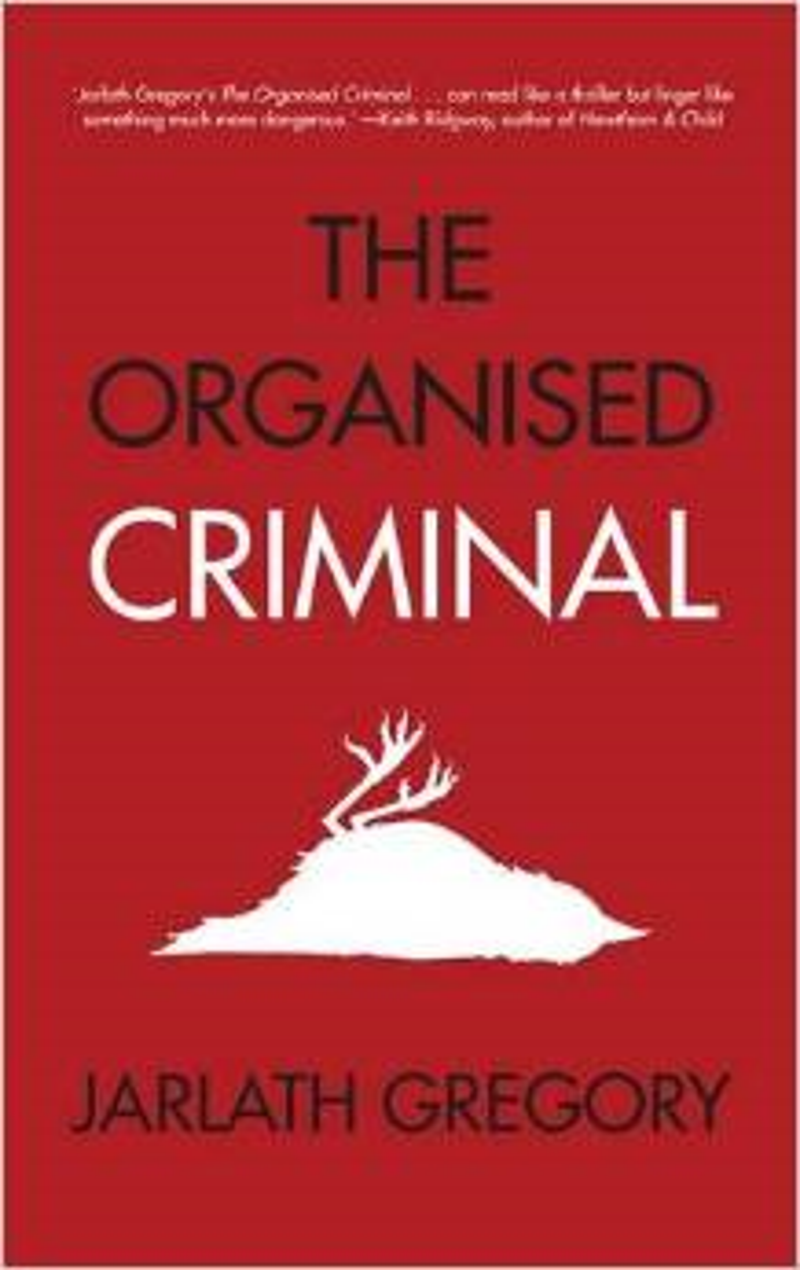
Prodigal son Jay O’Reilly returns home to the ‘no man’s land, the border, bandit country’ of South Armagh in Jarlath Gregory’s The Organised Criminal (Liberties Press, €12.99), where his father Frank holds sway as the area’s most notorious smuggler. When Frank offers Jay a life-changing criminal opportunity, Jay throws it back in his face, but soon Jay has been overtaken by events and is plotting to destroy his father’s empire from within. The Catholic Church and ‘the Troubles’ cast long shadows across Gregory’s story, which provides a cultural and historical context for Frank’s activities while simultaneously damning him for taking advantage of his own people. “Have you forgotten what it was like,” Jay asks his friend Martin, “the last time this town fell into the hands of people with guns?” The frequent narrative digressions and occasional diatribes do slow the pace of The Organised Criminal, but overall it’s a fascinating post-Troubles tale of moral ambivalence in a community still struggling to accommodate its very particular history.
The 11th novel in Norwegian author Karin Fossum’s Inspector Sejer series, The Drowned Boy (Harvill Secker, €20.55) opens with Sejer and his colleague Skarre attending the tragic death of toddler Tommy Zita, who fell into a pond beside his family home – or so his mother, Carmen, claims. Prompted by Skarre’s instinct that something isn’t quite right about the scene, Sejer interviews Carmen and her husband Nicolai, curious in particular as to how they both reacted on the night Tommy was born and they first realised he was a Down syndrome child. Fossum’s Inspector Sejer novels are invariably morally and psychologically complex affairs, but The Drowned Boy might well be her crowning achievement to date. Essentially a whodunit with only one real suspect, the story is notable for its empathy for both victim and killer alike as Fossum employs a spare style and austere tone (beautifully translated here by Kari Dickson) to explore the limitations of justice and truth as Sejer quietly goes about his business according to his life’s guiding principle, the deceptively simple belief that, “It’s important that everything is right, it’s fair.”
Philip Kerr’s police detective Bernie Gunther is a superb example of that crime fiction staple, the moral individual who finds himself in conflict with the corrupt apparatus of the State. Bernie, to be fair, is a more errant knight than most, not least because he serves the Nazi administration, and never more so than in the tenth Bernie Gunther offering, The Lady from Zagreb (Quercus, €28.50), which opens in Berlin in 1942 with Bernie a reluctant speaker at the International Convention on Crime. Subsequently commissioned by Joseph Goebbels to investigate the whereabouts of a missing man who was last heard of joining a monastery in Croatia, Bernie finds himself negotiating the killing fields of the Balkans and witnessing the worst excesses of the genocidal Ustaše. Kerr has Gunther mockingly reference Sherlock Holmes on a number of occasions, and the overall mood is enjoyably knockabout Chandler, but the juxtaposition of Gunther’s gallows humour and the bitingly satirical undertone (such as when Gunther is seconded to the Nazi’s ‘War Crimes Commission’) lend themselves to a bracing fatalism as Kerr explores the darkest corners of the human psyche and what Gunther describes as the impossibility of a restoration of the moral order. ~ Declan Burke
This column was first published in the Irish Times, June 6th.
Subscribe to:
Posts (Atom)